Translation blogs

I mentioned translation blogs on April 15 and intended to follow it up, but every time I wrote about translation blogs I got bogged down.

Luke Spear had collated a list of translation-related blogs, not so rare now as they were in 2003. 

75+ of the best translation, language and linguistics blogs to follow

This list dates from April 9 2020 and has links to every blog mentioned. In most cases, you need to click on the links to see what the blogs are about. Quite an achievement! Luke asks if there are more blogs that could bring the total up to 100. And he wonders if people are blogging less.

The blogs listed are in English – I follow some in German and they would not be of interest to a FR>EN translator.

But now, Nikki Graham has updated her own blogroll, comprising 350 blogs, mainly about translation but some about interpreting, editing and so on.

Not only is it a huge list, but there are asterisks marking which blogs have actually had a post in 2020 (up to 21 May, which is today). The blog names are coloured according to which language some posts are in – most are in English.

You’ll find over 350 blogs listed on this page. Although most are about translation, I’ve also added some on interpreting and some non-translation blogs related to grammar, writing and editing. ..

Although this list started out based on blogs in languages I can understand (English, Spanish and German), I’m quite happy to add colleagues’ recommendations in other languages too.

When I started, in 2003 blogs played a different role. I was lucky enough to be a member of the FLEFO forum on CompuServe, which was the main way translators exchanged information in those days. Nowadays it is easier to pick up quick information on Twitter. Facebook is also an important resource, but I don’t use it for translator links. Journals are often online too, and mailing lists still work very well (I remember when discussions of terminology on lists would call forth complaints that we were wasting bandwidth). 

My own blog has moved through three different software systems – losing some formatting in the earliest posts – but I’ve tried to keep the content. Old links no longer work.

I also used to use Google’s feed reader. Now I use Feedly (free version), which may be more flexible in the paid version. I have a huge number of feeds but many have not posted for years.I have not only translation blogs, but also blogs on law and food, and other miscellaneous topics. I still follow Language Log and languagehat. I’ve got a blogroll and linkroll if you scroll down to the bottom but I can’t guarantee that the blogs are still alive or the links work.

When I started, there were only a few blogs by translators. I mainly followed lawyers, in Germany, the UK and the USA. Translators included Céline Graciet, whose blog was originally called The Naked Translator (the URL is still that); Michael Wahlster with Translate This and others.

I do follow London’s Singing Organ-Grinder, as it is now called, but its language content fluctuates greatly.

Blogs tend to run actively for a few years and then quieten down (like this one) so I tend to follow a few active ones.

The blog I and many others were most curious about was by The Masked Translator, whose identity I never discovered.

I was proceeding in a northerly direction

I’ve just received a comment on a post I wrote in 2004: I was proceeding in a northerly direction/Polizeisprech.

The comment is actually a link to an article on another blog written by a police officer who picks up factual errors in TV police shows. He writes that no policeman has ever ‘proceeded in a northerly direction’, by which he means not that they never go north, but they never use the expression. But that’s exactly the point: it’s when a police officer is in a magistrate’s court refreshing his memory from his police notebook, which is standard practice and permissible, and reads out what he has written – it doesn’t come over naturally.

On this subject I can’t help remembering the German TV series Ein Fall für Zwei, where the German lawyers would strut up and down in court as if there had been a jury in the German court – US TV was the inspiration for that.

Here’s another article on the same topic

Leo Whitlock, one of the editors at the Kent Messenger group of newspapers, has penned an interesting blog looking at the how individuals use overly complicated words when speaking to people in authority.  

It is, I suspect, an attempt to appear not just ‘posh’, as Whitlock claims, but to appear better educated and to gain the respect of their peers. 

This inflated use (or abuse) of the English language is no better illustrated when engaging with the legal community. 

Take, most likely, the apocryphal PC writing in his notebook.  “I was proceeding in a northerly direction, when I apprehended the suspect…..”

No one talks like that.

That’s the situation, I think: talking in a courtroom setting.

Blog birthday in lockdown

Today is the 17th birthday of this blog, started on 15 April 2003, when it seemed obscure to have a weblog with such a narrow focus. Some other blogs of that time still exist.

We are currently in lockdown.

Machine translation

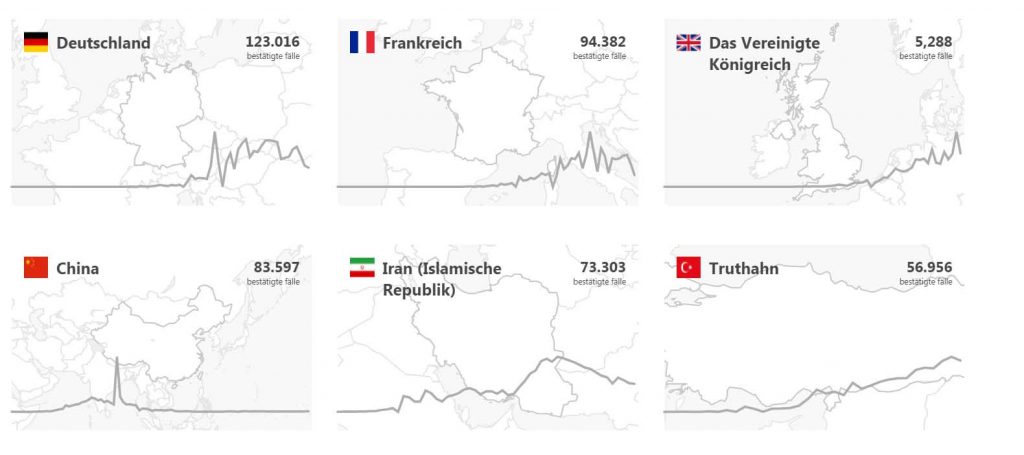
Meanwhile, a thought about machine translation. There is a lot more to be said about this, especially DeepL in connection with legal translation. One thing that strikes me is that in the old days, one might adapt machine translation systems to allow for context. But if you go to the WHO site and allow it to translate into German using Google Translate, you get a map of Turkey labelled Truthahn. Context is not taken into account here!

By the way, do people pronounce WHO double-u aitch oh? I usually say World Health Organization. But I heard someone on radio callilng it The Who recently, which I liked.

Screenshot:

Translation blogs

Luke Spear has chosen this auspicious occasion to collate a list of translation-related blogs, not so rare now as they were in 2003.

75+ of the best translation, language and linguistics blogs to follow

This list dates from April 9 2020 and has links to every blog mentioned. In most cases, you need to click on the links to see what the blogs are about. Quite an achievement! Luke asks if there are more blogs that could bring the total up to 100. Abd he wonders if people are blogging less.

Biut more about that in another post.

Kurzarbeit/furlough

In this time of lockdown, the question has arisen as to how to reduce employees’ hours and pay them less. I’m jjust going to touch on the terminology here – anyone who wants to know more can do a websearch nowadays!

There has been some comment in the UK press about the German system of Kurzarbeit (short-time work). From the Financial Times:

Kurzarbeit: a German export most of Europe wants to buy

Please use the sharing tools found via the share button at the top or side of articles. Copying articles to share with others is a breach of FT.comT&Cs and Copyright Policy. Email licensing@ft.com to buy additional rights. Subscribers may share up to 10 or 20 articles per month using the gift article service. More information can be found here
https://www.ft.com/content/927794b2-6b70-11ea-89df-41bea055720b

The tool is Kurzarbeit, or shorter work-time, a policy that has been copied by so many other countries that one economist called it one of Germany’s “most successful exports”. Under the scheme, companies hit by a downturn can send their workers home, or radically reduce their hours, and the state will replace a large part of their lost income.

The UK has now introduced a similar scheme. It allows works to be furloughed but kept on the payroll. I knew furlough only as leave for soldiers, but apparently it is used in the USA in this sense. Furlough is like garden leave, where an employee’s contract is terminated to a certain date and he or she continues to be on the payroll but may not work. It’s referred to as the coronavirus job retention scheme. A lot of law firm websites explain it, for instance Crossland Employment Solicitors.

A number of other countries use similar schemes, but I think Germany was the first. The FT thinks it works very well in a country like Germany which invests a lot in apprenticeships, so having trained their workers, they will not want to lose them. The German scheme was ramped up at the beginning of the coronavirus crisis.

In the USA, works who are furloughed are not likely to be paid 60% of their wages as in Germany, but they may retain health insurance and other benefits.

Some more vocabulary I have picked up recently from German daily coronavirus podcasts: der Impfling for the person being vaccinated, verimpfen to inject a substance.

A tweet from Scott Hanson @papascott:

The line grew to 5 people behind us, 2 of whom left when they learned there was no asparagus. 😂

Elsewhere I note that it took the virus crisis to make Germans give up cash.

Social distancing

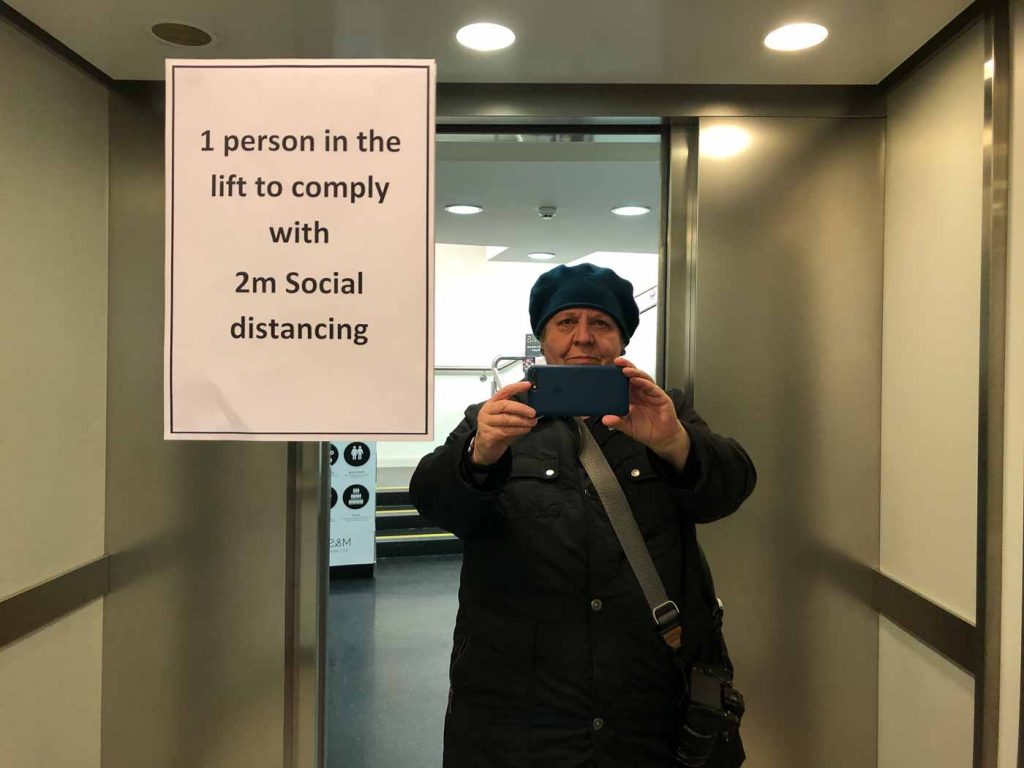
I am reporting back here to show that I’m still around. We are living in times of social distancing – at least that’s the term most media and people use. I read in the German press that the term borrowed from English was wrong, that it should be physical distancing as that makes more sense. My feeling was/is that the term social distancing has entered general use. I’ve now tweeted something about social distancing – here is the tweet I linked to:

social distancing

I had a response criticizing the term. So although I did not care about the dispute beforehand, I did a web search and found the Wikipedia article on Social Distancing and the discussion there after there was a request to change the heading.

I hadn’t realized that the WHO changed the term, not that this alters the fact that the disputed term has become common usage (see WP:COMMONNAME).

Feelings run high. Here is vsync:

Strong oppose and speedy close. This request isn’t even well-formed as it’s merely based on trifling wordplay from some obscure “WHO”, so-called, which has no standing whatsoever to comment on anything related to this crisis, let alone messaging on its seriousness or what is or isn’t effective. Now, for some “reasons” that will doubtless be demanded: The term existed prior to the current pandemic and will exist after. The meaning is perfectly coherent as relating to putting distance in social contact, rather than of other random objects. “Wikipedia isn’t a how-to manual” or whatever, but the article perfectly describes the meaning. The point of an encyclopedia is to expound even obscure terms, not rename them. Why don’t you go spend your time telling people masks don’t work or something? vsync (talk) 01:43, 1 April 2020 (UTC)

Book recommendation: Katrin FitzHerbert: True to Both My Selves

Katrin Fitzherbert’s autobiography won a prize for autobiography in 1997. I only heard of it recently and picked it up second-hand. It’s subtitled A Family Memoir of Germany and England in two World Wars.

Here’s the summary from the Virago website:

TRUE TO BOTH MY SELVES is an extraordinary account of a childhood disjointed by country and by war. Curiously mirroring her English grandmother, who married a German hairdresser in London and was then expelled to Germany following the First World War, Katrin Fitzherbert was born in Germany in 1936 and lived under Hitler’s regime until, at the age of eleven, she was suddenly ‘repatriated’ to an England she had never known. There she had to forget her German father and the German language. This is the story of three generations of remarkable women, and their struggle for survival and integrity as individuals in times divided by war.

This is a readable and honest account of some parts of English and German history I know only skeleton facts about – what it was like living through WWII as a child who supported the system and then being told to pretend she had been born in London (for fear of the 1918-type repercussions), that after WWII the English tended to see all Germans as either villains or victims, the psychological pressure when no one in her family had any understanding of what it was like having to hide half of one’s own history.

The blurb on the book says:

Katrin FitzHerbert was born in Germany in 1936. She was educated at fourteen schools in Germany and England and read PPE at St. Anne’s College, Oxford. She has been a journalist, an anthropologist, and trained and worked as a psychiatric social worker. She is the founder and director of the National Pyramid Trust, a charity promoting self-esteem and resilience in primary-school children. She is married, has two daughter, and lives in London and Totnes.