Twins marry / Nach der Geburt getrennt

BBC News reports (with a curious illustration of feet) a case of twins who were separated at birth and separately adopted and who only discovered their relationship after they were married. Hence annullment.

This has a touch of Siegmund and Sieglinde about it, and reminds me of the question as to whether English birth certificates have enough information on them.

This is all hearsay – told to the House of Lords by a peer who heard it from a High Court judge – so take it with a pinch of salt.

LATER NOTE: I traced the quote to Lord Alton of Liverpool on 10 December 2007 in the House of Lords Hansard, Column 101.

(Via John Bolch in Family Lore)

German civil proceedings for interpreters and translators / Buch: Der Zivilprozess – Eine Einführung für Gerichtsdolmetscher und -übersetzer

Helia Daubach und Claus Sprick: Der Zivilprozess – Eine Einführung für Gerichtsdolmetscher und -übersetzer

This book can be ordered from the BDÜ. The BDÜ website has a sample extract from this book – click on Publikationen.

Eine Leseprobe dieses Buchs befindet sich auf der BDÜ-Website – auf Publikationen klicken – dort kann das Buch auch bestellt werden.

Die Leseprobe enthält ganz Grundsätzliches, vielen schon Bekanntes, zur Aufgabe des Dolmetschers vor Gericht, zu Rechtsmitteln und Rechtsbehelfen und zu Registerzeichen, aber sehr ausführlich und verständlich erklärt. Heute gehört Gerichts- und Behördenterminologie nicht mehr zur Staatsprüfung für Übersetzer und Dolmetscher in Bayern, da könnte der Inhalt sehr nützlich sein. Und das, was zu Dolmetschern steht, würde manchen Richtern nicht schaden zu lesen.

Claus Sprick ist Richter am Bundesgerichtshof und übersetzt Flaubert und solche Sachen. (Er beschreibt die Schreibweise seines Nachnamens wie folgt: “Großes S, kleiner Prick”).

Seventeenth-century legal notebook / Juristisches Notizbuch des 17. Jahrhunderts

Commonplace Books of Law: A Selection of Law-Related Notebooks from the Seventeenth Century to the Mid-Twentieth Century
PAUL PRUITT, University of Alabama – School of Law
DAVID DURHAM, University of Alabama – School of Law

This collection of legal notebooks can be downloaded in full as a PDF. My attention was attracted by the Bounds Seventeenth-Century Legal Notebook, by several writers,

…in many ways a mysterious compilation. Beginning with a page of household memoranda and recipes, written in two different hands,1 it continues with ten pages of notes of trials or moot courts, written in a distinct, informal hand.2

Extract (there are footnotes explaining the terms):

Tender & Refusall
[T]he laste pipen of huney made forty 7 pound. The pipen made ii [11] pounde and a halef so theri was but thity 5 pound and a halfe of the huney.

… For the Gout
Put three Good heads of Garlick in to a Quart of Brandy & when the Gout attacks the Stomack, drink four or five Spoonfull.

…Hill. Terme. 36. Car 2d.
Jan: 23. 1684.
Jury A Returne of Jurys without Sheriffs.
Parish ought to maintaine ye high-way, Els[e] Indictable.
e8 ye Parishoners may have theire action agst. any one yt9
ought to repaire y[t] particularly.
Indictmt. quashed for not saying (what yeare ye session
was on)
Can: Law. H.8.10 Conserning Cannon Law.
Prohib:11 not granted for (lying incontinently with
another mans wife) because ye Ecle Crt hase conusance12
of it.

(The other documents are all from the USA)

Via Legal History Blog (thanks to Isabella of the much-missed Taccuino di Traduzione for the tip some time ago)

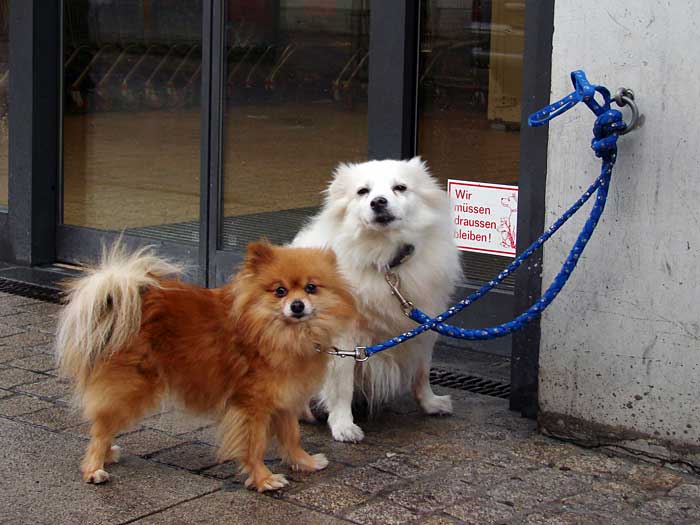
GPS dog location / GPS-Hundeortung

GPS dog collars are not new. From Netzwelt in 2005:

Hundebesitzer kennen das Problem: Einen Moment nicht aufgepasst und schon haben sich Hasso, Lara, Teddy oder Eika irgendwohin verkrümelt. Hunde sind ja auch leicht ablenkbar, Kaninchen oder Rehe sind prima Sportgeräte und irgendwann gehen Herr oder Frau Hund dann im Wald verschütt. Ein neuartiges GPS-Halsband soll nun dafür sorgen, dass Herrchen den haarigen Kumpel schnell wieder auftreiben kann.

At CES there are at least two new devices for dog location, Zoombak and Pocketfinder, reports WebWare in 2 ways to geolocate your dog (with pictures).

The German article refers to Hasso, Lara, Teddy or Eika, the American article to Spot.

Automatic OCR and translation in the field / Maschinelle Dokumentenübersetzung im Feld

The Defense Advanced Research Projects Agency (DARPA) (Wikipedia), which is responsible for the development of new technology for use by the US military, has commissioned a Multilingual Automatic Document Classification Analysis and Translation (MADCAT) system to convert documents of every kind in Arabic (in the first instance) into English. Thus Mark Rutherford on CNET.

If and when it pans out, MADCAT is expected to provide “relevant, distilled, actionable information” to commanders and troops on the ground by translating foreign language text images accurately and automatically without bothering with linguists and analysts, according to the contract specifications. During the MADCAT proposal process DARPA demanded bidders demonstrate a “revolutionary approach,” one that will produce a new benchmark in language translation. Specifically excluded were “minor evolutionary” improvements or “narrow applications” to current technology.
BBN says it plans to pull it off by integrating “optical character recognition with state-of-the-art translation and distillation techniques,” while developing “novel methods for processing handwritten text,” according to its press release.

DARPA’s original announcement is here.

Nomen est omen?

(via MacLingua at Yahoogroups)