
Frauenkirche Munich. I was just looking to see if photography was forbidden (I don’t usually use flash if I can help it).

Frauenkirche Munich. I was just looking to see if photography was forbidden (I don’t usually use flash if I can help it).
The Linguists – A Very Foreign Language Film
Here is some blurb from an email (via Forensic Linguistics Mailing List)
We are nothing short of elated to announce that our documentary feature
THE LINGUISTS was selected to world premiere in the newly
minted “Spectrum: Documentary Spotlight” category at the 2008 Sundance
Film Festival.THE LINGUISTS is the first documentary supported by the National Science
Foundation to ever make it to Sundance.The trailer is at http://www.thelinguists.com. Here’s a brief synopsis:
It is estimated that of 7,000 languages in the world, half will be gone by
the end of this century.THE LINGUISTS follows David Harrison and Gregory Anderson, scientists
racing to document languages on the verge of extinction. In Siberia,
India, and Bolivia, the linguists’ resolve is tested by the very forces
silencing languages: institutionalized racism and violent economic unrest.David and Greg’s journey takes them deep into the heart of the cultures,
knowledge, and communities at risk when a language dies.…
Happy Holidays,
Seth Kramer, Daniel A. Miller, and Jeremy NewbergerIronbound Films, Inc.
…
www.ironboundfilms.com
In this connection, see a ridiculous BBC News article about a language that is endangered because its two last speakers have stopped talking to each other. (Can’t remember where I got the link)
The British media are spreading lies about Germany yet again.
From today’s Guardian:
And a number of us will need to beware of what Germans call the Tantenverführer (aunt seducer) at this year’s office Christmas party, a young man of suspiciously good manners you suspect of devious motives…
Admittedly the article is by someone who wrote a whole book about odd words in foreign languages (‘Adam Jacot de Boinod is the author of Toujours Tingo published by Penguin’, another young man who may have devious motives). One wonders who gave him this one. Perhaps Mark McCrum?
Like Spinatwachtel (another rare word) in the LEO forum, I found Google suggested this was not known to German speakers:
googelt man nach “Tantenverführer” – Seiten auf Deutsch, erhält man bezeichnenderweise die Nachricht, daß es da nichts gäbe, ob man in einer anderen Sprache gucken möchte. Man klickt “ja”, und hey presto! 14 Hits, die fast alle mit diesem Buch zu tun haben.
Poodle-faker habe ich jetzt immer noch kein Gefühl für, welcher Slang ist das denn? Und kanntest du es schon, bevor du im Wörterbuch nachgeschaut hast? Ladies’ man hingegen habe ich schon gehört.
I’m not the first to comment on this. But I hope no-one gives me this for Christmas!
LATER NOTE: At Language Log, Benjamin Zimmer did a nice, if premature, piece on the author’s earlier book in 2005:
The multitudinous errors in such books should not be surprising; as Mark Liberman has reminded us, when a factoid about language is attractive enough, “the linguistic truth of the matter is beside the point.”
Trying to educate myself:

It’s marvellous what modern technology can do:

There was a discussion of the IAB Glossar on a translators’ mailing list recently. I was interested to know if anyone else found it useful. There came praise in the highest tones from an in-house ministry translator. I suspected the book was of most use to German civil servants who knew the topic and were working into English.
Here’s an entry on Freisetzung von Personal (click to enlarge):
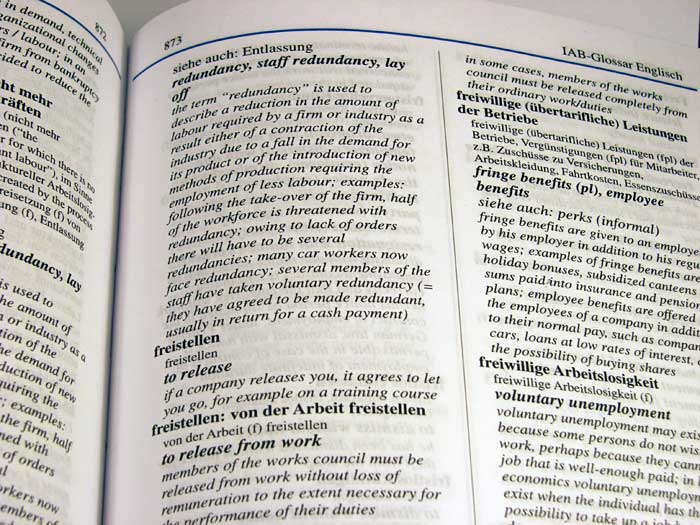
It looks to me as if that definition is a definition of the German term, which happens to appear in English. The identical definition appears in the EN to DE half.
This sort of thing makes me uncomfortable. Where did they find their English definition? I’d have to research it. Dietl is completely different: in the DE to EN part, it will have a definition of Amtsgericht, for example, in both languages. And I know as the reader that that is Dietl’s definition summarizing the German situation. But the IAB approach is not good for people translating between two systems of law. If I don’t know which system is being referred to, how can I assess the quality of the suggestion?
Another thing I found odd was that the word Freistellung was not given in the garden leave sense, which is quite common nowadays, of preventing people from working out their notice.
I did post a query, but unfortunately it was misunderstood as a request for more information about gross misconduct:
Könntest Du mir ein Problem erklären, das ich mit diesen Glossaren habe: im EN>DE Teil (2004 Ausgabe) unter “gross misconduct” steht eine lange Definition auf Englisch: “gross misconduct represents a serious transgression of disciplinary rules, which is normally punished through dismissal without notice …”, ohne Quellangabe. Im DE>EN Teil steht unter grobes Fehlverhalten keine deutsche Definition, sondern genau die gleich englische Definition, wieder ohne Quellangabe. Unter “Verfehlung” steht zum dritten Mal genau die gleiche englische Definition, wieder ohne Quellangabe.
EN>DE steht “schwere, / grobe Verfehlung, grobes Fehlverhalten” als
Übersetzungen.Ich habe den Eindruck, dass hier eine Definition aus dem deutschen Arbeitsrecht steht, aber da wäre es leicht, einen Paragrafen zu nennen. Und die deutsche Fassung der Definition müsste auch zu finden sein. Das ist mit ein Grund, warum ich das Buch selten öffne, gerade weil auch ich mich mit feinen Unterschieden beschäftigen und auskennen muss. Ich habe den Eindruck, hier ist ein internes Werk, das für Deutsche Beamten gedacht ist, die deutsches ins Englische übersetzen und denen die deutschen Definitionen bekannt sind, aber die gerne Hilfe bei der englischen Formulierung hätten.
(For details of this book, see earlier entry – it’s apparently available as a CD too now)
1. Try out mobile phones / Handy ausprobieren bei TryPhone (more models to be added). via Lifehacker
2. I know why I’d be worried about a referendum on the EU Treaty in the UK: it’s the British media. The Economist blog, Certain ideas of Europe, does a good job of showing them up, on the basis of a Sun article copied elsewhere, that refers to European judges as ‘unelected’ as if English judges were elected and places the ECJ in Luxembourg.
3. Audio: During the German train strike, rob-log produced a spoof ICE announcement to passengers (in German, but with a very authentic-sounding attempt at a brief English message at the end): …bitten wir kurz um Ihre Aufmerksamkeit…