Randnummer/pinpointing

A colleague recently asked how to translate Randnummer/Randzeichen/Randziffer into English, in three different contexts.

1. The usual query of inexperienced legal translators is ‘What does Rz./Rn. mean?’ The usual translation of Randnummer, Randzeichen or Randziffer is marginal number or margin number. Here’s a discussion on ProZ.

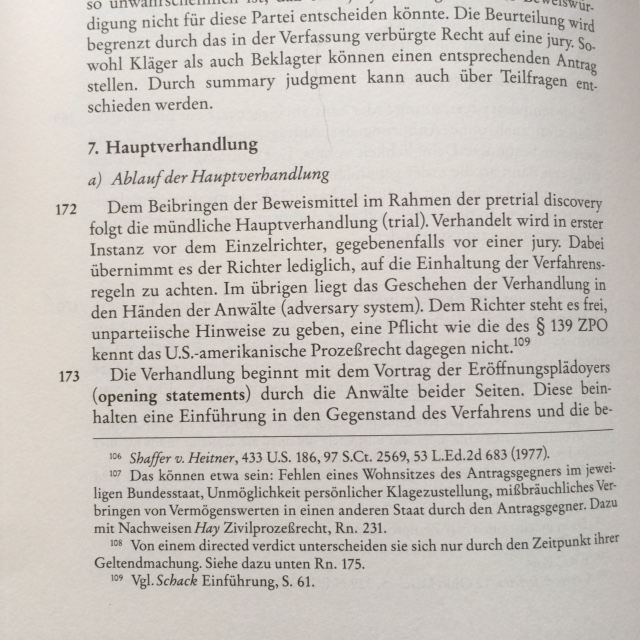
Germans just love marginal numbers, especially in legal contexts and above all in textbooks. This example is from an old copy of Peter Hay, US-Amerikanisches Recht, page 74:
hay IMG_6398

The marginal numbers here are the 172 and 173. Every single paragraph is numbered consecutively through the whole book. So you don’t need to refer to ‘7. a)’ but just to one number.

I think these are a peculiarly German thing, and there are instructions online on how to create them in Microsoft Word, for example, which is not too easy. (Randziffern in Microsoft Word). They are sometimes related to the subject matter and sometimes to the physical location, see the administrative court judgment below and the English case report practice mentioned further below.

Here’s another example of marginal numbers used in a German court case, which I don’t think is very common. The NRW Oberverwaltungsgericht uses these numbers in the right-hand margin to make it easier to refer.

2. Case reports of the CJEU use paragraphs, called para. or paras., a term which needless to say is hard to pin down when you’re looking for it (rather like indent in EU cases). So when a German version of an EU case refers to Randnummer, it is translated into English as para. The number is not in the margin, either.

3. Finally, we really do have marginal numbers/letters or marginal references in English. Some case reports have used not numbers, but letters to make it easier to quote. Google Books has Studying Law, by Simon Askey and Ian McLeod, from which I quote:

Marginal markings and neutral citations
Some series of law reports use marginal markings, in order to make it easier to provide pinpoint citations, while others do not. The original report of Henthorn v Fraser contains no such markings, while the most common system in the 20th century was to provide marginal letters, evenly spaced down each page. The system of marginal letters worked reasonably well, but it was rather cumbersome for true pinpoint citations, which had to take a form such as ‘page 234, letter D, line 3.’ More importantly, this citation would vary from one set of law reports to another, according to the page numbering of the report in question.

I remember barristers lugging cartloads of law reports to the Law Courts, where the court staff would lay out matching volumes from the court library and these would later be cited in argument. Nowadays I suppose at least for newer cases computers replace this.

More on citation in OSCOLA, whence the nice word pinpoint:

A pinpoint is a reference to a particular paragraph of a judgment or page of a report.

and also Latin ‘gadgets‘:

Avoid the use of ‘Latin gadgets’ such as supra, infra, ante, id, op cit, loc cit and contra, which are not widely understood.


The Sausage Man

I didn’t realize Herman Ze German didn’t make their own sausages.

sausages1

It seems they get them from The Sausage Man, who produce

Wholesale Bratwurst, Frankfurters, Hot Dogs in bulk, Bockwurst, Bratwurst, Weisswurst, Krakauer, Venison Salami, Foot Long Sausages, Beef Sausage, Chilli Dogs, Paprika Sausage, Chicken Sausage, Vegan Hot Dog Sausages, Beef Hot Dogs, Pepper Bite, Chipolata Sausages, Pepper Bite & Other German Related Products

sausages2

sausages3

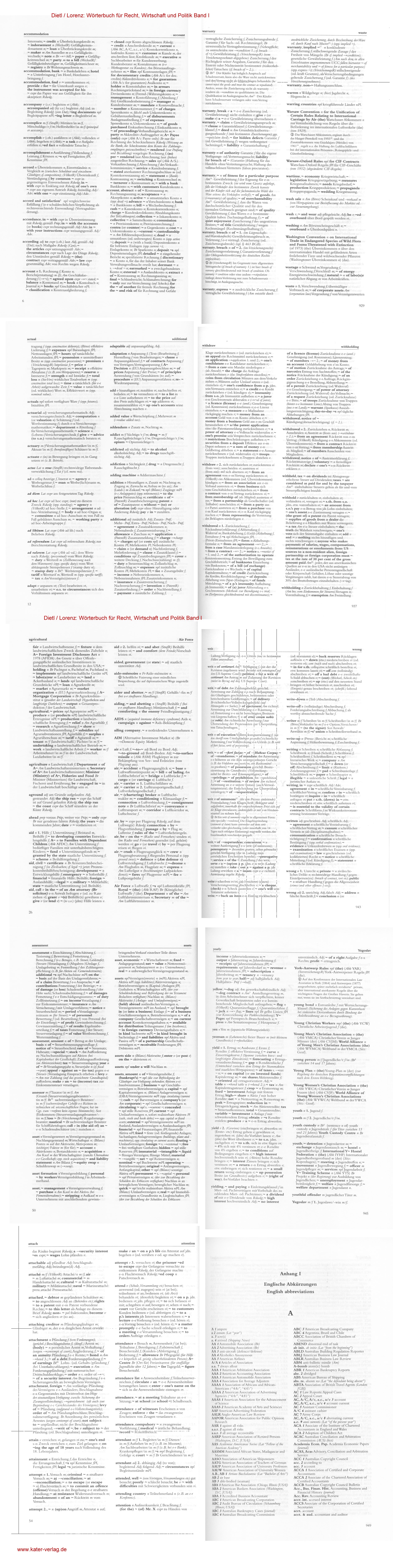
Dietl/Lorenz EN>DE published

I noticed that the new English-German volume of the Dietl/Lorenz law dictionary has appeared. Professor Egon Lorenz is still in charge. The German-English volume is announced for 2017.

Dietl/Lorenz: Wörterbuch Recht, Wirtschaft & Politik Band 1: Englisch-Deutsch

LATER NOTE: More details in an email from Hans Kotzur of Kater Verlag:

es freut mich, diese Neuauflage anbieten zu können, an der seit einigen Jahren gearbeitet wird.
Der Lexikograf Dr. Kettler tritt in die Fußspuren seiner Vorgänger und hat den Umfang des ‘Dietl/Lorenz’ auf 100.000 Begriffe ausgeweitet.
Neben der Zuordnung der Terme zu den jeweiligen Geschlechtern wurde die neue deutsche Rechtschreibung nachgeführt und jeder Begriffe lexikologisch überarbeitet.
Eine Neuauflage rechtfertigt man vor allem durch inhaltliche Erneuerung und Ergänzungen. So wurden der Rechtsentwicklung Rechnung getragen und neue technische Begriffe eingeführt.
Dies betrifft zum Beispiel den Bereich IT / Computer, Compliance, und viele andere mehr.
Der Wortschatz zum Thema Banken und deren Produkte wurde erweitert. Stichwort: Basel III.
Die Vertiefung der Wirtschaftsbeziehungen mit den Vereinigten Saaten von Amerika durch die Auflösung der Deutschland AG mit der Einflussnahme der Beteiligungsgesellschaften und Fonds (vulgo Heuschrecken) fand Niederschlag.
Die Neuordnung der deutschen Immobilienlandschaft durch Veräußerung der immensen Bestände an Immobilienverwaltungsgesellschaften fand entsprechend Raum im Wörterbuch.
Nicht zuletzt die Veränderungen im Rechtsgefüge, die durch EU-Bürgschaften, IWF-Garantien und supranationale dem parlamentarischen Recht nicht unterworfene Körperschaften geprägt werden, wurden nachvollzogen.
Ceta und TTIP werfen Schatten voraus, auf die ein Wörterbuch wie der Dietl / Lorenz reagieren muss.
Bleibt noch ein umfangreiches Abkürzungsverzeichnis mit ca 6.000 Einträgen und die Ausweisung britischer sowie amerikanischer Schreibweise um das Invest in dieses Meisterwerk der englisch/ deutschen Wörterbücher zu begründen.

Angeboten wird der Wortschatz als Buch Englisch / Deutsch. Artikelnummer: 4000 Preis: 169.- Euro
Warenkorb: https://www.kater-verlag.de/fachwoerterbuecher-recht-jura/Dietl—Lorenz–Woerterbuch-fuer-Recht–Wirtschaft-und-Politik-Band-I-Englisch—Deutsch-EN-DE.html
KaterScan: https://www.kater-verlag.de/images/inhalt/i4000.jpg
——————————

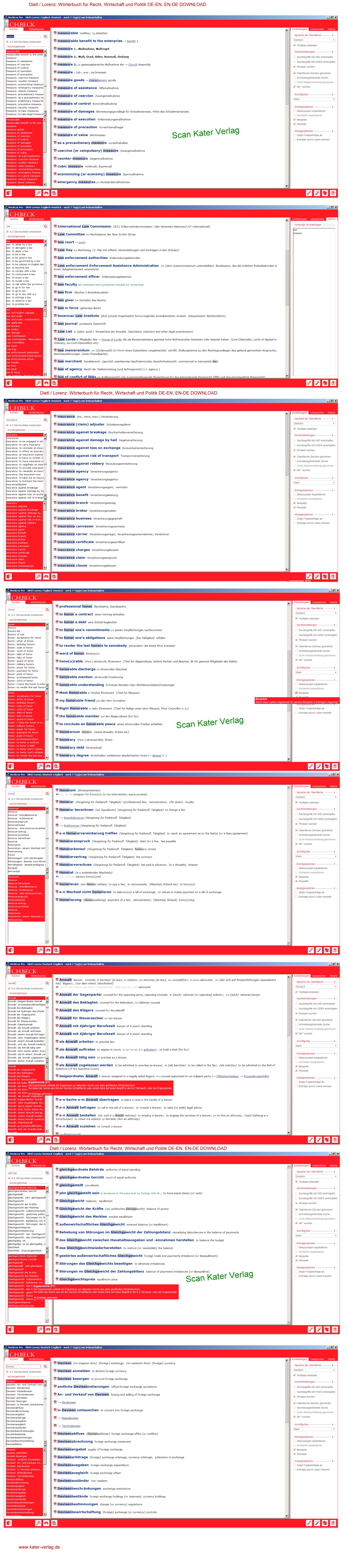
In Kürze wird der Wortschatz als Download Deutsch / Englisch und Englisch / Deutsch angeboten werden. Artikelnummer für Vorbestellungen 4290 Preis: 315.- Euro
https://www.kater-verlag.de/fachwoerterbuecher-recht-jura/Dietl—Lorenz–Woerterbuch-fuer-Recht–Wirtschaft-und-Politik-DE-EN–EN-DE-DOWNLOAD.html
KaterScan: https://www.kater-verlag.de/images/inhalt/i4290.jpg
——————————

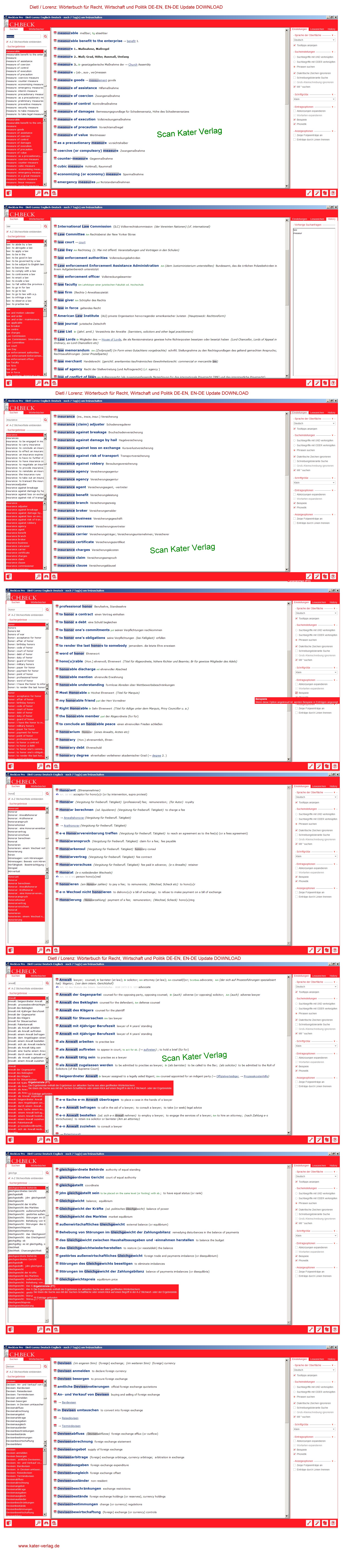
Vorbesitzer der CD-Version erhalten ein Update gegen Nachweis unter Artikelnummer: 4310 für Vorbestellungen Preis: 129.- Euro
https://www.kater-verlag.de/fachwoerterbuecher-recht-jura/Dietl—Lorenz–Woerterbuch-fuer-Recht–Wirtschaft-und-Politik-DE-EN–EN-DE–Update-DOWNLOAD.html
KaterScan: https://www.kater-verlag.de/images/inhalt/i4310.jpg
——————————

Kunden der IDS-Mietlösung von Acolada kommen bereits heute in den Genuss der elektronischen Version des Dietl/ Lorenz. Artikelnummer: 4296
https://www.kater-verlag.de/fachwoerterbuecher-recht-jura/Dietl—Lorenz–Woerterbuch-fuer-Recht–Wirtschaft-und-Politik-DE-EN–EN-DE-ONLINE.html

——————————

Für das Jahr 2017 erwarten wir die vollständig überarbeitete Buchauflage Deutsch/ Englisch.

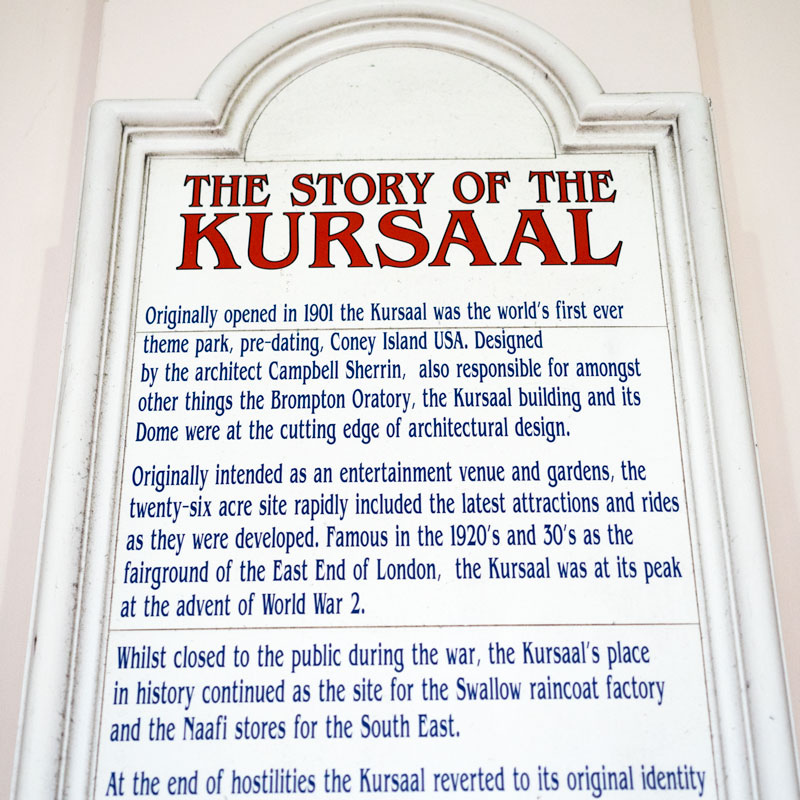
Kursaal

kursaal-info

Kursaal must have been the first German word I learnt, although I didn’t know it was German and I didn’t know what it meant, and nor do most visitors to Southend.

kursaalweb

I like the ceiling in the foyer. I don’t know if it was like that originally.

kursaal-ceiling

The dome is more familiar:

kursaal-dome

Language and Law – Linguagem e Direito

I posted about the journal Language and Law / Linguagem e Direito when it first appeared. I forgot to report (from From Words to Deeds blog) that the latest edition is about legal translation. That is, the journal is always about language and law, but not specifically on legal translation. Actually I got part-way through the first article, so this is a rather rushed account.

You can download it here.

The first article, by Karen McAuliffe, ist:
Hidden Translators: the Invisibility of Translators and the Influence of Lawyer-Linguists on the Case Law of the Court of Justice of the European Union. Here’s the abstract:

Abstract. Since the mid-1990s, when Lawrence Venuti published his book The Translator’s Invisibility, there has existed, in the field of literary translation, a debate on the (in)visibility, power and influence of translators on literature and academic theory. This paper shifts that debate to the field of legal translation, focusing on the role of and work done by lawyer-linguists at the Court of Justice of the European Union (ECJ) in terms of their (in)visibility in the process of text production of that court and in the texts themselves. Data presented here demonstrate that, in the ECJ itself, as in other fields, translation tends to be “a largely misunderstood. . . practice” (Venuti, 2008: vii), but that recent shifts in dynamics within that institution are leading to changes in perceptions of translation and more ‘visibility’ for translators in the process of production of that court’s case law, although they remain largely invisible in the context of the texts themselves.
However, the invisibility of translators in this context necessarily leads to a certain amount of power and influence on the texts they produce. Since those texts, in particular judgments of the ECJ, are intended to have force of law and to be applied uniformly throughout the 28 EU member states, that power and influence is not insignificant. This paper analyses some examples of such ‘influence’ on ECJ case law, and thus on EU law more generally. If we are to develop a full and nuanced understanding of the case law of the ECJ, the power of translators should not be ignored.

I was interested in this article, more in what I found out about the ECJ translators than in Venuti (I have got Venuti on my shelf but he has remained there). I had forgotten that French is the main language of the court.

One of the biggest difficulties, cited by almost every lawyer-linguist interviewed, is caused by the fact that those drafting the judgments are working in French, a language which for most is not their mother tongue

The translators tend to be lawyers, and above all lawyers without translation training. The translation they do has the force of law if it is judgments declared to be ‘authentic’, and this distinguishes their work from a lot of other legal translation.

Very few (only three of the 56 interviewed) had any experience of translation prior to working at the Court of Justice. Thus, the translating aspect of the role of lawyer-linguist appears to be one largely learned ‘on the job’. While that does, of course, have benets in terms of developing institutional translation norms and maintaining the consistency of the house style, it also runs the risk that translation ‘guidelines’ are interpreted as hard and fast rules of (ECJ) translation:
“I had no experience of translation prior to coming [to the ECJ], but that makes it easier to follow the rules of translation here, which are quite strict”. (lawyerlinguist)

With regard to the role of translation: a case can be brought before the ECJ in any one of the 24 official languages of the European Union, and each case has an official ‘language of procedure’19. Unlike EU legislation, which is ‘authentic’ in every language version in which it exists, with regard to ECJ judgments only the version of the judgment in the language of procedure is considered to be ‘authentic’. For practical purposes, the ECJ works in a single language: French. When an application is lodged before the Court (in any of the 24 official EU languages), all of the relevant documents are translated into French.

Interestingly, not a single one of the 56 lawyer-linguists interviewed for this paper was content to describe themselves as ‘translators’. Those who did initially refer to themselves as translators immediately qualified their statement by pointing out that as translators of judicial texts, with law degrees, they are “much more than simply translators” and that having a legal qualification “set [them] apart from ‘mere’ translators”.

I haven’t actually finished reading this article yet. But I found it particularly interesting as I was once part of an initiative to get more freelances working for the court. I was sent a huge pack of really interesting information and previous translations. Although I was using the internet and translation memory myself, it appeared that the lawyer linguists had a database of prior texts and EEC/EU documents which was not made available to me, so I spent an awful lot of time searching for and pasting existing English versions of the legislation and case law quoted. I also put a lot of effort into adapting my first translations, which were seen as a paid test, to the style of the materials sent me, and yet precisely that vocabulary was found lacking and was corrected minutely in red ink. I was told by another translator that that is what the court lawyer linguists are like: they give you a hard time until they get used to you. However, the initiative came to an end when the lawyer linguist who was promoting it died unexpectedly in his late forties. It really was not much fun translating because the work was three-quarters searching to find out what others had done. But if the lawyer linguists have not been trained in translation or had practice in it before they are employed, they will have no experience of revising other translators’ work. However, this is just my guess based on very little evidence.

Another article I have skimmed is by Vigier Moreno, F. J. – Teaching the Use of ad hoc Corpora. It’s about the problems of creating corpora for students learning to translate legal texts into their second language, so it’s close to my own experience of teaching legal translation. It’s a down-to-earth account of the subject. It has attached text examples and a useful bibliography.