The Times Online shows what it found were the best and worst English law firm websites.
Best and worst solicitors’ websites / Beste und schlechteste englische Anwaltswebsites
Reply

The Times Online shows what it found were the best and worst English law firm websites.
I was surprised to see a garment in a German fashion catalogue termed ein Chasuble.
An online dictionary says:
Chasuble (sprich schaßübl): Sehr lange Weste, die bis zur Kleiderlänge variiert werden kann.
Well, I was thinking of the English term pronounced somewhat like tSaezjubl. The last time I wore one of these was about forty years ago, when I had the misfortune to be cast as the chaplain in the school’s (all-female) production of the dreadful Christopher Fry play, ‘The Lady’s Not For Burning’ (later made more famous by Mrs Thatcher under a slightly different title). My garb wasn’t as exciting as this, but it was that kind of thing.
When did this term enter the German fashion world – at the same time as body bag?
Someone has clearly been making sprinkles in the colours of the German flag, as I saw in both Düsseldorf and Fürth. Deutsch-Amerikaner in Düsseldorf:
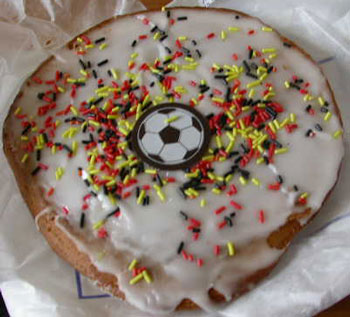
Dickmanns in Fürth (and surely elsewhere). It’s no longer Negerküsse (take that, Jessie Owens), but Deutschlandküsse. Should I worry that the sell-by date on these is June 8?

Here’s a footballer in quark dough in Düsseldorf:

‘Comedian Stewart Lee’ writes in the Guardian on German humour. This analysis arises from a trip to Germany with Richard Thomas, who wrote Jerry Springer the Opera, who was commissioned to write a musical of that type set in a British stand-up comedy club which then had to be translated into German. (Why am I laughing already?)
Lee says that Germans do have humour, but it is hard for us to recognize, and vice versa. He claims that English humour is facilitated by the English language. Putting verbs at the end of the sentence and using a lot of compound words kill humour, he says (apparently seriously). He now concentrates on the humour of ideas:
On my first night in Hannover I had gone out drinking with some young German actors. “You will notice there are no old buildings in Hannover,” one of them said. “That is because you bombed them all.” At the time I found this shocking and embarrassing. Now it seems like the funniest thing you could possibly say to a nervous English visitor.
At all events, Germans are invited to submit their own jokes in English, to show there is German humour. The four quoted have failed to do this. (Thanks to Trevor for the link).
Handakte WebLAWg refers to the conference ‘Legal English Teachers in Germany 2006’, at the University of Greifswald, 25-27 May 2006.
I’ve heard of this conference – it is one of a series for teachers of legal English in Germany that I would have liked to attend when I was teaching but couldn’t for pressure of time (as I can’t now). But this is the first time I’ve seen the programme.
So a few disconnected notes:
One of the speakers was at the Düsseldorf conference: Peter K. Cramer (Indiana), who spoke on teaching legal English. He brought a pile of coursebooks on legal English for us to look at. He commented on the lack of language practice material. I have heard that criticism before, and I assume that by the time you’ve found someone who speaks German and is a lawyer, you don’t necessarily have a person who knows much about the English language. Peter, who allegedly reads Transblawg, had a handout setting out the pros and cons of whether legal English should be taught by ESL teachers or legal professionals. I have been thinking about this and think the ideal person should know the pupils’ native language too. (There is a speaker on academic writing at Greifswald, another interesting point: it’s much easier to give a lawyer advice on academic writing if you know his or her own language).
I’ve also noted that several legal English courses on the market aren’t really suited for pick and mix work. When I was teaching, I wanted to use my own material and plan my own course – indeed, I had to, in order to take our students’ final exam into account – not to follow a coursebook for several chapters. I wouldn’t have minded students using a book, but it would have needed to have many short pieces.
Take Alison Riley’s English for Law (may be out of print): it has huge chunks of text and a mass of exercises related to those chunks. There are a lot of exercises such as guided reading, picking out vocabulary and so on. It’s difficult to take bits of the book rather than the whole. I was never comfortable with using other people’s guided reading exercises, where you consider certain questions before reading a text.
One of the speakers at Greifswald is: Donald R. Black, attorney-at-law (US), solicitor (GB) (Berlin) – Legal English as a Target Language: When Is Legalese the Right Choice?
Donald R. Black has published a ‘Black’s Legal Reader. An Introduction to the Anglo-American Law and Legal System’ privately. The details for the 1998 edition were ISBN 3 933 76330 4. This is one of the best things I’ve seen. It’s for Germans and has word lists with translation into English and a few exercises. It’s not expensive either. Black taught at the University of Hannover at that time. I don’t know if the script is still available. (If Donald R. Black were a German academic, he could be Dr. Dr. D.R. Black). It’s useful for me to have a publication with some German equivalents in it too.
Another speaker at Greifswald, Clare Abbott, is introducing a new Cambridge University Press Legal English course by Amy Krois-Lindner, an ELT specialist. CUP has put lots of extracts online. I have to say this is another book I couldn’t work with. One big problem with many texts for me is that they don’t distinguish between British and American English. I can see why not, and for most lawyers it doesn’t matter. But for translators, I think it does matter.
So for instance, the term ‘laws’ covers both U.S. ordinances and EU directives, and even parliamentary bills in the exercise on page 8. There is a footnote saying the UK equivalent of ordinance is ‘by-law’ (they omit the other spelling ‘bye-law’). A diagram to be completed on page 11 omits the English ‘claimant’ and again assumes a universal ‘Anglo-American’ legal system. Or on page 14 there’s a listening comprehension text, a very easy one:
bq. Anna: So, what are you two planning to do later, when you’ve completed your degree?
Linus: Well, right now, I’m planning to become a 1) ………, because I would really like to plead cases in court.
Anna: You’ve been watching too many of those American films, when the handsome young 2) ………. wins the case against the big, bad corporation!
I imagine Linus is an American in Britain. There’s something American about ‘plead cases in court’. I have linguistic objections to the definition of barrister as ‘A lawyer who is qualified to plead on behalf of clients’, probably because Germans overuse the word ‘plead’, thinking of ‘Plädoyer’ (final arguments).
However, this may be a false impression, as the course has both U.S. and British lawyers working on it. For instance, on page 15 there is a useful brief summary of studying law in the UK and studying law in the USA which I could imagine discussing with a class, going into more detail (for instance, telling them that some U.S. attorneys with a J.D. regard themselves as having a doctorate and others don’t).
It certainly looks as though this is the book of the moment for those who like lots of ELT-type exercises, gap-filling, matching words. Here’s more:
bq. Upper-intermediate to Advanced
International Legal English is the definitive course for those needing to work in the international legal community. Suitable for classroom use or self-study, this course teaches lawyers and law students how to use English in a commercial law environment. The book focuses on a variety of legal topics including contracts, company formation, debtor-creditor relationships and intellectual property rights. Using authentic texts to present and practise legal language, the course develops the four key skills of reading, writing, listening and speaking.
(In ELT, Advanced is not very advanced).
I have not studied all the materials in great detail. There are large sections online on several more topics. There are a number of texts, for instance on companies, where the U.S. differences are given in footnotes. These could be extremely useful – there is a lack of comparative legal language materials for British and U.S. English.
Apparently the University of Trier has been trying the course out, and there is a speaker on that topic. It appears that Cambridge has started an International Legal English Certificate (ILEC) and the book is the coursebook for that. The ILEC site has an electronic handbook for teachers.
There is a translation company called Translegal that is heavily involved in all this and is to have a new website from June:
bq. This summer, TransLegal will launch its new website with on-line legal English courses, legal English resources and a monthly on-line magazine focusing on legal English.
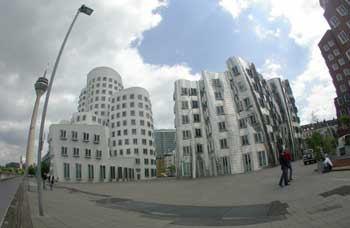
Car park for the shortsighted:
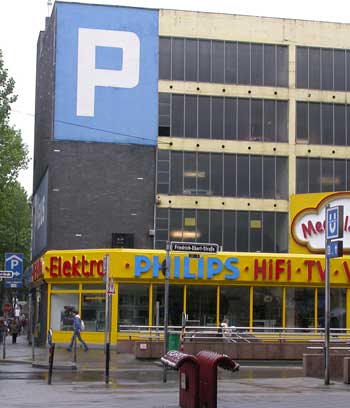
Information for short-legged literate dogs:
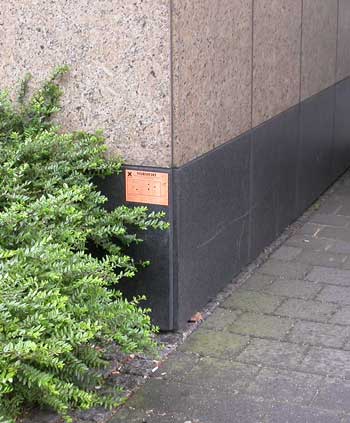
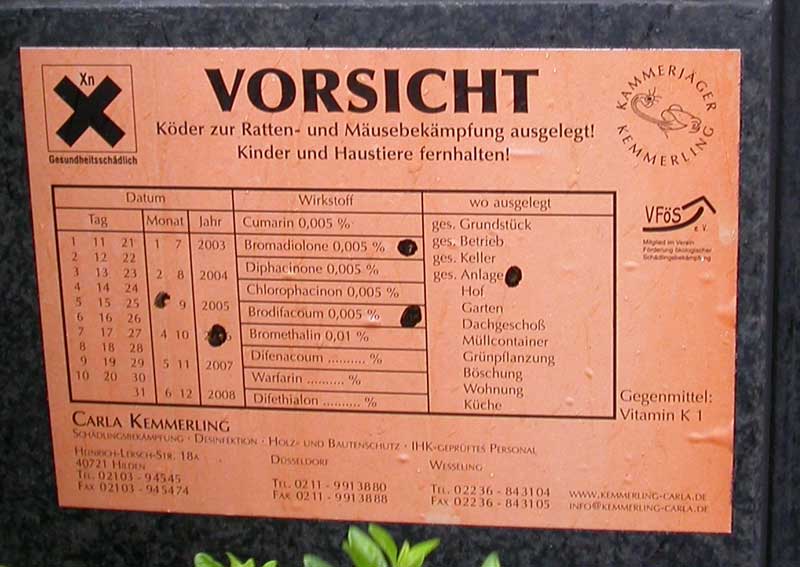
Bleach in Japanese supermarket (Breichmittel is not like Brechmittel, but somewhat similar to Bleichmittel):

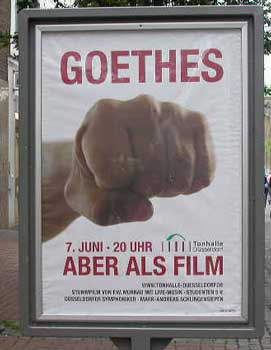
Drama:
Restaurant in Alt Himmelgeist:

Ceiling at Schloss Mickeln: