Milk bottles/Milchkartons

I noticed when reading the Adventures of an American Girl in Germany that she showed pictures of U.S. gallon milk jugs and said the standard German equivalent is 1-litre tetrapaks of long-life milk (H-Milch).

She may well be right – I would have said the common type is 1-litre tetrapaks of fresh milk.

There also appears to be a difference in frequency of full-fat and low-fat milk. The U.S. gallon jug has 1% fat milk. In Germany I usually see 3.5% or 1.5%. There are even half-litre cartons, and there are also bottles.

Personally I don’t like the taste of heat-treated milk (there’s some new stuff in the refrigerated department that lasts for 2 weeks or so that I haven’t tried), but then I can buy milk next door if I run out. But maybe a lot of people do buy the H-Milch.

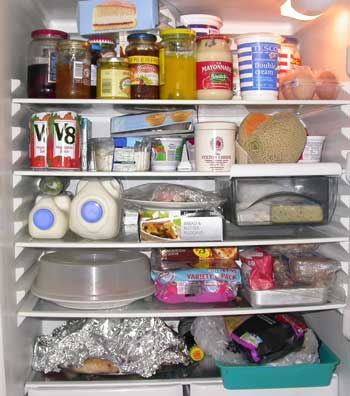
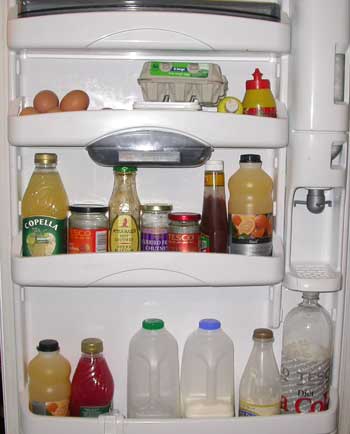
In Britain, the system has changed over the years. I most often see one-pint or two-pint plastic jugs that fit in the fridge door (although probably American fridges have bigger doors). Here are two pictures of a British fridge:

fridge2w.jpg

fridgew.jpg

I looked on the Net for a milk bottle picture, and I found ‘old-fashioned milk bottle’ next to what I would call a ‘new-style milk bottle’. I can remember two shapes of bottle. There are so many antique milk bottles out there that it’s difficult to find definitive pictures. Many at Milk bottle of the Week. Then there’s a Euromyth that the EU wants to ban the UK glass milk bottle (still the standard if you have milk delivered, I believe).

Here’s a picture of a variety of milks from a dairy.

The rich man in his castle, the poor man at his gate

The Guardian reports that Prince Charles’ household is described as ‘elitist’. I didn’t realize the Sexual Discrimination Act applied there, but of course it does.

bq. Ms Day told the tribunal the royal household was run in an “Edwardian” fashion. She said: “It’s hierarchical, elitist, everyone knows their place and if we forget our place the system will punish us.”

Well, I thought that was the whole idea.

bq. The prince wrote: “What is wrong with everyone nowadays? Why do they all seem to think they are qualified to do things far beyond their technical capabilities?

bq. “This is to do with the learning culture in schools as a consequence of a child-centred system which admits no failure. People think they can all be pop stars, high court judges, brilliant TV personalities or infinitely more competent heads of state without ever putting in the necessary work or having natural ability.

bq. “This is the result of social utopianism which believes humanity can be genetically and socially engineered to contradict the lessons of history.” The memo concludes: “What on earth am I to tell Elaine? She is so PC it frightens me rigid.”

bq. [Most hymnals omit the following verse] [Click on MIDI at ‘Bright and Beautiful’ by William H. Munk for the better tune]

bq. The rich man in his castle,
The poor man at his gate,
He made them, high or lowly,
And ordered their estate.

JUSLEX: terminology database design/Entwerfen einer juristischen Terminologiedatenbank

Rainer Langenhan von Handakte WebLAWg erwähnt einen Artikel von Eva Wiesmann (bei JurPC) zu JUSLEX, einem Terminologiesystem, das sie an den Universitäten Mainz und Bologna entwickelt hat. JUSLEX soll vor allem Übersetzern helfen und soll mehr Informationen enthalten als manche Terminologiedatenbanken.

The above links are to an article in German about a newly developed legal terminology database (system) for translators and others dealing with legal terminology on an international basis. Eva Wiesmann apparently created a pilot version as part of her Ph.D. work in translation at Mainz-Germersheim and Bologna University. The Ph.D. has been published in the Günter Narr Verlag:

Eva Wiesmann
Rechtsübersetzung und Hilfsmittel zur Translation
Wissenschaftliche Grundlagen und computergestützte Umsetzung eines lexikographischen Konzepts
Forum für Fachsprachen-Forschung 65, 2004, XIV, 485 Seiten, € [D] 98,–/SFr 155,– ISBN 3-8233-6107-4 (GNV)

I was disappointed not to find an example of Jurlex running anywhere. However, the article describes some of what Jurlex does – see continuation for a quotation.

German terms always state whether D, AT, CH, IT or whatever.
± / ÜV (Übersetzungsvorschlag) indicates approximate equivalents.
Definitions are followed by extra information placing a work in context (e.g. in the example below, the types of company).
Phraseology is included
Collocations are given.

I haven’t read the whole article and understood the difference in approach to Sandrini (a lot of work has been done on DE>ITMayer and others in Bolzano). I haven’t quite understood why the project is designed to help both lawyers and non-lawyer translation students (I don’t think universities like Mainz teach very much legal translation). It teaches students about legal terminology and law too.

The present situation in legal translation is that many translators call for more detailed dictionaries, but most of us have to do all our own research on law and terminology, since there is no completely reliable bilingual source. We also need to know the law in order to know, when our source text is badly expressed, what it was intended to mean. People often don’t consult dictionaries before they speak or write. Do we want a hugely detailed database designed for comparative law? Yes, probably we do. If it is designed for translating between German and Italian, will its German or Italian entries be sufficient for working into or out of another language? Possibly not.

At all events, Juslex would do what most legal translators spend their lives doing, reinventing the wheel. Continue reading

Comments blocked

Apparently comments from Hotmail addresses can’t be posted on my weblog. The following comment from Michael Wahlster at Translate This! was refused posting permission.

Here’s the comment, on the subject of online ads:

bq. Armin is right. Accessing the page from my US IP address serves English ads.

Here’s the reaction of my program:

bq. Your comment submission failed for the following reasons:
Your comment could not be submitted due to questionable content: mail.com
Please correct the error in the form below, then press Post to post your comment.

This is the first concrete example I have received. It seems the hotmail address was the problem. Does this come from Movable Type itself, or from the MT Blacklist plugin? I don’t intend to stay with MT in any case, but I haven’t found time to move. And totally invented addresses do work, although I might delete the comment if it appears pointless and I can’t tell where it comes from.

Paris Review interviews online

The complete Paris Review interviews with Writers at Work are going to be online, starting with the 1950s. You can read the beginning and see/download a PDF file of the rest. For some reason, they’re called ‘the DNA of literature’.

bq. Now, for the first time, you can read, search and download any or all of over three hundred in-depth interviews with poets, novelists, playwrights, essayists, critics, musicians, and more, whose work set the compass of twentieth-century writing, and continue to do so into the twenty-first century.

bq. Release dates for The DNA of Literature PDFs:
1950s: Online Now
1960s: January 10, 2005
1970s: February 14, 2005
1980s: April 4, 2005
1990s: May 16, 2005
2000s: July 1, 2005

Here’s some Thurber: Continue reading