Collins/Langenscheidt/Pons German dictionary

As already mentioned, the Collins large one-volume DE>EN EN>DE dictionary edited by Peter Terrell, originally sold in Germany as Pons Großwörterbuch für Experten und Universitäten Englisch, has two successors.

Language Hat seemed interested in a review of the new Collins-Langenscheidt dictionary (see recent entry). I can’t see myself doing a full review because I don’t use a bilingual dictionary like this much. I probably use the CD-ROM every day to jog my memory, but if I encounter a new German expression, I go to a monolingual dictionary or the Internet. And my translation problems usually relate to legal or cultural matters for which this dictionary is too small.

Still, I have a paper copy of the 1999 edition here and have now compared some of the pages of the new editions online with that.

First, the new Collins German Dictionary, known in Germany as Langenscheidt (Collins) Großwörterbuch Englisch (must remember the names). Some pages can be downloaded here. Take the lower link (Musterseiten), for the thumb index version – it gives 5 DE>EN pages and 5 EN>DE.

The 2004 dictionary and the 1999 dictionary are very similar indeed. I looked at the pages from biologisch – bisherig, and from E – echt, that is, only two pages, and only DE>EN. I looked at the layout of the EN>DE for the sidebars.

The layout is a bit nicer: markers like ADJ, PRON etc. are in capitals, white on a black background, so they strike the eye immediately. The sidebars (they exist in both language directions, but the sample pages show them only EN>DE) are now on a grey background, so they stand out nicely. The one I looked at was not new – it was in the 1999 dictionary too.

On one occasion, two entries have been separated, so that ebenerdig and ebenfalls are in separate entries, which makes more sense.

New words are Birnenfassung (light-bulb socket), Birnenwasser (pear brandy), and Eau de Toilette (eau de toilette – isn’t it toilet water?)

Words removed: eine weiche Birne haben (to be soft in the head).

Other alterations are trivial. Birgt replaces birg for those who are looking for the verb bergen and don’t know about the vowel change. Birst is added for bersten.

Under bisherig, the sentence der frühere Außenminister ist jetzt Kanzler has now become der frühere Stellvertreter ist jetzt Vorsitzender!

I did not compare the long entry on bis word for word. From length and layout it looks unchanged.

Two things struck me. One, why is Bisamratte given as muskrat (beaver)? I presume it means that Bisamratte is a muskrat but some people wrongly use the word for beaver. I can confirm the former because there are some in the Fürth Stadtpark. But I find the entry confusing.

Another interesting point is bisherig. Both dictionaries give:

wegen unserer bisherigen Arbeitsweise war das unmöglich: because of our previous way of working / because of the way we worked before that wasn’t possible
wegen unserer bisherige Arbeitsweise ist das unmöglich: because of our present way or working / because of the way we have worked up to now that isn’t possible

It’s interesting that bisherig can mean previous or present depending on context, but I’m sure they’re right. It means: running up to a particular time, and contains a tense problem.

That’s all, folks – not many changes, are there? Those with an earlier copy of the dictionary should have a good look, though, since the sidebars have not always been there and I suspect the 1999 edition had some big changes.

Now for the other one. That is Pons Großwörterbuch Englisch 2001, labelled on the cover Vollständige Neuentwicklung. If you click on praxisorientiert on that page, you will see a little bit of text.

Looking at the DE>EN example of fahren, it looks as if the dictionary is completely new. The meanings of the verb seem to be the same in number, but the examples are different. I missed er fuhr mit der Hand/einem Tuch über den Tisch: he ran his hand/a cloth over the table, but the entry is torn off and maybe that is there – they don’t show whole pages. There are some differences: Fahrensmann, a rather archaic word, is added, and peripatetic is added for fahrend.

Here’s the old entry for Fahrer:

Fahrer Fah|rer [>faùrŒ] m (-s, -), Fahrerin Fah|re|rin [-«rIn] f (-, -nen) [a] driver;
(= Chauffeur) chauffeur/chauffeuse, driver;
[b] (Sport) (inf) (= Radfahrer) cyclist;
(= Motorradfahrer) motorcyclist

The new one has: driver, motorist, motorbike ride, motorcyclist, biker, racing driver, racing cyclist, driver, chauffeur, chauffeuse.

Not all entries are longer, though. To compare this dictionary with the 1999 Collins, you would need to work with both and see if you developed a preference.

Genetic fingerprinting in Scottish buses/Der genetische Fingerdruck in schottischen Bussen

DNA-Testsätze sollen Busfahrern in Edinburgh helfen, die Passagiere zu identifizieren, die sie anspucken.

Ananova reports that more than 1,800 bus drivers in Edinburgh are to be issued with DNA kits to catch people who spit on them while they’re working.
The Scotsman’s article is dated April 21st and the kits were first issued in September 2003, since when over 25 bus passengers face assault charges.

bq. The kits include sterile swabs to pick up any trace of an offender’s DNA. The packs also contain a pair of latex gloves and an evidence collection bag.
New laws mean anyone arrested for any offence can be DNA-tested and their unique profile added to the national database. Any DNA matches can be made within a matter of seconds.

(Via follow the baldie)

London Underground map in German/Londoner U-Bahn-Plan auf deutsch

This is an old amusement, translating the stations on the London Underground into German.

It says Totenschinkenhofstraße, but I can still hear Dick Lister saying ‘Tottenschinkenhofenstraße’ in 1966.

Still, there’s more to translate now.

Got this from an interesting entry on London Underground maps in Catalogue Blog (by a librarian).

Annie writes:

bq. One of my favourite pieces on display at the Tate Modern is The Great Bear by Simon Patterson, 1992. The station names have been replaced by names of kings, philiosophers, footballers, engineers and other famous people in categories delineated by the tube lines. It’s difficult to distinguish the names on the picture on the Tate web-site, but DARE Artists’ Gallery includes a close-up of the North-Central section.

I like that map too. I gave a copy to the IFA in Erlangen but it got lost in the secretaries’ office.

There are a couple of other excellent links there too.

Being buried in Germany/Das deutsche Bestattungswesen

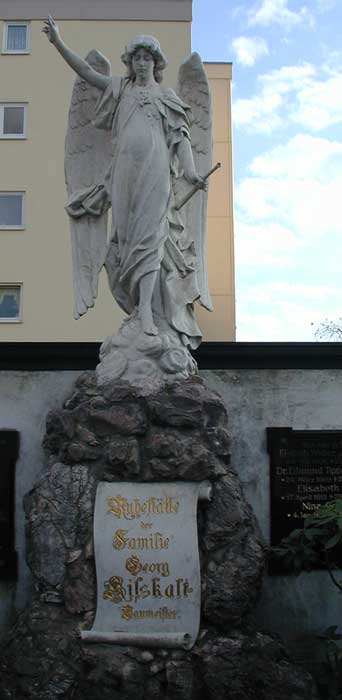
kisskw.jpg

(Click to enlarge/Anklicken, um zu vergrößern)

Am 15. April brachte Die Zeit einen Artikel über Sterben in Deutschland (Handakte WebLAWg erwähnte ihn auch).
Der Link funktioniert noch, und hier sind die Kosten.

People who get cremated in Germany have to have their ashes buried in an urn. (Does this mean there is a small hole that people throw small flowers into?)
There are local bye-laws too: in some places, tombstones of polished granite are forbidden because the mourners might see their reflections on the stone.

At the site www.postmortal.de there are various attempts to get round this, for example via the Netherlands or Switzerland.
(They use the word Kremierung– apparently archaic except in Switzerland – instead of Kremation.

One way is via Slangenburg in the Netherlands. Apparently you can have a civilized ceremony in a Netherlands cemetery. I think you can have the ashes scattered too, if you don’t want to smuggle them back into Germany (apparently frequently done).

The crematorium isn’t as elegant as the grave of Georg Kißkalt, the architect for whom the house I live in was built (see photo above).

The Guardian recently had an article on Berliners using a Czech funeral firm.

bq. Fed up with paying too much and waiting too long to bury or cremate their loved ones, Germans are taking advantage of a new funeral service – in the Czech republic.
The cross-border business has been flourishing because Berliners have grown weary of waiting up to three weeks to pay their last respects and being befuddled with the paperwork.
Instead, they have turned to an enterprising undertaker, Harmut Woite, who has bought a new crematorium in Vysocanske, 43 miles inside the Czech border.
In Berlin it would cost on average €5,000 for a standard funeral service, six times more expensive than a funeral across the border.

Incidentally, in August 2003 Germany first introduced apprenticeships for undertakers. There are some articles about the first trainees, for instance in the Stuttgarter Zeitung online.

Oasis in Munich/Oasis in München

Berichte in deutschen und englischen Zeitungen über Prügelei zwischen Mitgliedern der Band Oasis und fünf Münchner.

The Süddeutsche Zeitung

bq. Die Münchner Polizei ermittelt gegen fünf Männer, die Oasis-Sänger Liam Gallagher und seine Kollegen vor anderthalb Jahren im Nachtklub des Nobelhotels „Bayerischer Hof“ versohlt haben sollen.

Oasis-Sänger Liam Gallagher sah damals aus, als wäre er mehrmals gegen eine Wand gelaufen: Die Haare zerzaust, eine Lücke im Gebiss, zwei Schneidezähne fehlten. Dies war am 1. Dezember 2002 nach der Prügelei im Hotel „Bayerischer Hof“, die er und seine ebenfalls total betrunkenen Band-Kollegen angezettelt hatten

and the Independent report on possible criminal proceedings against five Munich men aged between 32 and 28.

bq. Anton Winkler, Munich’s chief prosecutor, said four members of the band were still being investigated on suspicion of assault, resisting arrest and damage to property, but were unlikely to face trial.

bq. Instead the five businessmen involved in the brawl with Mr Gallagher and three other members of Oasis are almost certain to face charges of causing grievous bodily harm. Two of Mr Gallagher’s front teeth were knocked out during the fight at theBayerischer Hof.

The Süddeutsche reports that the karaoke performance to their own song was not well received in the Munich night club. It also reports that the Munich men escaped, but the crews of ten patrol cars arrested the Oasis members:

bq. Festgenommen von zehn (!) Streifenwagenbesatzungen wurden nur die Bandmitglieder, wobei Gallagher einen Beamten mit einem Fußtritt begrüßte. Die fünf prügelnden Münchner entkamen unerkannt – bis die Polizei nach diversen Zeitungsveröffentlichungen doch noch einen Tipp bekam und nach und nach die anderen Schläger ermittelte.

dtv-Atlas Recht/Legal ‘atlas’

A visit to the dentist took me past a university bookshop in Erlangen recently:

menckebw.jpg

(Mencke-Blaesing)

There I picked up a couple of law books. The first was the dtv-Atlas Recht, Band 1.

(To buy from amazon.de click on picture – but read on first!)

cover

This book has some geographical maps, but most of the illustrations are diagrams intended to summarize the text visually. It’s volume 1 and covers general matters, constitutional law, EU law and criminal law. It has rave reviews on amazon.de and elsewhere, but I wonder about some of the illustrations.

verww.jpg

It seems to me you could spend a lot of time working out what the graphic actually means. Perhaps that’s the idea. Lots of legless people, anyway, unless the legs are really needed.

eitelw.jpg

urkw.jpg

I just wonder who did the graphics. I mean, I know who did them, but did the author provide the idea and the design company just execute it?

Of course, the title conjures up a different book, one that would show the differences between the Länder, that would indicate the line between Baden and Württemberg, where different types of files are used, the varying crime rates, where same-sex marriages are solemnized by the notary and where at the register office. But this does have a map showing the kontinental-europäischer Rechtskreis (divided into romanisch and deutsch, and deutsch including Scandinavia), and the anglo-amerikanischer Rechtskreis (divided into englisch and amerikanisch – very odd).

There is also a dtv – Atlas Weltgeschichte 2. Von der …
in two volumes or one. Interestingly, this has been translated into English for Penguin (The Penguin Atlas of World History:…). The translation isn’t perfect, but it’s a great source of terms for historical battles, personages, and other terminology.