What’s going on in Fürth?/Was passiert in Fürth?

Regular readers will be wondering what’s happening in Fürth? I’ve been doing a lot of work, but so has the beaver. Situation on January 5:

February 6:

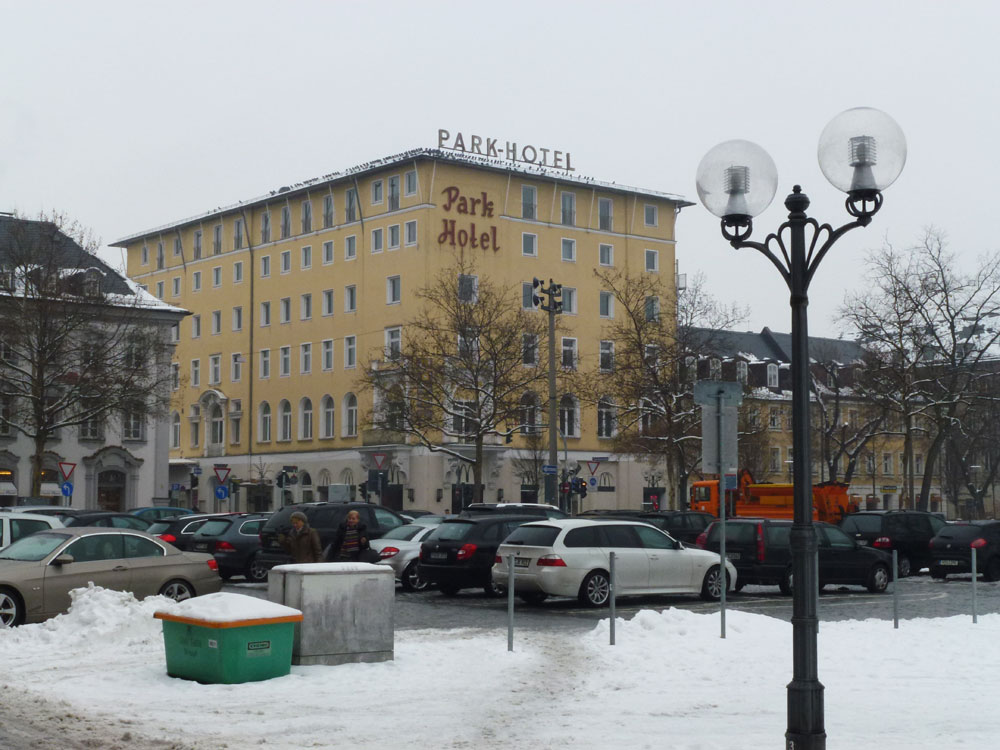
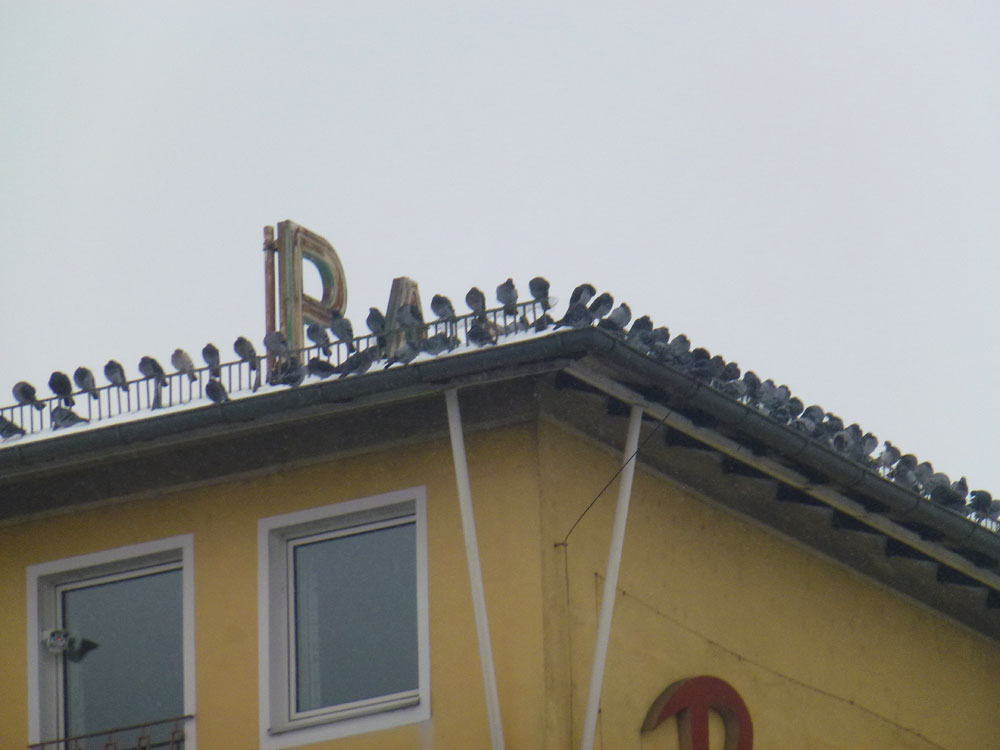
Meanwhile, there is a fight going on about the demolition of the Park Hotel. The City Council appear to believe that allowing a rather small shopping centre to be built while removing the famous banqueting hall (a place a bit like the Tower Ballroom in Blackpool but which no one has shown any interest in since the 1950s) and replacing the historic front with boring modern architecture would save the town centre from decline, whereas others wish to preserve the historic front (which again, no one has seen since the 1950s) and the banqueting hall (we were allowed in there recently) at the expense of the potential small shopping centre.

This is the 1950s yellow exterior of the Park Hotel, which is quite nice really but none of the plans intend to keep it:

There is or was already a shopping centre in Fürth, known as the City Center. It was never terribly wonderful and has the distinction of having 351 owners, which makes it hard to sell. I was surprised yesterday when coming back from Nuremberg on the underground to hear the announcement ‘Exit here for Line 1 train to City Center and Fürth’ (the City Center is in a kind of limbo but in decline after a failed sale).

City Center in the Fürth Wiki (in German)

Here you can find a picture of the Park Hotel as it might be with its historic façade hidden behind the yellow). It looks very nice but it’s not going to happen, folks! If you scroll down, you can also see the ceiling construction of the banqueting hall (Festsaal). This would be very easy to restore, but when it was opened to the public for a couple of hours the ceiling could not be seen.

Misdirected emails/Email-Adressen, die einander ähnlich sind

I know I’m not the only Margaret Marks out there, but I do keep getting emails sent to one in Washington State, I believe.
Margaret

You may find this helpful for you and your husband to use when planning meals on Sundays. And that frozen meal was called Organic Bistro.

Have a great week!

Erika Brown, RD, CD
20/20 Lifestyles Dietitian

A meal planner was attached.

Judges and dictionaries in the USA/Richter und Wörterbücher in den USA

The topic of judges and dictionaries was the subject of an earlier post.

Now a new paper has appeared on the subject: Oasis or Mirage: The Supreme Court’s Thirst for Dictionaries in the Rehnquist and Roberts Eras, by James J. Brudney and Lawrence Baum. From the beginning of the abstract:

The Supreme Court’s use of dictionaries, virtually non-existent before 1987, has dramatically increased during the Rehnquist and Roberts Court eras to the point where as many as one-third of statutory decisions invoke dictionary definitions. The increase is linked to the rise of textualism and its intense focus on ordinary meaning. This Article explores the Court’s new dictionary culture in depth from empirical and doctrinal perspectives. Among our findings are (a) while textualist justices are the highest dictionary users, purposivist justices invoke dictionary definitions with comparable frequency; (b) dictionary use is especially heavy in the criminal law area, serving what we describe as a Notice function; (c) dictionary use overall is strikingly ad hoc and subjective. We demonstrate how the Court’s patterns of dictionary usage reflect a casual form of opportunistic conduct: the justices almost always invoke one or at most two dictionaries, they have varied individual brand preferences from which they often depart, they seem to use general and legal dictionaries interchangeably, and they lack a coherent position on citing to editions from the time of statutory enactment versus the time the instant case was filed.

Via the UKSC Blog, Dictionary: A way to define an argument – actually an article by Robert Barnes in the Washington Post, reprinted. It discusses the 94-page paper and the problems of the way most judges use dictionaries – simply ransacking them to find a definition that confims what they already believe. I liked this:

Judge Richard Posner of the U.S. Court of Appeals for the 7th Circuit wrote last year that “dictionary definitions are acontextual whereas the meaning of sentences depends critically on context, including all sorts of background understandings.”

(a link is given but it doesn’t work).

MA dissertation on legal translation (Louisiana law)/Louisianas Zivilgesetzbuch als Quelle für Terminologie

Rob Lunn is a legal translator in Spain who has been doing an MA in legal translation at City University in London. On his blog Legally Yours, he offers Abstract and download of my dissertation on legal translation.

While it specifically looks at using the Louisiana Civil Code as a source of ‘third-system’ translations for Spanish legal terms, it also explores some of the general issues involved in bridging the gap between legal systems in translation, including non-equivalence and the idea that different audiences might require different kinds of legal English.

When I was first teaching legal translation in the 1980s, before the days of much legal translation theory, I was happy to use Martin Weston’s An English Reader’s Guide to the French Legal System, above all because of its chapter on translation methodology, which listed ways to deal with a foreign term. I didn’t always agree with Weston’s conclusions, but he offered a good framework to think about the problem. Weston is also in Rob’s excellent bibliography.

There are two useful tables on terms in the appendix. It’s a good place to get an orientation on the problems discussed. Civil-law terms needing translation into English are obviously found in German too. For instance, there’s the consideration of whether one translates Dienstbarkeit (Spanish servidumbre) as servitude or easement.

The dissertation invites further research into the search for terminological equivalents – he concentrates on property law.

Elsewhere in the blog, Rob explains why the Louisiana Civil Code might be very interesting for its Spanish connections.

So, as the civil codes of both Spain and Louisiana were originally based on the same sources (i.e., Spanish law and the French Civil Code), there is bound to be an amount of shared or similar content in them, even in today’s revisions.

More surprisingly, though, is that the Louisiana Civil Code of 1825 was influential in Spain’s draft civil code of 1851, a predecessor to Spain’s first civil code, the Civil Code of 1889. According to Parise (2008), reference was made to 1,103 articles of Louisiana’s 1825 code in the comments to 1,992 articles of the Spanish draft in Concordancias, motivos y comentarios del Código civil español, the rationale for the draft written by its principal author, García Goyena.

He also recommends Rome and Kinsella’s Louisiana Civil Law Dictionary. You can get this as an ebook, incidentally.

Pişmaniye – Keten helva

There’s always a lot to write about legal translation, but now for something more important.

When I first saw pişmaniye and read the translation cotton candy (US for candy floss, German Zuckerwatte) but the ingredients only 50% sugar, the rest flour and butter, I was curious.

It’s very light and fluffy and difficult to eat without getting it everywhere.

My local source was taken over by another firm and had only one box, chocolate-covered, left. I didn’t really want the chocolate, but it was good because it was very thinly coated and the chocolate coat made it easier not to make a mess – though not impossible, I can attest.

So I was excited when I got my hands, or rather my ereader, on Sherbet and Spice: The Complete Story of Turkish Sweets and Desserts by Mary Işin (the last i in the surname should not have a dot). I think I read about it in a tweet from Robyn Eckhardt, of the Eating Asia blog.

The blurb says:

Mary Isin has lived in Turkey since 1973 and started researching Ottoman cuisine in 1983. She is the author of a Turkish cookery book, an encyclopedic dictionary of Ottoman cuisine and a transcription of an Ottoman cookery book as well as many articles on food history. She is also editor of A King’s Confectioner in the Orient and an eighteenth-century Turkish dictionary of Persian culinary terms.

The book appeared in Turkish first.

She calls pişmaniye, which has many names, keten helva (linen helva). Apparently it used to be made with great effort by several people on one evening in the days before television.

Keten helva is made in three stages: first flour and melted butter are stirred over heat for nearly an hour. Then sugar syrup is boiled to crack, pulled until it turns white and satiny, and shaped into a ring about 20 centimetres in diameter. Now comes the stages that requires the greatest skill. The pulled sugar ring is generously sprinkled with roasted flour and placed in the centre of a large circular tray. Three, four or more people sit around the tray, place both hands on the right and squeeze it, simultaneously moving it in an anticlockwise direction.

Here are two of the illustrations:

Pişmaniye is made by machine nowadays, or partly by machine. See this video (thanks Bettina!).

And here’s a video with English voiceover – Dan Arnold shows how to make Hand-Pulled Cotton Candy: Dragon’s Beard, Pashmak, Pishmanie.

Links

More useful links to other people’s admirable work!

1. Isa Bogdan describes why, for literary translators in Germany, a standard page (Normseite) does not mean 1800 keystrokes. It goes back to typewriter days and includes short lines. This is known to many translators, but not to all clients. The kind of translations I do are not charged by the page, and even when I worked for publishers I worked by the line, but it’s worth knowing this. I know the EU has pages too, but they are different.

Die Normseite stammt noch aus der Schreibmaschinenzeit. Damals ging es darum, über einen bestimmten Rahmen nicht hinauszuschreiben. Übersetzer bekamen teilweise sogar vom Verlag Papier geschickt, auf dem dieser Rahmen aufgedruckt war. Hinein passten genau dreißig Zeilen mit jeweils höchstens sechzig Anschlägen. Schreibmaschinenschriften waren ja nicht proportional, sodass immer gleichviele Buchstaben in eine Zeile passten.

2. Timothy Cooper, a senior terminologist at the EU, gave a talk in London recently on IATE, the EU terminology database that many translators consult online. In his blog A Pragmatic Eye, Charlie Bavington gives a full account of this talk. This contains useful information such as not to select a domain when searching, as there are too many domains and terms may not be filed under the logical domain. Nor should you even search for a specific pair of languages.

Summary search tips:
– Don’t use plurals
– Ignore domains
– Search on all languages, not a pair
– The “reliability” star rating is not to be relied upon.

This looks like useful advice, and I may give IATE another chance. I remember hearing at a talk years ago that a lot of the earliest IATE material was made available free online because the quality checking system was not reliable. Mind you, my own terminology database is a mess, and they do say many cooks spoil the broth.