Linux distribution for translators / Linux für Übersetzer

Peter Sandrini, a legal translator, no less, has created a version of Linux especially designed for translators.

Peter Sandrini: eine Linux-Distribution für Übersetzer (hier Deutsch)

On the basis of the linux distribution PCLinuxOS we have created a desktop linux system for translators.
PCLOS-Trans is full fledged desktop system meant as a replacement for the widely known OS. But it is not just an operating system, it is also a collection of software applications which allows a translator to do his/her job most efficiently and in line with the latest standards.

Auf der Basis der Linux-Distribution PCLinuxOS haben wir einen Desktop-Pc zusammengestellt, der neben dem Betriebssystem eine Reihe von spezifischen Anwendungen enthält. Diese Anwendungen wurden ausgewählt, um ein möglichst effizientes Übersetzen am PC zu ermöglichen.

(Via Marc Prior at Flefo)

Forensic linguist enters fiction / Forensischer Linguist als Romanfigur

Newsday reported on November 29 (when I first drafted this entry) that Kathy Reichs has introduced a forensic linguist called Rob Potter in her latest novel. He is based on Robert Leonard, an academic and private forensic linguist. It was news to me that he retired as a rock singer at the age of 21.

The newcomer is based on one of Reichs’ friends, Robert Leonard, 59, a real-life former rock star-turned-forensic linguistics professor. Leonard, in fact, heads the Forensic Linguistics Project at Hofstra University. Professionals in that field analyze written and spoken language – including grammar, word choice, dialect and structure – in contracts, confessions, ransom notes, spoken threats, undercover recordings, transcripts of interrogations and other correspondence linked to crimes.

IAB Glossar

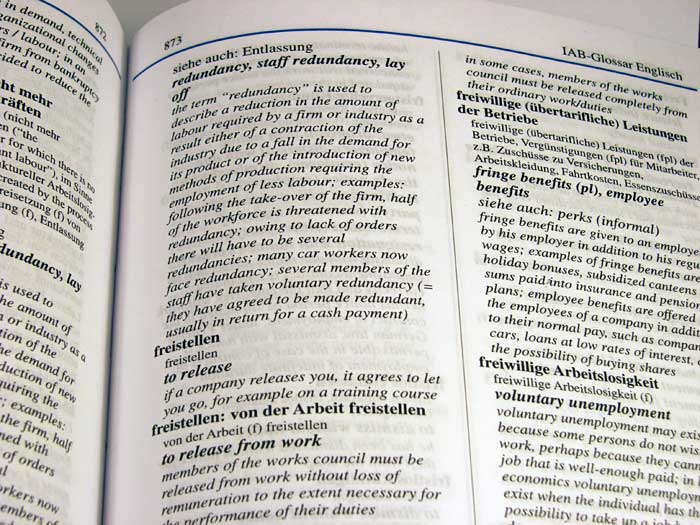
There was a discussion of the IAB Glossar on a translators’ mailing list recently. I was interested to know if anyone else found it useful. There came praise in the highest tones from an in-house ministry translator. I suspected the book was of most use to German civil servants who knew the topic and were working into English.

Here’s an entry on Freisetzung von Personal (click to enlarge):

It looks to me as if that definition is a definition of the German term, which happens to appear in English. The identical definition appears in the EN to DE half.

This sort of thing makes me uncomfortable. Where did they find their English definition? I’d have to research it. Dietl is completely different: in the DE to EN part, it will have a definition of Amtsgericht, for example, in both languages. And I know as the reader that that is Dietl’s definition summarizing the German situation. But the IAB approach is not good for people translating between two systems of law. If I don’t know which system is being referred to, how can I assess the quality of the suggestion?

Another thing I found odd was that the word Freistellung was not given in the garden leave sense, which is quite common nowadays, of preventing people from working out their notice.

I did post a query, but unfortunately it was misunderstood as a request for more information about gross misconduct:

Könntest Du mir ein Problem erklären, das ich mit diesen Glossaren habe: im EN>DE Teil (2004 Ausgabe) unter “gross misconduct” steht eine lange Definition auf Englisch: “gross misconduct represents a serious transgression of disciplinary rules, which is normally punished through dismissal without notice …”, ohne Quellangabe. Im DE>EN Teil steht unter grobes Fehlverhalten keine deutsche Definition, sondern genau die gleich englische Definition, wieder ohne Quellangabe. Unter “Verfehlung” steht zum dritten Mal genau die gleiche englische Definition, wieder ohne Quellangabe.

EN>DE steht “schwere, / grobe Verfehlung, grobes Fehlverhalten” als
Übersetzungen.

Ich habe den Eindruck, dass hier eine Definition aus dem deutschen Arbeitsrecht steht, aber da wäre es leicht, einen Paragrafen zu nennen. Und die deutsche Fassung der Definition müsste auch zu finden sein. Das ist mit ein Grund, warum ich das Buch selten öffne, gerade weil auch ich mich mit feinen Unterschieden beschäftigen und auskennen muss. Ich habe den Eindruck, hier ist ein internes Werk, das für Deutsche Beamten gedacht ist, die deutsches ins Englische übersetzen und denen die deutschen Definitionen bekannt sind, aber die gerne Hilfe bei der englischen Formulierung hätten.

(For details of this book, see earlier entry – it’s apparently available as a CD too now)

The future of patent translation / Patentübersetzung nach dem Londoner Übereinkommen

Gemäß dem Londoner Übereinkommen, das 2008 in Kraft tritt, sollen weniger Übersetzungen für Patente anfallen:

Die Vertragsparteien des Übereinkommens verpflichten sich, auf die Einreichung von Übersetzungen europäischer Patente in ihre Landessprache ganz oder weitgehend zu verzichten. Für die Praxis bedeutet dies, dass Inhaber europäischer Patente künftig keine Übersetzung der europäischen Patentschrift vorlegen müssen, wenn das Patent für dem Londoner Übereinkommen angehörende EPÜ-Vertragsstaaten erteilt ist, in denen eine der EPA-Sprachen Amtssprache ist. In allen anderen Fällen ist eine vollständige Übersetzung der Patentschrift in die Landessprache nur dann vorzulegen, wenn das Patent nicht in der von dem betreffenden Staat bestimmten EPA-Sprache vorliegt. Die Einzelheiten sind in den Artikeln 1 und 2 des Übereinkommens ausgeführt.

Mit diesem Übereinkommen ist ein Durchbruch in der Sprachenfrage erzielt worden, der das europäische Patent künftig deutlich kostengünstiger machen wird.

The London Agreement is to come into force in 2008 and provides that fewer translations will be needed to register patents:

The Parties to the Agreement undertake to waive, entirely or largely, the requirement for translations of European patents to be filed in their national language. This means in practice that European patent proprietors will no longer have to file a translation of the specification for patents granted for an EPC Contracting State Party to the London Agreement and having one of the three EPO languages as an official language. Where this is not the case, they will be required to submit a full translation of the specification in the national language only if the patent is not available in the EPO language designated by the country concerned. For more details, see Articles 1 and 2 of the Agreement.

This breakthrough on the language issue will significantly reduce the cost of European patents.

RWS Holdings, a global translation company that does a large amount of patent translation, is not too concerned about this, according to the Scotsman:

The company added that an expected £1m hit from a new agreement aimed at reducing the translation costs of patents granted under the European Patent Convention, due to come into force in spring next year, would be offset by the company’s strong performance in the next financial year.

The IPKAT reports this with a dry remark (and further links):

A recent story in the Scotsman reports that RWS plan on taking a £1 million hit when the agreement kicks in, but don’t see this as being much of a problem with a turnover in excess of £46 million. The future is bright, apparently, and the loss of a few German and French translation jobs is nothing to be worried about.

Germany’s oldest Christkind / Kindermangel trifft Pottenstein

Judith Herberth, 42, ist Deutschlands älteste Christkind.

Für Pottensteins Bürgermeister Stefan Frühbeißer ist die sympathische Frau gerade die richtige Wahl. «In Pottenstein hat sich gezeigt, wie schwierig es ist, ein neues Christkind zu finden», sagte Frühbeißer. So will Judith Herberth bei ihren Auftritten nicht nur den Prolog von Steffi Ribold vortragen, sondern auf Wunsch auch ein Lied singen, oder Geschichten erzählen.

Nürnberger Nachrichten