Front:

Back:


Front:
Back:
Some Germans think the English word gift is funny, because in German Gift means poison. They have the same origin – something you give someone. Dose has the same idea.
Is this the origin of the Neudeutsch word givings, which I encountered on an ITI list today?
Here’s an example from the Internet:
In drei große Bereiche untergliedert sich die Ambiente. Im Dining-Segment werden Glas, Porzellan, Keramik, Besteck und sonstige Küchenartikel, Elektro-Kleingeräte sowie Hausrat vorgestellt. Ins “Land der Wünsche” führt der Besuch des Bereichs “Givings“. Hier dreht sich alles um Geschenkartikel aller Art vom Schmuck, Festdekorationen über Handwerk bis zu Raucherutensilien. Aktuelle Wohntrends mit Möbeln, Wohntextilien und -accessoires sind dagegen im Messebereich “Living” zu sehen. Das Angebot ist abwechslungsreich und vielseitig.
This reminds me of a dictation given by a colleague of mine where the student wrote ‘He went to bed with Miss Givings’.
Along the same lines, I recently discovered that sideboard and highboard are items a German office worker might have behind his or her desk. This is for those who believed that a sideboard belongs in a dining room and a highboard above a swimming pool.
Translators into English have to be careful nowadays.
The date didn’t strike me until afterwards.

I’ve been meaning to write about the Abmahnwelle in Germany, but since I haven’t researched it in depth and there are new examples every day, I don’t get round to it. I did mention it in an earlier entry.
Abmahnen means to send someone a letter before action. For instance, lawyers can do this to people whose Impressum is inadequate. The rules for the Impressum, the legal notice on a weblog that allows the person in charge to be contacted, are similar throughout the EU, I believe, but it’s only in Germany that legislation enables such a wide range of people to sue and collect fees. It’s a source of income for some lawyers to sue on formalities, because they can collect their fees. It’s particularly ridiculous that in order to sue someone for a formal defect in an Impressum, you have to be able to contact them, and the sole purpose of the Impressum is to enable you to contact the webmaster – so the mere fact you are able to take action against them proves the Impressum was doing its job.
Fortunately Larko has written on the topic in English. He says it’s a combination of legislation and some German courts. I had thought it was just the legislation. Here on the Impressum (note the link to the Abmahnwelle blog, in German):
The justice system is also frequently abused by lawyers who choose to sue bloggers and forums as a matter of routine although they could just as well write to the blogger or forum administrator and politely ask them to remove an offensive comment or post. Rather than negotiating in a civilized manner, they promptly sue because they can then charge their fat fees from the person who was sued even if the dispute itself is settled. This sort of dog law approach is so common in Germany that there is a word for it: Abmahnwelle. And believe it or not, a special blog was recently kicked off with the sole purpose of covering lawsuites against bloggers.
Incidentally, I hadn’t encountered the term dog law, but apparently it was coined by Jeremy Bentham with reference to judge-made criminal law:
It is the judges (as we have seen) that make the common law. Do you know how they make it? Just as a man makes laws for his dog. When your dog does anything you want to break him of, you wait till he does it, and then beat him for it. This is the way you make laws for your dog: and this is the way the judges make law for you and me. They won’t tell a man beforehand what it is he should not do – they won’t so much as allow of his being told: they lie by till he has done something which they say he should not have done, and then they hang him for it.
But these German lawyers could not behave in this way if the legislation did not support them.
This term dog law was used in German to refer to the Abmahnwelle by Professor Maximilian Herberger, I learn.
It would be fundamentally unjust to punish someone for violation of the law, if this person did not have a fair chance to know the law beforehand. This would be, as Jeremy Bentham has put it in criticism of his contemporary law, a kind of “dog law”, the point of comparison being that the dog learns about his failures only by being punished. He has (in this view) no chance to know the applicable rules before.
I still think dog law is a bit of a misnomer for the whole phenomenon, since it seems to result from legislation, even if judges and lawyers exploit it in unjust ways.
Every Dog’s Legal Guide here.
I picked up this discussion in RA-Blog, where one of the commentators had strong objections to Larko’s use of the word sue for out-of-court pursuit. I notice I used the word sue above myself loosely. When I wrote that German law allows a wide range of people to sue, that was correct, because even if they have to write a letter before action first, they could still sue afterwards. But it was strictly incorrect to say that German lawyers earn money from suing. They earn money from sending letters before action. I suppose this might be misleading for someone who doesn’t know the German legal system.
Incidentally, the commenter tells Larko that he can find the correct translation of Abmahnung in a dictionary. Obviously an optimist.
According to a dpa report I’ve only seen in English, at Expatica, a German lawyer is suing a German state, Bavaria I presume, for interfering with his constitutional right to enjoy nature:
Munich (dpa) – A lawyer has sued a German state on behalf of a dead bear, a spokesman for a tribunal in Munich said Friday, four months after Bruno the badly behaved bruin was shot.
The lawyer argues it was illegal to declare open season on Bruno, an Italian-born animal that was the first wild bear to roam Bavaria state for 170 years. Officials said it was likely to attack people.
…The lawyer, acting in his own name, is trying a different tack, suing at a tribunal that reviews administrative decisions and citing his constitutional right to enjoy the fruits of nature. The case could take several months to decide, the spokesman said in Munich.
I presume that by tribunal they mean an administrative court, the Verwaltungsgericht. Just because we don’t have administrative courts in England, I don’t see it as a reason to downgrade the German ones in translation!
By the way, Expatica has some interviews with people working in Germany: an English teacher, a journalist, and someone in the NGO sector.
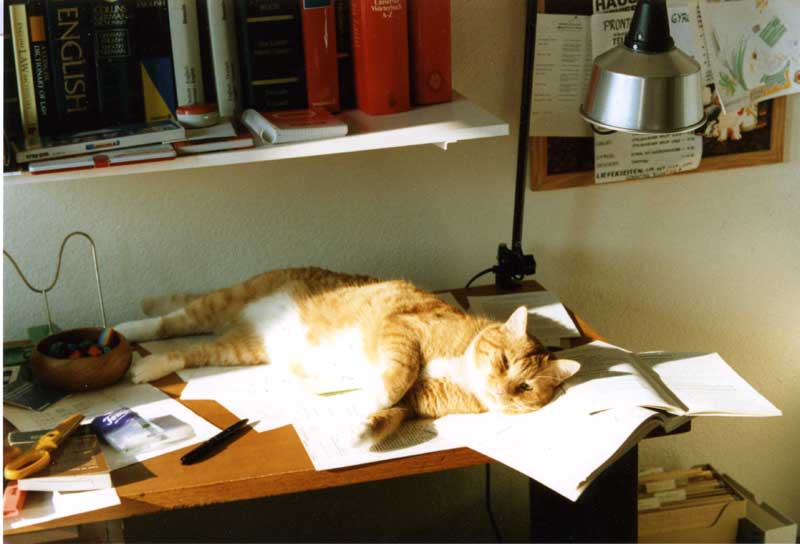
These are very old photos of my desk – over ten years old. I was translating a church guide with very few references.
The picture on the medieval monitor below shows that the office assistant had kindly inserted quite a lot of tab stops.