Interpreter attacked in Munich court/Dolmetscherin wird von TV-Anwalt gerettet

Süddeutsche Zeitung über lawblog.

Giouri A., the defendant in a Munich court, charged with bewaffnetes Handeltreiben mit Betäubungsmitteln – armed drug dealing – on Tuesday morning suddenly produced a 20 cm (8″) nail, put a headlock on his Russian interpreter and pressed the nail against her neck. His defence counsel got the nail away from him before two court officers overpowered him.

The defence counsel, what’s more, was Sewarion Kirkitadse, a lawyer of Georgian extraction who appears on afternoon court TV shows in Germany. His photo shows his heroic qualities. *And* he has worked as an interpreter himself, for the fascinating Georgian language.

The Russian interpreter is described as Erina J., 50 (maybe Irina or Erika?). Since the defendant is in custody, one can’t help assuming he found the nail in the prison wall.

bq. Am Morgen war er mit einem Gefangenen-Transporter ins Gericht gebracht worden. Üblicherweise werden alle Häftlinge vor dem so genannten Schub noch einmal gründlich durchsucht. Ein Kripobeamter kündigte bereits „interne Ermittlungen“ zu dem Vorfall an.

I quoted that because I remember the ‘so genannten Schub’ – the trip by van to the prison, or the prison away from the court itself.
Online DE>EN legal materials / Deutsch-Englische Rechtswortschatzübungen

The George Washington University Law School has some vocabulary tests and a drilling utility online. You can have the answer shown and decide yourself if you were right or wrong. The drills work in IE for me, not in Firefox, but that may be my setup.

The material comes from Profs. Gregory E. Maggs and Robert Brauneis, and there are some Internet links there too (including one to me!).

German-English legal translator makes good

Grace Donalds, née Smith, is a magistrate on the Cayman Islands (report). She was at Wellesley College with Hillary Clinton and studied law later at LSE in London.

bq. Another of Mrs Donalds’ qualifications is that she speaks German and reads French. In August 1975 the German Academic Exchange granted her a scholarship to pursue a course in Modern German Law. In addition, while studying at LSE she worked for two summers as a German to English translator of corporate documents at law firms in Frankfurt, West Germany.

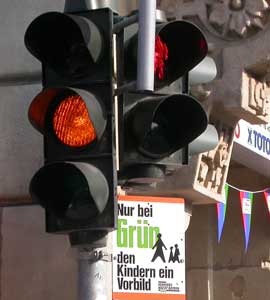
Crossing against the lights/Bei Rot über die Ampel

amp1_051011w.jpg

Udo reports the case of a pedestrian who crossed the road when the light was red and was given a fixed penalty notice for 5 euros. He was seen by two policemen (and finished up paying a lot more because the deadline had passed).

I’ve lived here all this time and I never knew it was punishable.

How about the UK? You see signs on the road there saying ‘Look right’, so you know where to check there is no traffic before crossing.

The Highway Code contains some provisions which are subject to a penalty. They contain the words must or must not:

bq. Many of the rules in the Code are legal requirements, and if you disobey these rules you are committing a criminal offence. You may be fined, given penalty points on your licence or be disqualified from driving. In the most serious cases you may be sent to prison. Such rules are identified by the use of the words MUST / MUST NOT. In addition the rule includes an abbreviated reference to the legislation which creates the offence.

Not so the rules for crossing against the lights as a pedestrian:

bq. 21: At traffic lights. There may be special signals for pedestrians. You should only start to cross the road when the green figure shows. If you have started to cross the road and the green figure goes out, you should still have time to reach the other side, but do not delay.

Note should, not must.

See the comments to Udo’s entry. Is it a regulatory offence in Austria too? Doesn’t sound like it.