This might be worth knitting/crocheting if the weather gets any colder. It might also make me look younger.
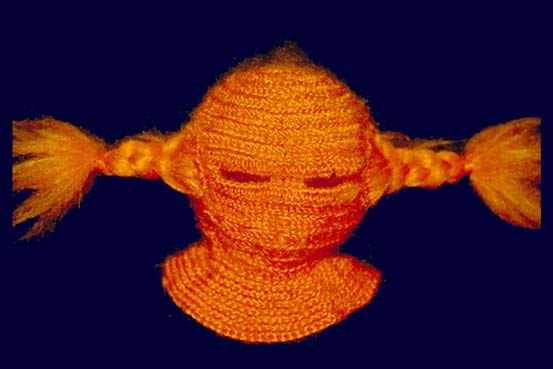
From Felieke van der Leest, Jewellery and Objects (note also the nifty tampon holders), via Cobwebs of Petty Inquisitiveness.

This might be worth knitting/crocheting if the weather gets any colder. It might also make me look younger.
From Felieke van der Leest, Jewellery and Objects (note also the nifty tampon holders), via Cobwebs of Petty Inquisitiveness.
An article in the Boston Globe reports that Lernout & Hauspie’s auditors have agreed to make payments to investors ($115 million, but market capitalization was $10 billion). Thanks to Robin Bonthrone for this link.
bq. During the late 1990s and 2000, Lernout, a pioneer in systems that convert speech to text and computer commands and also turn digital text into synthesized speech, engaged in a host of schemes to inflate its revenues and bolster its soaring stock price, which hit $72.50 a share in March 2000. They included $100 million in bogus sales in South Korea and the creation of shell subsidiaries in Belgium and Asia to create paperwork for phony sales reports.
bq. Caught in the scandal was the former Dragon Systems Inc. of Newton, a speech recognition company that agreed to be bought for $460 million in June 2000 by L&H, just months before accounting problems erupted. Software vendor ScanSoft Inc. of Peabody agreed to buy most of Lernout’s remaining assets for $53.8 million in December 2001.




Via jurabilis and Handakte WebLAWg: there is a new weblog (in German) by the apparently fictitious German member of the Bundestag Jakob Maria Mierscheid. Here’s his Bundestag entry. Here we see, for example, that in 1967/1968 he published a four-part series on the route taken by a probably invented species of pigeon – a hooded and collared dove – and its flight characteristics.
There is a famous German invented creature called the Steinlaus (stone louse), which was invented by the German comedian whose stage name is Loriot and found its way into the Pschyrembel medical dictionary, but I had never heard of this ‘phantom of the Bundestag’ (there is a reference to a Steinlaus symposion in his bio linked above).
Mierscheid has apparently been around for quite a while and has his own page on the Bundestag website.
Steinlaus in the German Wikipedia.
Mierscheid in the German Wikipedia.
Bundestag page on Dr. Dietrich Sperling, a ‘friend’ of Mierscheid’s.
Mierscheid’s new blog, Geschichten aus dem Bundestag.
Recently someone posted a comment on one of my entries advertising not one URL, but 176 URLs. With Jay Allen’s MT Blacklist plugin for MT 2 (I believe there’s a variant for MT 3), it’s easy to remove. And I can block comments altogether if I go away. Every time I look at the Activity Log, I can see many attempts to post URLs that are already on my blacklist being warded off.
Then there are comments that are not spam. There is a school of blogging that won’t remove anything without a note saying something has been removed, and won’t alter a spelling without indicating by strikethrough what the original error was. I have deleted a few comments, but not always with a note. I remember once deleting a comment by an Austrian who felt the other comments had been getting at Austria and used a swearword or two. I don’t see why swearwords should be smeared all over my comments, unless we’re discussing them, of course.
Werner Patels, who has a German-English translation weblog and sometimes comments here, has stopped comments altogether, in part because some people who comment on his site are just advertising themselves:
bq. In case anyone has wondered: I have disabled the comment feature on this blog. There is simply too much spam flying around out there (not to mention some wise guys who think that their less-than-intelligent comments will get them those “15 minutes of fame”……).
Absolutely right – as the Germans say, ‘Wo er Recht hat, hat er Recht’. I think I’ll take this as my model and if I feel like it, I’ll remove a comment that is just posted for self-aggrandizement. Of course, if I myself post such comments on other people’s weblogs, I would not like to be removed.

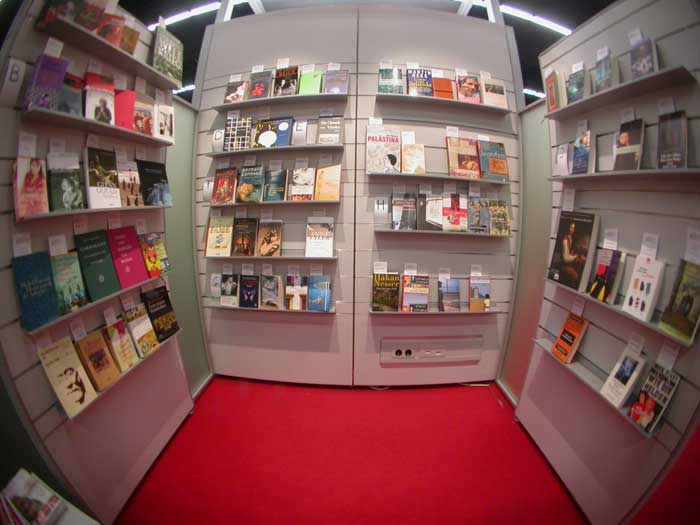
Übersetzerzentrum bei der Frankfurter Buchmesse. Mit Kreide geschrieben: “Literaturnobelpreis 2004 Elfriede Jelinek”.
Bücher mit Übersetzernamen.
Zu Jelinek siehe www.perlentaucher.de und Wikipedia.
The photos show the translators’ area at the Frankfurt Book Fair. The words in chalk announce that Elfriede Jelinek has been given the Nobel Prize for Literature. The books all show the names of the translators, on cards. The translators’ area also has a space with chairs for presentations to an audience, and it’s beside a coffee station, so it looks suitably large and professional.
Some observations on Jelinek: she has recently translated and adapted, together with Karin Rausch, ‘The Importance of Being Earnest’ (‘Ernst ist das Leben (Bunbury)’) and is working on ‘An Ideal Husband’. She has also translated Feydeau and co-translated Pynchon (list of works).
As I was in Frankfurt all day, I missed interviews and discussion on TV except for about ten minutes. The anger and narrowmindedness of some Austrians when confronted with something they don’t like is astonishing and may be untranslatable. It reminds me of the Nurembergers standing in front of the rabbit sculpture that commemorates, with irony, Dürer’s hare. It used to be fun to stand there and hear the complaints. But I haven’t heard this amount of personal affront in Franconia when it comes to literature.
I didn’t realize how much autobiographical content went into ‘The Piano Teacher’ (‘Die Klavierspielerin’). According to the German biography on Wikipedia, she was sent to a convent school, and from the age of 13 she studied organ, piano and recorder at the Vienna Conservatory (having previously had piano, guitar, flute, violin and viola lessons) and at the same time attended a normal grammar school (Gymnasium). She married in 1974, and I presume the novel is based on the idea of what might have been if she had continued her mother’s plan.
Jelinek was born in Mürzzuschlag: I remember a translator once asking on a mailing list how to translate it (Zuschlag is a translatable German word, but Mürzzuschlag isn’t).