Gherkins, wallies / Gurken

I see Des of Desbladet (see September 3rd, Puntnings, Gherkins and Wald) went for a punt trip in the Spreewald area and tried some Spreewaldgurken, which he calls gherkins. (Does he realize that’s the Sorb area?)

Well, I’m sure they are correctly called gherkins. But at home I thought of gherkins as these, which the Germans call Cornichons:
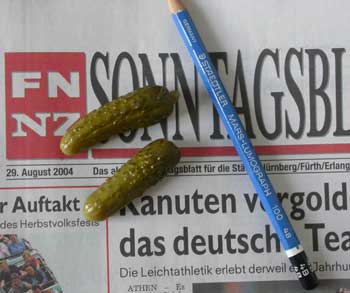
gherkins1w.jpg

(Note the curious German word Kanuten for people in canoes – canoists?)
We only ever encountered the big ones in fish and chips shops, where they were called wallies, and where they still are called wallies, as I was able to confirm recently. But apparently it’s a Cockney term.
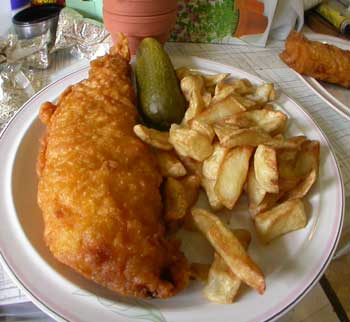
wally1w.jpg

Those chips were better than they look. Incidentally, nearly all Germans believe you can’t eat fish and chips off a plate but have to have newspaper.

The other term I encountered for these was pickled cucumbers, which is a term used in Jewish cooking, as far as I can tell – there are many different types.

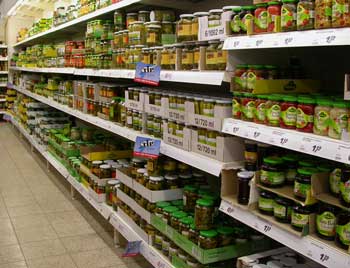
Finally, here are the pickle shelves in a not particularly big German supermarket.

sauerk2w.jpg

saurk1w.jpg

It sounds as if wallies were named after the brand name.

Machine-translated legal notice / Maschinenübersetztes Impressum

The Landesmedienzentrum Baden-Württemberg (Baden-Württemberg Media Centre) website has been drawn to my attention.

This excellent example of the authorities at work was posted on the pt mailing list at Yahoo Groups by John Hayduska, who has a nice website. I’m particularly taken with the vertical green bar at the left, but on its own it would be nothing.

Its Impressum has been translated into English by a machine, not without some human help:

bq. All rights lie with the Landesmedienzentrum Baden-Württemberg. As far as in the individual case in a different way regulated and untill foreign laws are not concerned, the spreading of the documents lying on this server is desired as a whole or in parts of it in electronic and printed form under the condition that the source (Landesmedienzentrum Baden-Württemberg) and the URL are named. Without previous written approval by the LMZ a commercial spreading of the documents lying on this server is strictly prohibited.

Here’s the URL, to do what is requested:

http://emac.pi-consult.info/emac/index.php

The French pages look better in part.

Blogger in local paper/Deutscher Weblogger in englischer Zeitung

Armin Grewe is German, lives in Swindon and blogs. His blog, Ministry of Propaganda, has been featured in his local paper – see a scan on the blog.

Here is a page on Armin’s other websites, which include a list of ‘expatriate’ bloggers (try to avoid the eggcorn ‘ex-patriot’).

Sometimes I get the impression Armin would rather be living in Scotland. – I am trying not to think too much about the fact that he has a new D70.

San Diego doctors challenge free translation and interpreting

Eric Bakovic of Language Log, in ‘Translation and Free Speech’, links to a New York Times articleof August 31st:

bq. SAN DIEGO (AP) — Several doctors and a group supporting English as the nation’s official language filed a lawsuit Monday challenging a Clinton-era executive order requiring federally funded hospitals, clinics and doctors to offer translation services for patients who speak limited English.

bq. The plaintiffs said the order is an illegal intrusion into their practices and will further motivate doctors to restrict their services or leave the industry.

They also, mysteriously, claim transaltion and interpreting limits doctors’ freedom of speech.

Apparently ProEnglish and Colwell filed a similar lawsuit two years ago in Virginia, but it was dismissed for several reasons.

New German spelling /Neue deutsche Rechtschreibung

ndrw.jpg

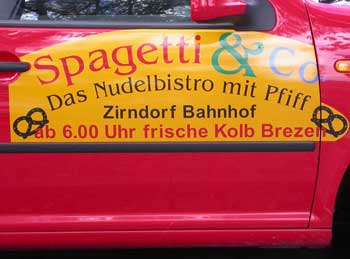
This is one of the new spellings – Spaghetti is still allowed as well as Spagetti. It’s long been possible to write Frisör / Friseur, but now you can have Grafit / Graphit, Panter / Panther, or Myrre / Myrrhe.

The topic of the German spelling reform was very popular in language blogs a week or so ago. I had the feeling some of those opining were speaking more in theory than from experience of this specific reform: it’s easier to say the reform is a good idea if one hasn’t experienced some of its illogicalities or realized just what kind of a camel an international German-speaking committee can design. There is a good summary of links by Mark Liberman at Eggcorn Log, and Eamonn Fitzgerald’s Rainy Day had a summary of an article in the Neuer Zürcher Zeitung on English spelling reform:

bq. Waser runs through the various attempts to “put manners” on English, from the British Spelling Reform Association, which Tennyson founded in 1879, to the more recently instigated Simplified Spelling Society. The latter, by the way, would have us turn “their language” into “thair languaje” and “other countries” into “uther cuntries”. Er, yes. Along with its website, the Simplified Spelling Society informs the world of its doings with “leeflets” and “pamflets “.

There was an article by Professor Theodor Ickler in the Frankfurter Allgemeine Zeitung on the latest edition of the Duden Rechtschreibwörterbuch that goes into some detail on the kinds of problems involved.

Haribo story misreported abroad/Haribo-Geschichte verwirrt die Welt Katolska kyrkan ogillar fruktsex

maoam2.jpg

Here is another of those stories that get reported wrong abroad. Ananova got the wrong end of the stick, and this filtered through to Wordlab too, and thence perhaps to the world. Boing Boing had it too.

In March this year, final-year students at a Jesuit school in southwest Germany sent Haribo a joke letter purported to be from school authorities, complaining about the lascivious appearance of the wrappings for Maoam sweets. A few days later, Haribo replied. The letter was clearly a joke, and it looks as if Haribo realized this (German originals here).

The Kölner Express newspaper reported on this on August 31st, suspecting in the last line that the letter was a practical joke, but milking the story for all it was worth, as did Bild a day later. Thanks to BILDblog for the true story (in German). BILDblog shows the first-page headline in Bild, which of course gives no suggestion that the letter was a hoax.

Ananova also places Sankt Blasien, which is near the Feldberg in the Black Forest, near Bonn, which isn’t. This seems to be because Haribo is in Bonn.