Notaries Public in Florida

Here is a nice list of all the things a notary public in Florida is not allowed to do, at the Florida Governor’s Office.

bq. Translate the phrase “Notary Public” into a language other than English in an advertisement for notarial services. §117.05(11).
Attest to the trueness of a photocopy of a public record if a copy can be made by another public official. §117.05(12)(a).
Use a name or initial in signing certificates other than that by which the notary public is commissioned. §117.107(1).
Sign a blank form of affidavit or certificate of acknowledgment. §117.107(3).
Take the acknowledgment of a person who is blind until the notary public has read the instrument to such person. §117.107(5).
Take the acknowledgment of a person who does not speak or understand the English language, unless the nature and effect of the instrument to be notarized is translated into a language which the person does understand. §117.107(6).
Change anything in a written instrument after it has been signed by anyone. §117.107(7).
Other prohibited acts:
Do not notarize a photograph.
Do not notarize a copy of a birth certificate, or any other vital record or public record.
Do not certify a translation of a document from one language into another.

It seems that translating the term notary public into Spanish in particular may inflate the importance of the job.

Translation seminar

On Saturday 12th July I spent the day in Munich at a seminar on translating contracts (I’m not sure how long that link will continue to work) held by Barbara Müller-Grant, a U.S. interpreter and translator from Wiesbaden. She doesn’t seem to have a website (yes she has), but can be found in the database at www.bdue.de. There were at least three Austrians there, two of whom had come specially from Vienna. Hence the question as to how to ‘translate’ the Austrian court names into English – I will deal with that soon in a separate entry, but I did start by listing resources for Austrian law.

There were about 30 people in the audience. Most of the time we had a general discussion based on a number of authentic German and (U.S.) English documents.

I don’t intend to appropriate all the material in that seminar, but one or two interesting things came up. I made a list and intend to research some of the questions that occurred to me.

Posted in law

Translation seminar

On Saturday 12th July I spent the day in Munich at a seminar on translating contracts (I’m not sure how long that link will continue to work) held by Barbara Müller-Grant, a U.S. interpreter and translator from Wiesbaden. She doesn’t seem to have a website (yes she has), but can be found in the database at www.bdue.de. There were at least three Austrians there, two of whom had come specially from Vienna. Hence the question as to how to ‘translate’ the Austrian court names into English – I will deal with that soon in a separate entry, but I did start by listing resources for Austrian law.

There were about 30 people in the audience. Most of the time we had a general discussion based on a number of authentic German and (U.S.) English documents.

I don’t intend to appropriate all the material in that seminar, but one or two interesting things came up. I made a list and intend to research some of the questions that occurred to me.

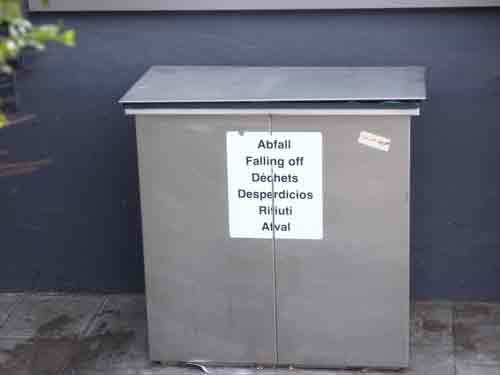
Abfall / Falling Off

fallingw.jpg

Sometimes a dictionary just isn’t enough.

Thanks to Steve Tomlin for this one. He took it somewhere in Germany (Google reveals a reference to the same error on a bin at Saarbrücken Zoo).

Georgia Court Interpreters

Via Isabella Massardo (Taccuino di traduzione), an article about court interpreters in the U.S. state of Georgia, in the Atlanta Journal-Constitution. The article gives a general survey of the numbers of interpreters required and how they are used.

bq. In one recent case, a victim robbed by three juveniles required a Spanish translator. While the victim testified about how she identified one assailant, the translator mixed up the gender of a crucial word. The interpreter asked her how many people she was shown in a lineup, rather than how many males she was shown, explained Marina Navia, a victims’ advocate with the Fulton County district attorney. The resulting confusion contributed to the case’s dismissal.

On this subject, see also the website of NAJIT, The National Association of Judiciary Interpreters and Translators.