
UOGB v. TUKUO

What is this?

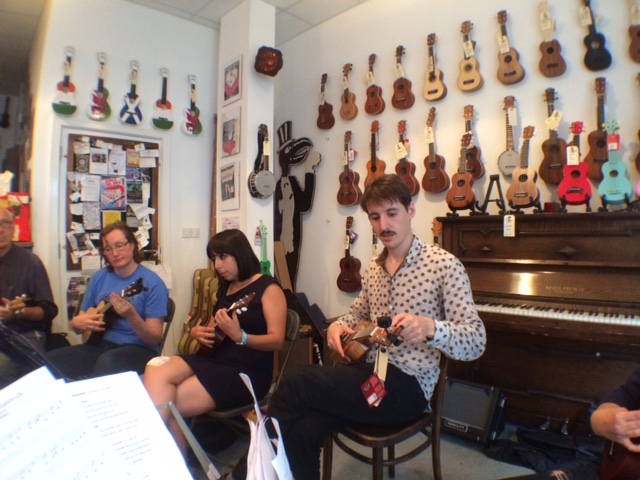
The mere sight alone promises curiosity: six men, seated, two women, instruments on their laps which look like newly-hatched baby guitars. Ukulele orchestra is the name of this bizarre appearance and wherever it plays it elicits frenetic applause from the audience everywhere.

It could almost be the Ukulele Orchestra of Great Britain.

British ukulele players indeed.

But what is that tell-tale touch of Denglish doing there?

Don’t miss it !!! , judged the SWR television. The Stuttgarter Zeitung titled ” The Ukulele rocks”, the Mannheimer Morgen spoke of a “brilliant performance of musical cabaret”, the Frankfurter Allgemeine Zeitung thought it was a “magic moment of musical comedy” and for the “Heilbronner Stimme” the whole show was “just great fun”. The musicians from London, Edinburgh, Nottingham and Glasgow just know how to capture the audience wherever they go.

But it doesn’t really matter, it is not going to be much different from the real thing.

You’d think they could have found a German or two, though.

The Intellectual Property Enterprise Court, part of the Chancery Division of the High Court, had to decide whether the United Kingdom Ukulele Orchestra, a German set-up with British players, had infringed the Ukulele Orchestra of Great Britain’s community trade mark and committed passing off and infringement of copyright.

Judgment

The trade mark was not held to be distinctive, so the claim failed, except with regard to passing off.

UKUO was set up by Mr Clausen, his business partner Mr Tings and Mr Moss in 2009. The three of them agreed upon the name. Mr Clausen admitted that at that early stage he knew about UOGB and informed himself about them by looking at their website. He must have known of their style of dress and the nature of their performances and that by 2009 they had enjoyed a good deal of success, particularly in the UK and Germany. Mr Clausen must have known that the concert services to be provided by UKUO were similar to those of UOGB. He must also have known that as a matter of language ‘The United Kingdom Ukulele Orchestra’ would to most people mean very much the same thing as ‘The Ukulele Orchestra of Great Britain’, not least in Germany where UKUO was to be based.

In my view, in those circumstances Mr Clausen and his colleagues either knew or ought reasonably to have known that from a commercial standpoint they risked objection from UOGB. In pressing ahead without seeking the sanction of UOGB or any kind of accommodation with UOGB, they acted outside honest practices within the meaning of art.12(b).

There is an account of the case at The IPKat, which concludes:

Ultimately only the claim under passing off succeeded, and UOGB’s mark was deemed invalid. This Kat is by no means an aficionado of small instruments, and believes the fight was a surprising one, seeing as the market for ukulele performances cannot be that big (readers more inclined in this area of music can correct me here, of course). In the end, the case seems shut, and the two orchestras just might have to get along for the foreseeable future.

I must admit that my attempts to learn the ukulele were fun, particularly in the classes of the redoubtable Pete of the Duke of Uke, but the idea of a large number of ukuleles strumming away in unison seems a bit of a dead end.
IMG_1569

Lord Chancellor’s advice on language

From The Independent: Michael Gove instructing his civil servants on grammar

Mr Gove, who studied English at Oxford University’s Lady Margaret Hall, is notorious for his obsession with correct language. While secretary of state for education, he changed the curriculum so that schoolchildren studied more classical literature. “It’s slightly patronising,” said a Whitehall source. “It does feel like the sort of thing someone would do when they have too much time on their hands.”

It appears there are a lot of style guides for civil servants, most probably not available online, and for a minister to request this kind of thing is not unusual. Apparently William Hague requested all correspondence to be written in the Ariel font, except correspondence to himself, which was to be in Georgia. However (to start a sentence in a way he bans), The Independent is keeping an eye on Michael Gove. He was unpopular with teachers but does have more brain cells than the last Lord Chancellor. But how will he use them?

On the subject of civil servants’ language, here is a PDF on Mandarin English

You will recall that
No you won’t.
You will wish to be aware
No you won’t, it’s bad news I’m afraid.
You may wish to consider [doing this]
Do this or else!
You Should Be Aware
Even worse news – not my fault, honest.

Changes in legal terminology

If a legal concept changes slightly, a new term may be introduced to replace the old.

For instance:
enduring power of attorney (EPA) up till September 2007
lasting power of attorney (LPA) from October 2007

These are the common powers of attorney you might take out for an aged parent while they are still compos mentis and have registered later. There are definite differences so the distinction is necessary.

But what about family-law terms like
custody > residence
access > contact

See John Bolch, A matter of terminology:

Perhaps the best known example – one that still catches out lay people (and some older lawyers) – is the new names given to the two main types of children’s order by the Children Act 1989. Out went the old terms ‘custody’ (which, incidentally, is still understood throughout the English-speaking world) and ‘access’. In their place came ‘residence’ and ‘contact’. I acknowledge that ‘residence’ has a different meaning to ‘custody’, but is a ‘contact order’ really that different to what an ‘access order’ used to be?

See that article for more on: child arrangement, ancillary relief > financial remedy, Divorce Registry > Principal Registry, registrar > district judge, child mnaintenance > child support > child maintenance, absent parent/person with care > non-resident parent/parent with care > paying parent/ receiving parent > parent who pays/parent who receives

As John writes about custody and access, these are terms familiar throughout the English-speaking world. It’s all quite a pain for translators out of English, and also into English, especially if they don’t translate from German for one specific jurisdiction.

In a later post, also on Marilyn Stowe’s family law blog, (Are the terms ‘custody’ and ‘access’ really degrading?). John Bolch writes that the terms custody and access are still sometimes used but some regard them as degrading. This sounds as if the change in terminology was regarded as a move towards PC.

My personal bugbear is the replacement in England of plaintiff by claimant. There was no change of meaning that might have justified this: it was purely done because the hoi polloi were not expected to understand it. But the term remains used in Ireland and hence in the EU, in the USA, Canada, Australia, New Zealand and elsewhere. When I translate into English for German clients my translations are not just for England so I always write plaintiff.

Translators and copyright

HC0114287

Translation and intellectual property rights is a brochure/PDF prepared for the EU by Bird and Bird LLP. It is only available in English (a bit Franglish).

The brochure considers the law in the EU and in a number of countries (Belgium, France, Germany and the UK). It considers it both from an upstream point of view (is the original text subject to copyright?) and a downstream one (is the translation subject to copyright?).

Whether one’s translation might be copyright is one of those topics that translators’ mailing lists get heated about every year or so.

Copyright usually attaches to literary and artistic works. But what about other types? For example, are statutes copyrighted? One hopes not. They should be freely distributed. Thus it’s interesting that the EU does not exclude EU publications from copyright, but at the same time the Commission’s policy is to increase their use:

In this respect, the status of European Union publications is not very clearly regulated. On the one hand, there is no legal provision at the European Union level, as it is the case under national laws, which stipulates that legal texts such as Regulations or Directives fall within a category of works are deprived of copyright protection. The “Legal notices and copyright” contained within the “Information Provider’s Guide”40 and the section related to copyright in the Interinstitutionnal style guide”41 (these two documents emanate from the European Union institutions) both tend to go in the opposite direction: they provide for that the European Union owns a copyright on all official publications of the Union institutions or bodies. It does therefore not seem that the official texts of the European Union are legally excluded from copyright protection. That being said, the reuse policy of the European Commission42 aims at increasing the use and the spread of the European Union information, also to foster innovation. Hence we believe that the official texts of the European Union fall under that policy and should be easily and freely reused despite their possible copyright protection, in accordance with the provisions laid down under Decision 2011/833/EU, hence, among other things, under reservation of the
exclusive rights of third parties.

There is a comparison of how the four countries treat works created by an employee in the course of employment.
Exceptions to copyright, e.g. for educational use, are discussed, and this is also related to the problem of machine-aided translation (where your database might contain elements from copyright works). The law as it stands would appear not to protect machine (-aided) translation, and the authors would welcome ‘full compulsory harmonization’.
Another aspect considered is how various legal systems treat translations carried out without the original author’s consent.

I was particularly interested in the protection of official translations of official texts.

It derives from the situation created by the Berne Convention that a distinction must be made in most Member States between the following three types of works: (i) official texts/acts; (ii) official translations of official texts/acts; and (iii) non-official translations of official texts/acts. For the first two categories the regime is rather straightforward: no copyright protection. …The situation is more complex with respect to non-official translations of official texts/acts. Scholars consider that the wording of article 2(4) in fine indicates a contrario that a contracting party of the Berne Convention “cannot deny protection to non-official translations of these texts – presumably translations made by private publishers”.

(Is in fine a French Latinism for the German am Ende? haven’t seen it in English before).

There is more, of course, including information on database rights and recommendations for contracts with translators – I have just skimmed the 146 pages. There’s a bibliography and case references too. Recommended.

Where has the Centre for German Legal Information gone?

www.cgerli.org seems to have vanished from the radar.

Here’s my post introducing it in 2008.

It had links to all sorts of translations of current German statutes and many other documents too.

I hope it is just being updated and has not been removed altogether.

There is a site with links to ‘official’ translations, Gesetze im Internet, but there are many more statutes out there in translation, good or less good, that can be useful to translators and lawyers.