
Shareholders/Gesellschafter

The translation of forms of business association is quite complex and takes so long to discuss that the steam goes out of the boiler before the discussion has got off the ground.

I met some U.S. translators briefly last Friday, but not too briefly for one of them to tell me that all the U.S. lawyers she works for reject the translation of Gesellschafter of a GmbH as shareholder.

This is a good concrete example – without such examples it’s really impossible to discuss why some lawyers don’t like some translations (see earlier entry without examples).

It would be great if people asked their English-speaking lawyers why they don’t like the translation.

So, let’s look at this. Gesellschaft itself is a problem, but at least my favourite translation of GmbH, which is GmbH, is straightforward (until the client complains).

But the word Gesellschafter has to be translated. The nearest equivalents (not translations) of Gesellschafter in English are:

AG: shareholder
GmbH: member
KG: partner
OHG: partner

But look at this:
Aktie in AG: share
Anteil in GmbH: share

So it has become standard to translate every Gesellschafter of a limited company as a shareholder. Of course, it may seem like translatorese in a GmbH, but it seems a good solution to me. For some reason, hardly any Germans seem to have heard of the word members.

The U.S. lawyers who didn’t like shareholder apparently wanted members or partners. Members, OK, but never never never partners in a GmbH: it creates the wrong idea.

It’s been suggested to me that the lawyer familiar with two languages may simply be getting confused, and transferring the existence of two terms for shares (Aktie and Anteil) in German to a wrongly assumed existence of two terms in English.

Severance clause / Salvatorische Klausel

Here’s a severance clause (severability clause, saving clause) from Mark Anderson, A-Z Guide to Boilerplate and Commercial Clauses:

If any provision of this agreement is prohibited by law or judged by a court to be unlawful, void or unenforceable, the provision shall, to the extent required, be severed from this agreement and rendered ineffective as far as possible without modifying the remaining provisions of this agreement, and shall not in any way affect any other circumstances of or the validity or enforcement of this agreement.

Plenty of other examples can be found online for harvesting elements to translate a German salvatorische Klausel.

The courts won’t always accept the clause, but it might help, for instance, where an employment contract has a clause in restraint of trade governing post-termination work.

I found salvatorische Klausel in the small Langenscheidt-Alpmann dictionary but not otherwise. Maybe that’s why DE>EN translators are always asking what it is.

At all events, the weblog verbraucherrechtliches … is looking at some inadmissible general terms and conditions and has an entry on salvatorische Klauseln.

Some clauses add nothing to the provisions of the Civil Code, but are harmless.
But this:

Anstelle der unwirksamen Bestimmungen gilt eine angemessene zulässige Regelung, die den angestrebten wirtschaftlichen Zweck weitgehend erreichen.

is apparently known as geltungserhaltende Reduktion and is NO GOOD. Consequences here.

Of course, this doesn’t relieve us from translating them into English.

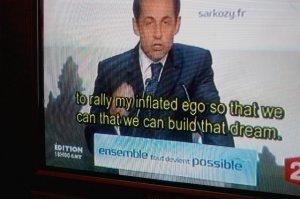
Sarkozy subtitles / Untertitel bei Sarkozy

I’m a bit late on this story of a freelance subtitle translator slipping a joke into the programme (accidentally?)

file_250888_84958.jpg

This was apparently an American freelance and the subtitles were seen in the USA on April 23:

Le 23 avril, un reportage du journal montre un discours de Nicolas Sarkozy. A un moment, le candidat UMP invite les Français à «s’unir à moi». Ce qui, traduit avec un brin de fantaisie en anglais, donne: «rally my inflated ego» («unissez-vous à mon ego surdimensionné»).

English reports here and here.

A top official with France 2 swiftly blamed the gag on American freelance journalists who play with the translations to amuse each other, including this one that managed to surface on television instead of their PC’s.

None of this explains how you can ‘fire’ or ‘sack’ a freelance.

Via Enig

Corrections by customers / Kundenkorrektur

ck’s comment on a recent entry warrants more discussion so I reproduce it here:

Dieser Gedanke “I will be more likely to devise some rules of etiquette and consider how to phrase comments to the author, rather than seguing into a rant about stupid foreigners who think they can write English.” sollte irgendwie standardisiert werden. Zu einem aus dem Deutschen uebersetzten Vertrag machte ich mir kuerzlich diese Gedanken, die gegenueber dem Uebersetzer hoffentlich fair sind:
“Zunaechst ist der englische Text fuer den amerikanischen Juristen sowie Gerichte, Schiedsgerichte und die Geschworenen im Zivilprozess nicht verstaendlich. Das gilt bei einzelnen Passagen ganz besonders, aber im Ergebnis auch fuer den gesamten Vertrag.
Dabei will ich nicht die Uebersetzerarbeit kritisieren. Die amerikanische Juristensprache ist schon fuer Amerikaner schlimm genug. Fast kein Uebersetzer kann bei der Uebersetzung von Begriffen aus einer Sprache in die andere auch die hinter jedem Begriff stehenden Rechtsbedeutungen kennen. Um der rechtlichen Bedeutung jeden Begriffs gerecht zu werden, muesste der Uebersetzer ja auch den Vertrag umschreiben.”
Ist das fair? Wieviel Toleranz haben Uebersetzer fuer die Kommentierung ihrer Arbeit durch Anwaelte? Wenn Anwaelte und Uebersetzer unabhaengig voneinander fuer einen Auftraggeber arbeiten, kann sich die Arbeit verdoppeln. Wenn sie zusammenarbeiten – oder dem Anwalt zumindest mitgeteilt wird, ob der Vertrag von einem Uebersetzer uerbersetzt wurde oder nur einen Versuch darstellt, einen Vertrag auf Englisch zu verfassen -, lassen sich einige Probleme vermeiden.

I can’t have made myself clear. I was referring to corrections of guides to churches and castles, where the correction contains wrong grammar. For instance, I once had my name omitted from a brochure where I had written (rather stiffly) ‘The boot [a bootmaker’s diploma work] has a height of 2 m’ and this was changed by the author into ‘The boot has a high of 2 m’, on the assumption that I couldn’t write English. The example ck refers to, where a lawyer, who may be a German who has lived in the USA for a long time, corrects the translator’s knowledge of English law. That is certainly not what I meant by a native speaker being corrected by a non-native – in fact I don’t see the connection.

So, what does a translator think if a lawyer corrects the translator’s legal English?

I don’t know! My legal English is sometimes corrected by German lawyers. Indeed, I can well imagine that they change whatever they like and don’t report back to me. After all, the translations aren’t often published. And I can’t remember getting a comment on the few occasions when my work was received by an English lawyer.

There surely might be problems. ck is thinking of using terms appropriate for a U.S. lawyer or layperson. I might not have the right ones for an English lawyer or layperson. My translations go to more than one country and not just to native speakers of English. That’s why I was interested in the presentation referred to. If I suddenly started translating regularly for people solely in the England and Wales legal system, I think I would have to be broken in. I would have to be grateful for any correction.

But what do they want? Examples, ck? I have a feeling I would be wanted to translate Rechtsanwalt as solicitor and Kläger as claimant. I am afraid there would be cases where I would not be happy about this. Much as I like to do a lot of what the customer wants, there is a limit to how many specialized vocabularies I can keep apart.

Stadtmuseum Ludwig Erhard opened/eröffnet

The Fürth town museum has moved from Schloss Burgfarnbach to Ottostraße and opened this morning.

20070210fue027w.jpg

Some of the busts of famous Fürthers were more convincing than this one.
The exhibition is Aus den Hinterhöfen zur Weltspitze. It’s not exactly anything to write home about, but then it’s practically next door.

Mysteriously, the odd English translation of a title appeared, even though the text below (a list of crafts and trades, for example) would need to be translated too. Perhaps this was in the spirit of ‘Just so you know what you’re missing’. I thought the following header:

Das Handwerk zu Beginn des Königreichs
Craft At The Beginning Of The Kingdom

(capitalization theirs) perhaps conveyed little. But this is carping. It is a nice museum and some of the permanent exhibits are interesting.

Here’s a pane of the Fürth window at the Germanisches Nationalmuseum – note Fürth skyline, Frau Fürth with clover leaf and Frau Nuremberg (with the town wall round its hat) holding the Adler, the first train in Germany.

20070210fue041w.jpg

LATER NOTE: Zonebattler links to the articles in the local paper, and I see the big exhibition is by the Haus der Bayerischen Geschichte – well, I knew that really, but it sounds as if this is just a temporary state of affairs (the exhibition had some good things, but it was hard to read the texts and there was a heavy sense of boredom about the whole thing, very reminiscent of the exhibition on 200 years of Franconia in Bavaria, which I had the misfortune to see last week. The small Fürth permanent exhibition, on the other hand, was put together in only one month by the new director of archives, Sabine Brenner-Wilczek, after someone else dropped out because of illness. And it’s excellent.

Literary translators continued/Literaturübersetzerstreit

The discussion about the payment of literary translators continues, for example in the Neue Zürcher Zeitung. in an article by Joachim Güntner headed Notwendige Unterbezahlung? This remark strikes me:

Wenn ein gefragter Übersetzer wie Burkhart Kroeber klagt, «wir müssen von etwa 1000 Euro pro Monat leben», dann ruiniert er nicht nur seine eigene Glaubwürdigkeit, sondern die der ganzen Zunft. Zweifellos gibt es Übersetzer in Armut, denen eine bessere Bezahlung von Herzen zu wünschen ist. Aber es riecht aufdringlich nach Propaganda, immer die Unterprivilegierten vorzuschicken, von denen mit gutem Auskommen aber zu schweigen.

The question is: do literary translators really only earn 1,000 euros per month – does this claim deprive them of their credibility?

That’s the trouble with being a disadvantaged minority – no-one believes you!

By the way, some conflicting definitions:

literary translator 1) someone who translates novels, plays, poems, short stories – literature.
2) someone who translates for publishers, not just literature in above sense.

technical translator 1) (older) someone who translates everything except novels, plays, poems, short stories etc.
2) (newer) someone who translates texts about technology, as opposed to a legal translator, finance translator, medical translator etc.

And while I’m at it:
linguist 1) someone who speaks at least one foreign language fairly well
2) someone who studies or teaches linguistics

We’re talking about translators of literature in sense 1) here, which I’m not one of.

Another question raised is whether it’s right for translators to earn more than authors. Most non-translators think that doesn’t sound good.

Finally, a quote from an article in the Süddeutsche Zeitung by Brigitte Grosse, which doesn’t seem to be available online:

Die gestiegenen Kosten beim schwächsten Glied der Kette, den Übersetzern
nämlich, wieder hereinholen zu wollen, ist so unredlich, als würde ein
Manager, der sich verspekuliert hat, das Geld an der Putzfrau einsparen
wollen. Mit einem großen Unterschied: Urheber und Verwerter brauchen
einander, um ihr Metier überhaupt ausüben zu können.

(We don’t need cleaners, of course?)

LATER NOTE: Links, including a radio broadcast from Deutschlandradio Kultur (the strangely renamed Deutschlandradio Berlin), at Text & Blog.