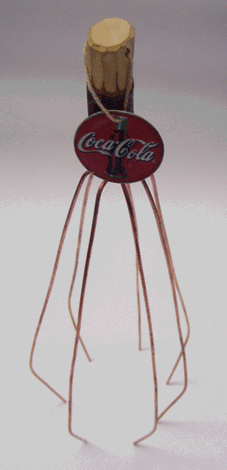
Head massager / Kopfkrauler

Deutsche Sprache schwere Sprache:

Falls Sie der- oder diejenige sind, der die Kopfmassage erhalten möchte, ist das Wichtigste, sich jemanden zu suchen, der Dich krault!
Und vielleicht möchte er oder sie ja auch „kopfgekrault“ werden…
Sitzen Sie sich hierzu aufrecht mit dem Kinn nach unten gerichtet hin.
Der „Masseur“ setzt den Kopfkrauler an Ihrem Hinterkopf an und bewegt ihn (unter Drehen) bis zum Nacken und dann wieder zurück. Mit ein bisschen Übung lässt sich die Massage durch Variieren des Drucks, fließendere Bewegung und Einbeziehen des ganzen Kopfs intensivieren. Für jeden, der „kopfgekrault“ wird, ist es wichtig, die Augen zu schließen und sich zu entspannen.

You can get them to use as a freebie, with your business name on a plaque:

werbung.gif

Vorteile des Kopfkraulers:
• gut gegen Migräne etc.
• entspannende Wirkung bei Parkinson-Patienten
• überwiegend positives Feedback bei geistig behinderten Menschen
• gut bei Kindern vor den Schularbeiten oder vor dem Schlafengehen
• begeisterte Frisör- und Kosmetik-Kundinnen
• Ideal zur Entspannung z.B. auf Arbeit bei Streß
• Anwendung als ergänzende Elemente zu herkömmlichen Massagen
• Ideal zum Verschenken, Partygag, Werbegeschenk etc.

Perhaps I should add that I am not thinking of getting one.

ß and capitals/ß Großschreiben

Das ß sollte abgeschafft werden, wie in der Schweiz – das Problem sieht man in der Überschrift. Es mausert sich aber langsam zum Großbuchstaben, das Versal-ß – siehe Berlin Blawg (mit guten Links) und das praegnanz.de Blog.

The header here shows the problem: the German ß is only a lowercase letter, and when it appears in capitals, it is replaced by SS. So what happens when you use fonts that automatically convert into uppercase? Or small capitals? I didn’t think about this when I set up Movable Type to capitalize the headers, so I usually avoid ß in the heading.

Berlin Blawg has an entry on the gradual appearance of ß as a capital – without a vote, and without even a spelling reform commission.

Apparently the uppercase ß was recognized by the ISO for Unicode at the end of April. Good news for typeface designers.

The ß came from a ligature of two s’s and in my view it should be done away with altogether. Bring back the SS (oh no, we aren’t allowed to say that). But actually, the strongest argument for the uppercase ß is the fact that some people use it in their surnames, so it should be detectable in uppercase as well as lowercase, as Fontblog says:

b

Vor allem nach der Rechtschreibreform hat die Diskussion an Bedeutung gewonnen, weil das scharfe s nach kurzem Vokal generell weggefallen ist (daß/dass) und damit die Aussprache eindeutig definiert ist: das »Ruß« in Stefan Ruß-Mohl spricht sich auch versal gesetzt – RUSS-MOHL – immer noch »Ruhs« aus.

Here, from Wikipedia, is an uppercase ß on the title page of the 1957 Leipzig Duden.
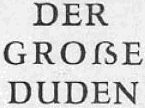
Eszett_Leipziger_Duden_1957.png

LATER NOTE: I see Movable Type automatically converts ß to SS in the header. I don’t think it always did that. Indeed, the triple S was not permitted before the recent German spelling reform. OTOH my Movable Type is prehistoric.


Golf

1. 20070502fue037w.jpg

(Print your own photos on)
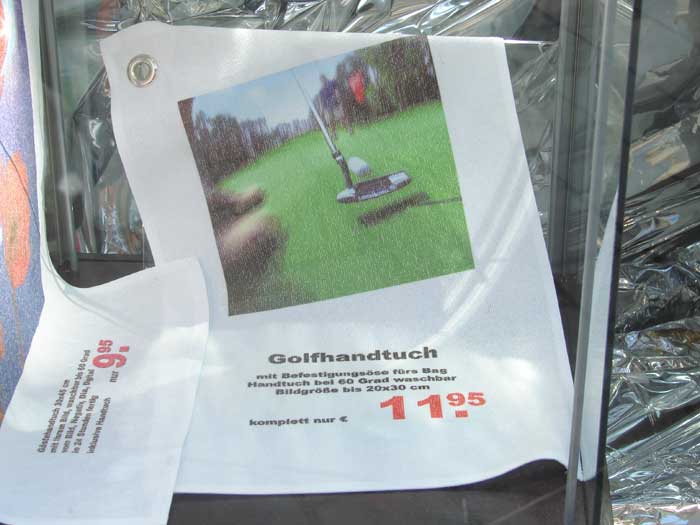
Golfhandtuch
mit Befestigungsöse fürs Bag
Handtuch bei 60 Grad waschbar
Bildgröße bis 20 x 30 cm
Komplett nur EUR 11,95

2. GolfRange Nürnberg

Sommergrüns geöffnet
Sehr geehrte Mitglieder und Gäste,
ab sofort sind die Sommergrüns wieder geöffnet! Trollies sind ebenfalls erlaubt!
Auf Grund des geringen Wachstums besteht die Möglichkeit, dass bei schlechten Wetters die Sommergrüns wieder geschlossen werden.
Vielen Dank für Ihr Verständnis!
Ihr Team der GolfRange Nürnberg

I thought summer greens were something you ate. Or is that spring greens?

LATER NOTE: My attention has been drawn to this poetic description of some holes (apparently regular players were each invited to describe their favourite):

Ein unbeschreibliches Gefühl des Glücks steigt in einem auf, sobald der Abschlag des 10. Loches betreten wird. Der Rundblick, der sich von hier aus auf die Voralbberge und die Täler der Fils, Lauter und des Reichenbaches bietet, gibt jedem ein Gefühl der Weite und Schönheit unserer Heimat.

This is not golf as I remember it, the game where the angrier you got with the ball, the worse your score became, and looking at the view was quite out of the question.

Dog law

I’ve been meaning to write about the Abmahnwelle in Germany, but since I haven’t researched it in depth and there are new examples every day, I don’t get round to it. I did mention it in an earlier entry.

Abmahnen means to send someone a letter before action. For instance, lawyers can do this to people whose Impressum is inadequate. The rules for the Impressum, the legal notice on a weblog that allows the person in charge to be contacted, are similar throughout the EU, I believe, but it’s only in Germany that legislation enables such a wide range of people to sue and collect fees. It’s a source of income for some lawyers to sue on formalities, because they can collect their fees. It’s particularly ridiculous that in order to sue someone for a formal defect in an Impressum, you have to be able to contact them, and the sole purpose of the Impressum is to enable you to contact the webmaster – so the mere fact you are able to take action against them proves the Impressum was doing its job.

Fortunately Larko has written on the topic in English. He says it’s a combination of legislation and some German courts. I had thought it was just the legislation. Here on the Impressum (note the link to the Abmahnwelle blog, in German):

The justice system is also frequently abused by lawyers who choose to sue bloggers and forums as a matter of routine although they could just as well write to the blogger or forum administrator and politely ask them to remove an offensive comment or post. Rather than negotiating in a civilized manner, they promptly sue because they can then charge their fat fees from the person who was sued even if the dispute itself is settled. This sort of dog law approach is so common in Germany that there is a word for it: Abmahnwelle. And believe it or not, a special blog was recently kicked off with the sole purpose of covering lawsuites against bloggers.

Incidentally, I hadn’t encountered the term dog law, but apparently it was coined by Jeremy Bentham with reference to judge-made criminal law:

It is the judges (as we have seen) that make the common law. Do you know how they make it? Just as a man makes laws for his dog. When your dog does anything you want to break him of, you wait till he does it, and then beat him for it. This is the way you make laws for your dog: and this is the way the judges make law for you and me. They won’t tell a man beforehand what it is he should not do – they won’t so much as allow of his being told: they lie by till he has done something which they say he should not have done, and then they hang him for it.

But these German lawyers could not behave in this way if the legislation did not support them.

This term dog law was used in German to refer to the Abmahnwelle by Professor Maximilian Herberger, I learn.

It would be fundamentally unjust to punish someone for violation of the law, if this person did not have a fair chance to know the law beforehand. This would be, as Jeremy Bentham has put it in criticism of his contemporary law, a kind of “dog law”, the point of comparison being that the dog learns about his failures only by being punished. He has (in this view) no chance to know the applicable rules before.

I still think dog law is a bit of a misnomer for the whole phenomenon, since it seems to result from legislation, even if judges and lawyers exploit it in unjust ways.

Every Dog’s Legal Guide here.

I picked up this discussion in RA-Blog, where one of the commentators had strong objections to Larko’s use of the word sue for out-of-court pursuit. I notice I used the word sue above myself loosely. When I wrote that German law allows a wide range of people to sue, that was correct, because even if they have to write a letter before action first, they could still sue afterwards. But it was strictly incorrect to say that German lawyers earn money from suing. They earn money from sending letters before action. I suppose this might be misleading for someone who doesn’t know the German legal system.

Incidentally, the commenter tells Larko that he can find the correct translation of Abmahnung in a dictionary. Obviously an optimist.

Word division and rubbish sorting / (Müll)trennung

RA-Blog regrets the division of the compound word Gelassenheitsdemonstrationsf-loskel.

I thought I’d seen the equivalent in Munich last Friday, but it was obviously deliberate:

20061020mue42w.jpg

I also saw Einkaufst-asche. More examples here – my favourite is Katzens-treu. And there’s a rubbish sorting game that’s a bit less fun than Space Invaders (click beside the three bins).

Chasuble

I was surprised to see a garment in a German fashion catalogue termed ein Chasuble.

An online dictionary says:

Chasuble (sprich schaßübl): Sehr lange Weste, die bis zur Kleiderlänge variiert werden kann.

Well, I was thinking of the English term pronounced somewhat like tSaezjubl. The last time I wore one of these was about forty years ago, when I had the misfortune to be cast as the chaplain in the school’s (all-female) production of the dreadful Christopher Fry play, ‘The Lady’s Not For Burning’ (later made more famous by Mrs Thatcher under a slightly different title). My garb wasn’t as exciting as this, but it was that kind of thing.

When did this term enter the German fashion world – at the same time as body bag?