
Schweitzer International Bookstore

Have I recommended the Schweitzer legal bookshop in Munich before? I’ve only been once and they had an eclectic selection of law books in English in the basement. Don’t know if that’s still the case. More interesting was a list of books, for example German law in English, which I got hold of years ago. What I didn’t realize is that its successor and various materials are now available online.

Schweitzer Fachinformationen

If you click on International Bookstore, you will find a number of links to newsletters, including special editions of newsletters, in the form of PDFs with details on relevant literature:

Spezial-Ausgaben des ILFB-Newsletters /
Newsletter – special edition
ILFB Spezial: Arbitration
ILFB Spezial: Germany
ILFB-Spezial: Contracts – Forms – Drafting
ILFB-Spezial: Insolvency
Sonderheft: International Corporate Reporting
ILFB-Spezial: Intellectual Property
ILFB-Spezial: Securities Law & Regulations
ILFB-Spezial: Joint Ventures & Strategic Alliances
ILFB-Spezial: Estate Planning – Trusts
ILFB-Spezial: Private Equity
ILFB-Spezial: Islamic Business & Finance
ILFB-Spezial: Business Crime
ILFB-Spezial: Company Law Reform Act

The newsletters relate to books on law, economics and tax, and you can subscribe to them.

From the special newsletter on Germany (August 2011), here is a typical book description from page 37 (I have this book by Singh and it looks very good – English texts on administrative law are not so easy to get – but I haven’t got round to mentioning it yet).

German Administrative Law in Common
Law Perspective
Singh, Mahendra P., 2nd edition 2001
ISBN 3540423656, 377 p.
(Springer Verlag)
Hardback,€ 85,55
A thoroughly revised edition of the author’s book on German Administrative Law, first published in 1985. From the perspective of a common law jurisdiction the author presents the basic framework of German administrative law, along the lines administrative law is understood in the English speaking world. It covers all the essential elements of German administrative law. It is updated to include the latest developments and the impact of EC law in different spheres.
Contents:
Nature, Scope, Growth of German Administrative Law. Legislative Powers of the Administration: Delegated Legislation. Administrative Powers: Administrative Act. Administrative Powers: Contracts, Private-Law Acts, Real Acts, and Planning. General Principles of Judicial Review. Judicial Review of Discretionary Powers. Administrative Courts. Judicial Remedies & Procedure. Liability of the Public Authorities. The Basic Law Grundgesetz). Law on Administrative Proceedings of 25 May 1976 (VwVfG). Code of Administrative Court Procedure (VwGO). An Illustrative Judgment.

Great work by Bettina Kube.

There’s a bookshop from the same chain in Nuremberg, but it doesn’t have a brilliant selection on international law. Maybe others do.

The Lost German Slave Girl/Eine Deutsche als Sklavin in Louisiana?

Here is yet another gratuitous book report.

The Lost German Slave Girl. The Extraordinary True Story of Sally Miller and Her Fight for Freedom in Old New Orleans, by John Bailey, Atlantic Monthly Press 2003

This book was a present from my friend and fellow-translator Karen in Denver (thanks, Karen!). I read it quite a few weeks ago, so my report is rather vague now.

John Bailey is an Australian lawyer who has now turned to writing, and he discovered this story when he was researching the details of law relating to slavery in Louisiana. Sally Miller was the ‘lost German slave girl’, who won a case freeing her from slavery because a person who was Caucasian could not be a slave. It’s a fascinating story and it throws some light on the situation of slaves who could not be freed from slavery. There’s also a fair amount about the circumstances in which the Müller family from the Alsace emigrated to the USA, following years of pillaging by French troops, bad harvests and ice in summer (apparently resulting from volcanic eruptions in the West Indies, the Philippines and Indonesia from 1813-1816 – so tonight I will be watching the arte documentary on ‘The year without a summer’).

From an interview with John Bailey:

My plans unraveled, when one day, in the quiet corner of a law library on a university campus in Louisiana, as I struggled to bring some semblance of order to my unruly and ever expanding manuscript, I opened a volume of the Louisiana law reports for 1845. There I met Sally Miller, the Lost German Slave Girl. I was immediately enthralled by her story. By the end of the day, I had shoved my notes on lawyers, judges and politicians into my bag, and opening a fresh page in my diary, had began to jot down ideas for an entirely different project – this one, on the saga of Sally Miller’s bid for freedom.

One feature of the book is that while it cloaks the story in mystery – the witnesses in the trial are obviously long dead – at the same time it often knows exactly what the weather was like or what the main characters were thinking. This is part of the genre ‘bringing history to life’, I think. For a long time I was convinced that I was never going to know anything more about the truth or falsity of the story, but in fact more information was revealed at the end, which made the end of the book more satisfying than I had expected.

A bit of research on the Internet revealed that the story has been told before. Curiously, there is a 2007 American book on the subject, which looks similar to Bailey’s: The two lives of Sally Miller: a Case of Mistaken Racial Identity in Antebellum New Orleans, by Carol Wilson. You can read quite a bit of this on Google Books.

The other most stupid book you read as school reading/Das andere blödeste Buch, das du während der Schulzeit als Lektüre gelesen hast

I know this meme is getting really boring, and I should not go back and repeat an earlier entry, but I forgot I wanted to rant about a long poem, rather than a book, that I think we did for O Level. It was a poem by Gerard Manley Hopkins called The Wreck of the Deutschland.

I never really ‘got’ Gerard Manley Hopkins, but I understood we are suppose to venerate him and recognize his brilliant originality in devising stuff like sprung rhythm. I couldn’t even appreciate this much in short poems.

You can get an impression of this work on youtube nowadays. I must say this brings back all the negative feelings I felt then. Here is the text (beginning – it gets quite long):

To the happy memory of five Franciscan Nuns exiles by the Falk Laws drowned between midnight and morning of Dec. 7th. 1875

PART THE FIRST

1

THOU mastering me
God! giver of breath and bread;
World’s strand, sway of the sea;
Lord of living and dead;
Thou hast bound bones and veins in me, fastened me flesh, 5
And after it almost unmade, what with dread,
Thy doing: and dost thou touch me afresh?
Over again I feel thy finger and find thee.

I didn’t know about the Leytonstone connection, though.

Chris Durban and Eugene Seidel: The Prosperous Translator

I am going to introduce two books by colleagues that have fallen into my hands in recent years. This is not a review, as I haven’t read them all.

The Prosperous Translator – Advice from Fire Ant & Worker Bee is a compilation of the agony aunt and uncle column in Gabe Bokor’s Translation Journal. The authors answer questions from translators and would-be translators. They have been doing this for many years now.

I always thought that the questions were invented by the authors, but I have been firmly told this is not so. I have also been tempted to create a spoof column in this style: I think the format has a lot of potential.

The book has a website. You can buy it from lulu.com or from amazon (the latter probably gives the authors less royalties).

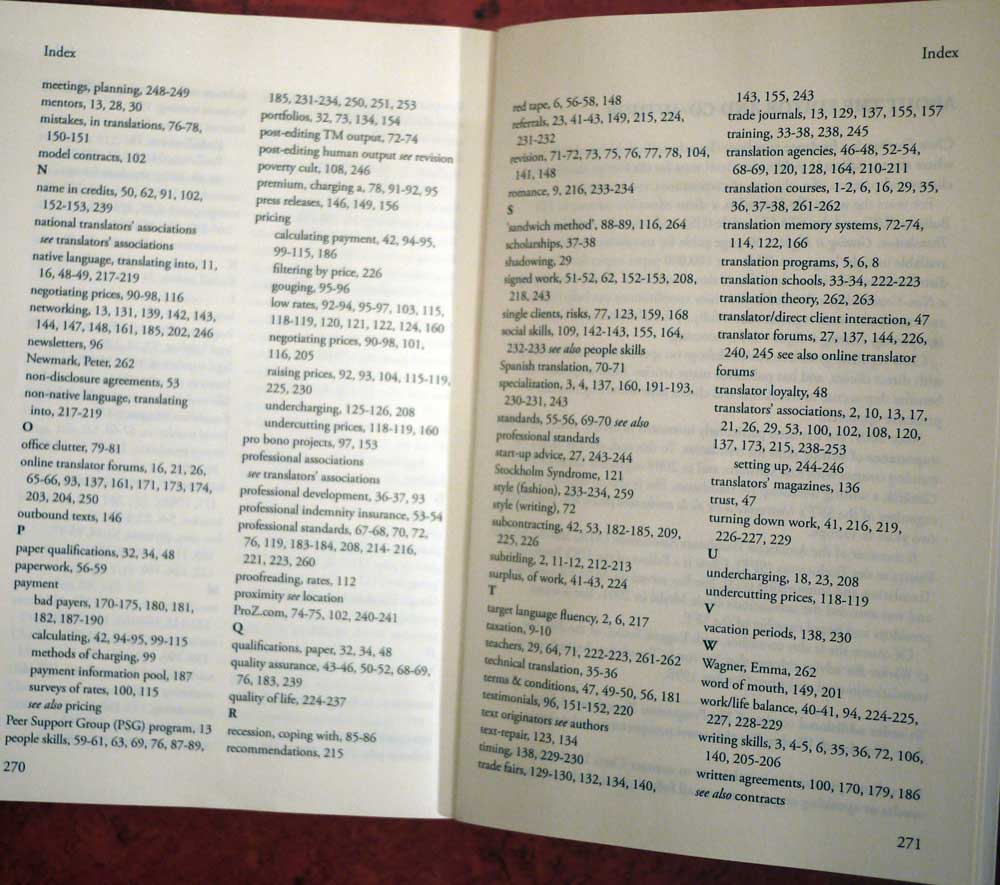
What I find very interesting is the classification into topics and the index (Chris told me the index was done by a professional indexer). This makes the information more accessible.

It wasn’t very easy to photograph that. I toyed with tearing a page out and scanning it (can’t be bothered to reinstall my flatbed scanner), but the pages seem very hard to tear out – a mark of quality – so I left it in.

Thus there are a number of queries on legal translation now collected together, as one sub-chapter of ‘8: Specializing’ (by the way, I find the spelling of -ise/-ize words inconsistent). Other main chapters: Is this a real option for me? – Getting started – Doing the job – Client/cupplier relations – Pricing and value – Marketing and finding clients – Pamynet issues – Ethics – Quality of life – Professional associations – Kitchen sink.

I lingered just now on an entry where the asker is caught off guard by a client dropping in and wonders what to do about the clutter. You can read this – any many more – at the Translation Journal site.

Dear Fire Ant & Worker Bee,

I am a freelance translator with an office in my home and a reasonably successful business serving clients in the UK and the Netherlands. The other day I was caught off guard when a client phoned me out of the blue and insisted on dropping in to review a text in person (he happened to be in the neighbourhood, and the text was urgent).

It was a chastening experience—not for the text itself and our discussion, which went very well, but because my office is a shambles, with papers papers papers and files files files as far as the eye can see. I will spare you the details, but from the look on this man’s face as he crossed the threshold, I don’t think my frantic hoovering accomplished much. …

Litter Bug

A:

Dear Bug,

…
Successful techniques we have observed firsthand depend on the size of your office, the size of the cluttered patch, and advance notice.
…

we have five suggestions (note that for options 3 to 5, you will have to buy in supplies in advance):

1. Square Up the Corners: somehow piles of papers that are carefully stacked look infinitely neater than those in haystack format.
2. Strategic Lighting: carefully targeted, this can be a big help, depending on the time of day.
3. The Green Plant/Colorful Bouquet: a strategically placed giant green plant or bouquet may divert the visitor’s eye temporarily.
4. Archives In Transit: a store of packing cases folded behind a bookcase will serve you in good stead. Should a client-intruder’s call alert you to an impending visit, whip these out and place all extraneous documents/papers inside. Tape shut and stack neatly as per Square Up the Corners (above). Explain briefly to your visitor that your archives have just been transferred in from storage or are on their way out.
5. Emergency Tape: in extreme cases—and depending on the layout of your office—you might consider taping off the cluttered area with that striped fluorescent tape they use to mark out danger areas on construction sites. Explain briefly to your visitor that there was a burglary the previous night and the police have instructed you to leave everything as is until they can get over for fingerprinting. (Let us know how this one works, OK ?). The tape can be found in most hardware stores.

FA & WB

Comments have been closed on this post.

Ferdinand von Schirach

Ferdinand von Schirach (grandson of Baldur) is a criminal defence attorney who has now published two books of stories about his clients which have topped the best-seller lists, are being filmed and translated.

The first book was Verbrechen (August 2009). I got it as a birthday present this year. I thought it was wonderful. The stories are based on real cases, but mixed up so the characters can’t be identified. Schirach uses a minimalist style. In a German interview (FAZ), he says that most crime novelists never experience a crime, so they sit in cafés and fill their books with descriptions.

Die meisten Leute, die Krimis schreiben, erleben keine Krimis, sondern sitzen in Prenzlauer Berg bei einem Cappuccino und denken sich die Welt aus. Deswegen müssen sie sehr ausführlich beschreiben, wie jemand mit Messer und Gabel gegessen hat, dass die Tischdecke ausgefranst war, dass der Himmel sich zuzuziehen begann . . . Ich hab’ da einfach Glück. Ich hab’ einfach diese Geschichten und kann die dann auch relativ kurz schreiben.

The second book was Schuld (August 2010), which I borrowed a few weeks ago. This time I was disappointed. The book lender thought these must be the stories which were rejected for the first book. I thought Schirach might be indulging himself following his success on the market.

The first book told the stories in a minimalist style. The second one seemed to me as if someone had taken a haiku and spoilt it with emotions and the author’s opinions.

Denis Scheck said the books are OK but they are not really literature, and their only real appeal is that they appear to reflect ‘reality’ (I quote from memory, and hope I am not distorting it).

Take the end of the first story in Schuld:

Nach der Haftprüfung gingen mein Studienfreund und ich zum Bahnhof. Wir hätten über den Sieg der Verteidigung sprechen können oder über den Rhein neben den Gleisen oder über irgendetwas. Aber wir saßen auf der hölzernen Bank, von der die Farbe abblätterte, und keiner wollte etwas sagen. Wir wussten, dass wir unsere Unschuld verloren hatten und dass das keine Rolle spielte. Wir schwiegen auch noch im Zug in unseren neuen Anzügen neben den kaum benutzten Aktentaschen, und während wir nach Hause fuhren, dachte wir an das Mädchen und die ordentlichen Männer und sahen uns nicht an. Wir waren erwachsen geworden, und als wir ausstiegen, wussten wir, dass die Dinge nie wieder einfach sein würden.

This goes too far for me. There is more of this in this second book, but some in the first too. I reread that, and I still love the story of the two neo-Nazis in the station (Notwehr).

In an interview in New Books in German, Schirach described his technique of mixing stories:

The essence of each story is true. You have to imagine it as one of those beautiful old printers’ typesetting cases. When you have been a Criminal Defence Lawyer your whole life, then you have quite a stock of typesetting cases full of people, events and little episodes. And I then put these together anew for a story. The only thing that I don’t change is the basic tone of a case, the motive, the atmosphere.

Of course, we are spoilt for simple and thought-provoking stories of crime by some German lawyers’ weblogs, such as law blog and Strafprozesse und andere Ungereimtheiten.

Thanks to Katy Derbyshire for the link to New Books in German.