
Schichttorte – Baumkuchen – Baumstriezel

I was mystified by the German Schichttorte in the Great British Bakeoff programme, but then I realized they meant Baumkuchen.

I think the word Schichttorte is a misnomer. Any cake with layers is a Schichttorte, and it will usually have buttercream between the layers, like an opera cake. Whereas the cake they showed consisted simply of twenty layers of sponge cake, each grilled separately as they were built up, with no filling but with a coating.

The programme did show a real Baumkuchen being made: the cake mixture is dripped onto a sort of metal spit revolving on a grill. Here are pictures from the LA Times. you can buy one from the German Bakery in Windsor.

The cake in the program was grilled layer by layer in a cake tin, but it was still a Baumkuchen in structure, although the layers run in a different direction.

By chance I am more familiar with the Transylvanian Baumstriezel. It is also made on a rotating tube, but the pastry contains yeast and it is covered with caramelized sugar. It is apparently the Hungarian Kürtőskalács.

Meanwhile, the Japanese besieged Qingdao in World War I and thus inadvertently introduced a Baumkuchen maker to Japan.

Baumkuchen is one of the most popular pastries in Japan, where it is called baumukūhen (バウムクーヘン?). It is a popular return present in Japan for wedding guests because of its typical ring shape.[6]

It was first introduced to Japan by the German Karl Joseph Wilhelm Juchheim. Juchheim was in the Chinese city of Tsingtao during World War I when Britain and Japan laid siege to Tsingtao. He and his wife were then interned at Okinawa.[7] Juchheim started making and selling the traditional confection at a German exhibition in Hiroshima in 1919. After the war, he chose to remain in Japan. Continued success allowed him to move to Yokohama and open a bakery, but its destruction in the 1923 Great Kantō earthquake caused him to move his operations to Kobe, where he stayed until the end of World War II. Some years later, his wife returned to help a Japanese company open a chain of bakeries under the Juchheim name that further helped spread baumkuchen’s popularity in Japan.
Norma goes British

Norma, one of the less interesting competitors of Aldi and Lidl, is offering British food from Monday October 6.

That food consists of Cadbury’s chocolate fingers and Chivers jams and marmalade. A bit thin. It won’t satisfy the commenters who sometimes visit my post on Lidl’s British specialities and lust for more.

However, I saw recently that you can use the chocolate fingers to make a dreadful hedgehog cake.

(Thanks to Barbara in Regensburg)

Quark as a superfood/Völliger Quark

I’m glad we can call Quark quark now, which does away with the problem of ‘translating’ it as curd cheese or cottage-cheese-without-the-lumps (Hüttenkäse!), almost as dreadful as the problems of translating Zwetschgen.

The Daily Mail is today touting it as a superfood:

Rise of the soft cheese that can help you lose weight: Sales of ‘superfood’ quark rocket 40% in a year

It’s every dieter’s dream: the cheese that could actually help you shave off those extra pounds.
Sales of quark – a soft cheese that’s virtually fat free – have rocketed by 37.9 per cent in the last year.
Health-conscious Britons forked out a staggering £8.5million for the ingredient, a jump of £2.3million from the previous year.

I am mystified by the term ‘virtually fat free’. That sounds like low-fat quark to me, the stuff I refuse to eat but have accepted, if reluctantly, as a poultice (Quarkwickel sounds like a sort of samosa but isn’t).

But it looks as if Lake District Quark don’t do anything but low-fat quark. They call it ‘naturally fat-free’. They must have got hold of some fat-free cows. And Jennifer Lopez and Carole Middleton are apparently fans.

What makes Lake District Dairy Co. Quark, different from other Quarks?

If consumers are familiar with European Quark, they will notice a distinct difference with our British Lake District Dairy Co. Quark as it is noticeably smoother in texture and more spoonable making it more versatile and perfect for cooking, baking and mixing.

As the Germans would say, that’s a load of Quark (das ist doch völliger Quark!).

Südmilch, for instace, sell it in qualities from low-fat to 40° Fett in der Trockenmasse (fat in dry matter).

Es gibt ihn in verschiedenen Fettstufen von mager bis hin zu 40% Fett i.Tr. Egal ob pur oder mit Joghurt zu frischem Obst, für Desserts oder mit frischen Kräutern zu Kartoffeln: Der Südmilch Speisequark ist immer ein Genuss.

I think quark desserts may be a good way of getting some people to eat more protein. We can get French soft cheese desserts now, but they seem only to be produced in child-size containers.

If you’re keen to get quark in the UK other than low-fat quark, it looks difficult. German Deli has a certain amount, but not only is it Milram Frühlingsquark, which means it’s mixed with herbs and stuff, but it’s described as containing ‘skimmed quark’, and Aldi also apparently has a fat-free version.

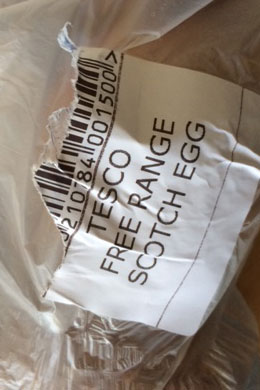
Free-range Scotch eggs

I am surely not the first person to wonder how far free-range eggs (Eier aus Freilandhaltung) actually range.

See Down with free-range chickens! Up with free-range eggs! (quoting Thomas More):

They breed an infinite multitude of chickens in a very curious manner; for the hens do not sit and hatch them, but a vast number of eggs are laid in a gentle and equal heat in order to be hatched, and they are no sooner out of the shell, and able to stir about, but they seem to consider those that feed them as their mothers, and follow them as other chickens do the hen that hatched them.

I don’t think More foresaw these:

scotchegg

It seems you can also get free-range pickled eggs, albeit from England – but after today’s referendum that might be necessary.

German foodie treats

Nine German treats you’ll want to eat right now

says The Local. Well, I think they could learn a thing or two about food photography here.

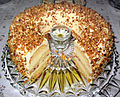
I don’t think they could find a Frankfurter Kranz so they had to bake one quickly (from a packet mix perhaps?). It is a traditional German cake, but I would have thought not so common now.

But no! They took the photo from Wikipedia!

120px-Frankfurter_kranz_hg

The plum tray bake is maybe not quite in season yet?

Much better photos on delicious:days, albeit the English is weird:

Tell me, what is the very first thing you think of, when you see or hear the word “woodruff”? Probably the same I connect it with, a pretty nasty green color. For sure if you grew up in the 70s and 80s.

Hmm. That might be what I think when I hear the German word Waldmeister.

Copyright and cupcakes

It seems that Lola’s Cupcakes have stolen Ms Marmite Lover’s (Kerstin Rodgers) recipe for marmite cupcakes – that is, they’ve taken bits of text (you can’t copyright the ingredients) and messed up the instructions.

The comments are sometimes rather silly or downright rude. But I don’t understand why she doesn’t go to a lawyer but is waiting for Lola’s to do the right thing. I think she needs some damages and not just a donation to charity.

MsMarmiteLover writes:

You cannot copyright, for instance, a classic recipe such as a Victoria sponge or a recipe for hummus.

Perhaps that’s unfortunate when one reads that Konditor and Cook recommend adding extra egg yolk and crème fraiche to a ‘Victoria sponge’ – that doesn’t sound very German to me. From The Spectator:

Konditor and Cook (Ebury, £20, Spectator Bookshop, £18) is the book of an Anglo-German cake shop, which, given the excellence of German cakes, is oddly rare on the scene here. Gerhard Jenne is notable for his quirky decorations and humorous take on fondant fancies and you get a fair share of jolly stuff here, but there are also things like plum streusel in the German fashion. It’s all delicious, but I should warn you that some of the cake bases are quite dense, the cooking times aren’t always geared to domestic ovens and there’s a variation on a Victoria sponge (extra egg yolk, added crème fraiche) which comes squarely into the category of gilded lilies.

Meanwhile, Time Out recommends London’s best German bakeries, Victoria sponge hin oder her.

Thanks to Trevor as usual.