
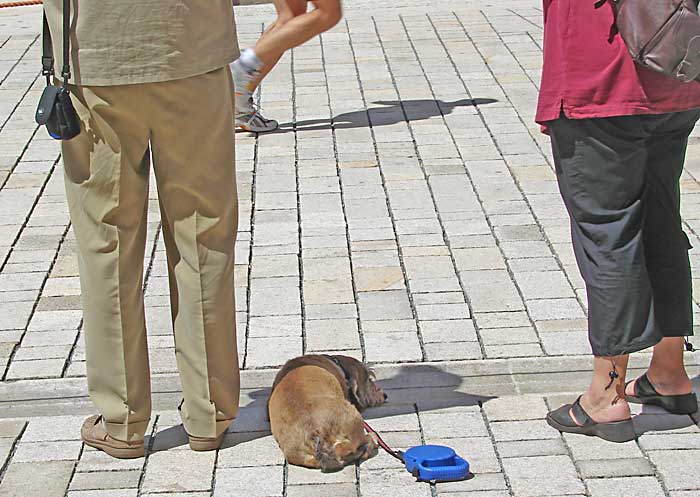
Stadtpark, Fürth

Stadtpark, Fürth
Helen Pidd writes in The Guardian on the interesting subject of what the Chinese, Indians and Italians regard as exotic food. I was interested in the sticky dried Xinjiang fruitcake sold in Peking. Googling took me to the horse’s mouth, the eGullet Forums:
Jun 14 2007, 03:35 AM
Hi everyone
Helen Pidd here. I’m a journalist with the Guardian in London (www.guardian.co.uk). I’m writing a feature about what “foreign” foods are most popular in various countries in the world (eg in Britain we eat Indian, in India they eat Chinese, in Russia they eat Georgian…) and wondered whether anyone in China would be able to help me.
I’m just looking for a China-based, and ideally Chinese, foodie to talk to me about what sort of food Chinese people eat when they go out. Obviously it’s a huge country and tastes will vary, but I’m interested to hear anything you have to offer.
My deadline is the end of Friday 14th June, so any responses very welcome before then.
You can read all the answers she got here, not just the ones quoted (and attributed) in the Guardian article. Her query on Indian food was less successful – no replies.
It looks as if Helen Pridd’s deadlines are even tighter than mine. Still, I was one of the people who missed the episode of Goodness Gracious Me where Indians ‘go for an English’:
A group of drunk Indians decide to go for an “English” at the end of an evening’s drinking in Mumbai. One demands “the blandest thing on the menu”, the women cluck over the waiter’s “lovely pasty skin” and the head of the table orders 24 plates of chips, ignoring well-meaning advice that “you might have ordered too much”.
I found more about the ‘fruit cake’ in a blog search. at Loaf of Bread Car by Eveline, who lives in Beijing:
Anyway there are always all these Uighers in front of the mosque, on flatbed tricycle thingys with a huge tray of this fruitcake stuff that they sell. The fruitcake is really good. It’s not cakey at all but someone called it fruitcake in a book I read so I’m sticking to that name. It’s like, a really densely pressed together concoction of sunflower seeds ‘n’ peanuts ‘n’ nuts ‘n’ dried fruit, held together with something sweet & sticky, maybe honey. & then they stud the whole shebang with rows of walnuts & some sort of red fruit, maybe haw berries (?), so it looks really pretty.
A new police radio system called Airwave has been introduced in the UK, and in connection with this it was reported at the weekend that police are to be taught to use a set of expressions that are uniform throughout the country.
Mark Garner of Aberdeen University, David Matthews from Edinburgh and Edward Johnson of Cambridge University have analysed an hour of police radio talk from every police force in the UK. This was news to me, but it’s been reported a number of times since at least December 2005.
[They] found officers used 50 different words and phrases just to say “yes”, including “aye”, “yeah”, “OK”, “wilco”, “will do”, “right”, “alright”, “go ahead”, “excellent”, “thank you”, and “affirmative”.
Officers will be asked to restrict themselves to just three standard terms: “Received” for “I have understood you”; “Yes, yes” for “I agree”, and “Will do” for “I shall carry out the task”.
Johnson said: “Countless operational errors over the years have resulted from inappropriate communications provision, inappropriate procedures and poorly worded messages. Many lives have been sacrificed in the process.
I was worried myself about all the deaths resulting from English and Scottish police failing to communicate. But a talk by Edward Johnson, ‘Talking Across Frontiers’, explains it better:
It is doubtful that The Light Brigade would have charged at Balaclava in 1854 had Raglans command which prompted it been worded differently (Woodham-Smith 2000). The Tenerife air crash of 1977 may not have occurred had the air traffic control messages been clear (Hawkins 1987). The lives of an entire diving crew may not have been lost in the North Sea in 1983 (Godden 1983) had not the message You can talk about overtime when youve made the clamp been mistakenly interpreted as an instruction to open a pressure lock.
The commenters at Scotland on Sunday took a narrow view of things, possibly as a result of inability to read. Others wanted English police to learn Scots. Jim A, more pertinently, wrote, ‘Me, ma talkin’s jist fine, it’s the rest o the buggers, no me’.
Edward Johnson’s paper linked above has lists of examples of radio talk and texting. It also discusses cross-border police communication (French/ English, German/Polish). In One six a sierra sierra bravo golf one six two’ ‘there is conflict between the NATO alphabet – alpha, bravo, charlie, etc., and the brand names of motor cars – Sierra, Golf, Alpha Romeo, Bravo.’
I had a book on learning Scots last year. It was the only language book I remember seeing that advised me not to try out my new knowledge in the country itself. There’s some good stuff online too, here texts and audiofiles, and look inside a Scots dictionary here.
Here’s an entry I never got round to publishing, because I didn’t get round to investigating the German situation.
Under the heading Taking no shit from judges, Mark Liberman at Language Log recently took up the topic of how judges express themselves when they need to quote words like shit and fuck.
He quotes an article in the New York Times on the decision of the U.S. Court of Appeals of the Second Circuit that fleeting expletives are OK on TV, but I couldnt tell whether the following euphemisms came from the court or the journalist. I was also surprised that there was a reference to circuit-court judges – was this an appeal from a circuit court? It looks to me as if well have to wait for the opinion to be published to see what was actually said.
Adopting an argument made by lawyers for NBC, the judges then cited examples in which Mr. Bush and Mr. Cheney had used the same language that would be penalized under the policy. Mr. Bush was caught on videotape last July using a common vulgarity that the commission finds objectionable in a conversation with Prime Minister Tony Blair of Britain. Three years ago, Mr. Cheney was widely reported to have muttered an angry obscene version of get lost to Senator Patrick Leahy on the floor of the United States Senate.
I notice that some feeds head this report H0ly Sh17, a new combination of characters for me.
I did some research in English reports. Its easy to search the Court of Appeal decisions at BAILII. I looked at the civil cases, but some of those are appeals relating to criminal offences. I had the impression that in cases where the police are involved, its impossible to quote the larger British public verbatim today without using these words. When they are quoted in other contexts, I found cases where the word was quoted, but accompanied by an apology. Heres a House of Lords debate (the parliament chamber, not the court):
Perhaps in relation to the discretionary law, I may instance what happened to me yesterday. As I was walking out of Charing Cross Underground into the little linear path nearby, which noble Lords will know, there was a young adult urinating quite openly against the gates leading into the park. I made the remark, “That’s going to leave a nasty smell.”, and he said, “Fuck you.”. I am sorry to use the word in this House, but it happens to be the commonest single word in the vocabulary of that age group, I fear. That was his response. I believe that he said it, first, out of shock that anyone should even take note of the act and, secondly, out of a kind of indignation that anyone should interfere with what he undoubtedly considered to be a perfectly reasonable and proper act. Therefore, I must confess to a certain disappointment that, yet again, we are in the process of deluding ourselves and the public that we shall achieve anything in a measure covering 63 pages of new law relating to anti-social behaviour. But I would love to think that we might.
Lord Phillips of Sudbury
And here is a Court of Appeal civil case. The applicant received bad medical treatment on one occasion and on this basis refused to pay an invoice (which his insurance company would have met) for a longer period of time – a man of principle, but perhaps his hospital memories were retroactively coloured by the one occasion:
In the apparently colourful language of the evening, Mr Holcroft told this young doctor to “fuck off” and that he would rather die of renal failure than be murdered by his ill treatment. It was dramatic, perhaps overstating, but not uncharacteristic of the man whose company I have enjoyed over the last three quarters of an hour. The result was that Mr Holcroft was totally dissatisfied, and this is the important point with which he must begin to grapple, not only with the treatment meted out to him on that evening but also dissatisfied with the whole of the treatment he had received during the whole of the duration he was in the hospital’s care. He accordingly refused to sign any certificate of satisfaction with that treatment and, although he had the benefit of the Norwich insurance, he refused to pass the bill to the Norwich Union, but determined to show up the hospital for the bunch of incompetents that he now believes they are.
The population of Fürth transfixed by the 1000th-anniversary marathon. And also the half-marathon:
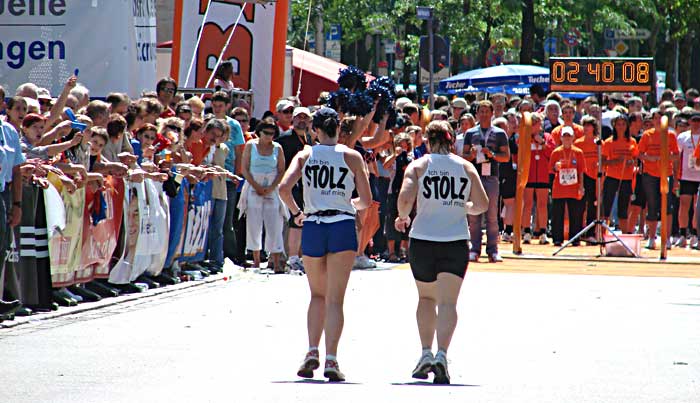

Added later (see comments):

The list of winners shows these are Wolfgang Vogt (born 1959) from Düsseldorf fire brigade and Andreas Engelhardt (born 1981) from Fürth fire brigade, who finished 94th and 90th respectively. Both took about 3:15 hours for the course. There were 1407 runners and the last one took 6:32 hours. Photo taken at 11:36.
Letter from a firm that works with amazon.de:
Sehr geehrte Margaret Marks,
vielen Dank für Ihre E-Mail.
Der voraussichtliche Liefertermin für die von Ihnen bestellte Ware in unserem Hause wird der 736-0098127-8790569 sein. Wir bitten noch um etwas Geduld.
Sobald die Ware in unserem Hauptlager eingeht, wird sie auf dem schnellsten Wege in den Versand gegeben. Natürlich erhalten Sie hierüber wie gewohnt eine Versandbestätigung.
Bei weiteren Fragen stehen wir Ihnen gerne zur Verfügung.
Mit freundlichem Gruß
Reply:
Sehr geehrte Frau XXX,
danke für die Antwort.
Muss ich mich wirklich bis zum 736-0098127-8790569 gedulden? Es kommt mir sehr lange vor.
Mit freundlichen Grüßen
Margaret Marks
Reply:
Sehr geehrte Margaret Marks,
vielen Dank für Ihre E-Mail.
Das stimmt, das ist eine sehr lange Zeit. Sorry, so sollte das eigentlich da gar nicht stehen, da hat der Fehlerteufel zugeschlagen. Gemeint war: 26.06.2007 – 28.06.2007
Bei weiteren Fragen stehen wir Ihnen gerne zur Verfügung.
Mit freundlichem Gruß
Here we see the Fehlerteufel, which can more or less only zuschlagen in German, and the German usage of Sorry, which must have some cachet.