On Cobwebs of Petty Inquisitiveness I read that when you see a Shakespeare quotation in someone else’s blog, you have to post one in yours.
Here’s mine:
Lady Macbeth: What, in our house?
Macbeth, Act 2 scene 3

On Cobwebs of Petty Inquisitiveness I read that when you see a Shakespeare quotation in someone else’s blog, you have to post one in yours.
Here’s mine:
Lady Macbeth: What, in our house?
Macbeth, Act 2 scene 3
The various uses of the word counsel are confusing enough to those new to common-law countries without Allen & Overy creating a new definition.
In England and Wales, counsel means a barrister (two counsel – no s on the plural – means two barristers). In the USA too, the term applies to a lawyer in court. But the words of counsel after a lawyer’s name mean something different: that the lawyer is a consultant to the firm, for example, or assisted in a matter without being the main lawyer in the case.
But at Allen & Overy, according to RollOnFriday:
The track to partnership stays the same, but an alternative role of “counsel” will be available to a very limited number of senior associates. They can expect to earn between £150,000 and £230,000 basic, again with a bonus of up to £50,000 on top.
Another term new to me is PSL or professional support lawyer. Here is a definition from the mysteriously named British Law site:
The role of Professional Support Lawyer (PSL) was established more than 10 years ago and utilised the skills of lawyers looking for reduced hours (often female lawyers). Support work is now a career in its own right, and PSL’s may even achieve partnership in law firms. Most PSL’s play a part in a firm-wide support function, while others join specialist departments such as corporate and commercial property. New areas of work now include support for IT projects.
Thomas Klotz of RA-Blog has offered me a meme, so here goes, before it’s too late.
Was bedeutet Ostern für dich?
Nichts besonderes. Ich darf nicht vergessen, dass Ostern ein wichtigeres Fest für Christen als Weihnachten ist.
Feierst du Ostern bei dir zu Hause?
Feiern nicht direkt. Ich muss arbeiten, es gibt auch keine störenden Anrufe von Kunden. Ich übersetze einen Domführer, also da ist schon etwas Religiöses. Ich habe vergessen, den Papst im Fernsehen zu schauen, tue das aber manchmal.
Was gibt es an den Feiertagen zu essen?
Nichts besonderes. Ich habe am Karfreitag Lachs gegessen, eine schlechte Idee, weil es das letzte Stück Lachs in Fürth war und Dill war überall ausverkauft.
Versteckst du noch Osternester?
Was heißt hier ‘noch’? Ich habe noch nie im Leben ein Osternest versteckt. Ich weiß auch nicht genau, was ein Osternest ist.
Bemalst du selbst die Eier?
Niemand bemalt hier Eier.
Welche Technik verwendest du?
Wofür?
Hast du eine bestimmte Osterhasen-Schokoladen-Marke?
Eventuell Gubor, die waren aber alle weg.
Wer macht das Osterfrühstück?
Ich, natürlich.
Bekommen die Kinder noch etwas anderes geschenkt außer Süßes?
Wenn es welche gäbe, nein.
Hältst du Fastentage?
Nein.
stud.iur. Martin Malkus links to three German students’ law journals – written by students in the American law review style – available online, one from Hamburg, one from Bremen and one from Freiburg. Some of the articles are in English. (Unfortunately, some – but not all – articles on German law written in English are very hard to read because the author or translator has not found a natural English sentence flow. English versions of academic articles are a real problem, and professional translation is not feasible in view of the amount of research that would sometimes be needed).
For obvious reasons, I’ve been trying to remember Brumas’s name. I remember going to see him when he was the most famous animal in Britain. I didn’t realize he was female, though.
Brumas: Brumas was the first Polar Bear to be born at the ZSL London Zoo (1949?). “He” was said to be a male, but it was later confirmed that she was in fact a female. However, the public was not informed of this “sex-change” for several months. Brumas was named after the two keepers, BRUce and SAM. Attendance at the zoo soared as a result of “his” appearance, and in his first year reached 3,000,000a figure that has yet to be topped.
I was disappointed when I heard this fountain is to be moved a few hundred metres down the road, ostensibly to show it off better and to make this part of the pedestrian zone more beautiful, but really, I suspect, in order to stop the hoi polloi from sitting around it in the middle of the seating belonging to the Italian restaurant and ice-cream parlour. Still, I had to accept it when I saw the place already prepared for it. I then looked forward to getting a picture of it being transported through the air, rather like the scene in Goodbye Lenin.
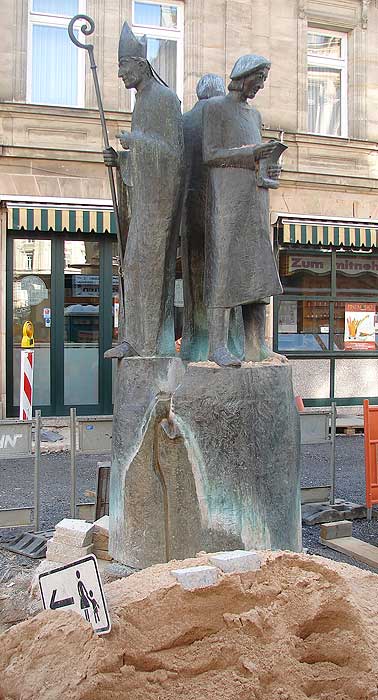
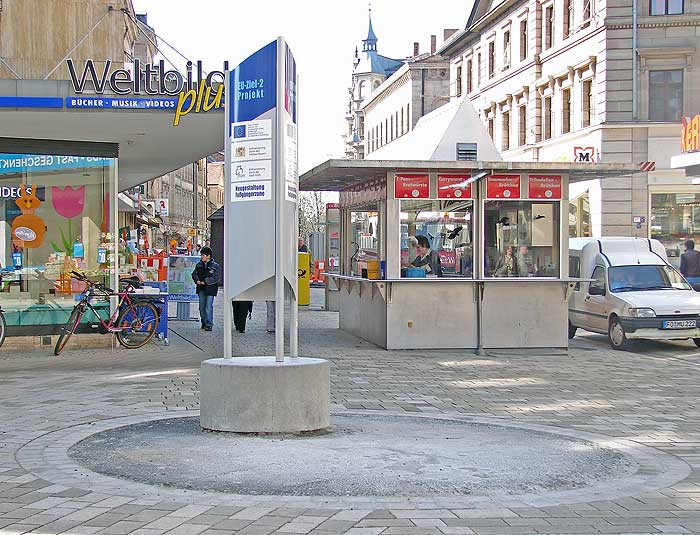
But now the Fürther Nachrichten reports that the fountain will have to stay where it is. No-one wants to move it next to the Bratwurst stand, which apparently was intended to go but which has an option of extending its lease for another ten years.
They’ve already spent 8,000 euros on making the water available at the new site, but now they say it may be used in future for another fountain there.
The figures of the three rulers of Fürth are a bit soppy. but it’s quite a good fountain, not in the class of the Centaurenbrunnen in front of the station, but much superior to the monstrosity on the Grüner Markt.
