
I am rather late to the party on this.

I am rather late to the party on this.
According to a dpa report I’ve only seen in English, at Expatica, a German lawyer is suing a German state, Bavaria I presume, for interfering with his constitutional right to enjoy nature:
Munich (dpa) – A lawyer has sued a German state on behalf of a dead bear, a spokesman for a tribunal in Munich said Friday, four months after Bruno the badly behaved bruin was shot.
The lawyer argues it was illegal to declare open season on Bruno, an Italian-born animal that was the first wild bear to roam Bavaria state for 170 years. Officials said it was likely to attack people.
…The lawyer, acting in his own name, is trying a different tack, suing at a tribunal that reviews administrative decisions and citing his constitutional right to enjoy the fruits of nature. The case could take several months to decide, the spokesman said in Munich.
I presume that by tribunal they mean an administrative court, the Verwaltungsgericht. Just because we don’t have administrative courts in England, I don’t see it as a reason to downgrade the German ones in translation!
By the way, Expatica has some interviews with people working in Germany: an English teacher, a journalist, and someone in the NGO sector.
These are very old photos of my desk – over ten years old. I was translating a church guide with very few references.
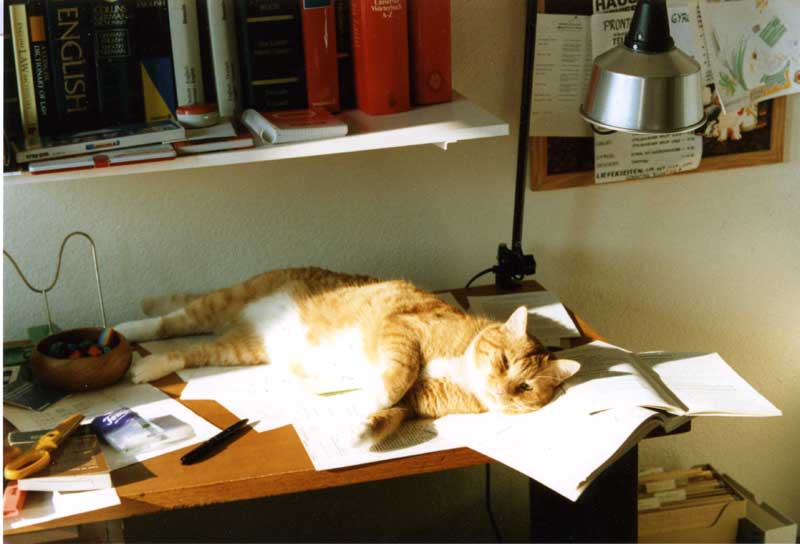
The picture on the medieval monitor below shows that the office assistant had kindly inserted quite a lot of tab stops.

Signs on the autobahns in Germany like Medizin- und Universitätsstadt Erlangen or Fränkisches Seenland are called Unterrichtungstafeln. Fürth will be getting one of these along the lines of Denkmalstadt Fürth: the city of listed buildings.
But a few unlisted buildings have been sneaked in. The electronics chain Saturn (‘shoebox architecture’ according to the Stadtheimatpfleger Dr. Alexander Mayer) is coming, despite the heroic stand of a law firm who have long leases on four parking spaces around which Saturn is having to build.
The Zonebattler refers to the latest excitement. Here is the drawing (picture pinched from Fürther Nachrichten, but it isn’t originally theirs afaik):

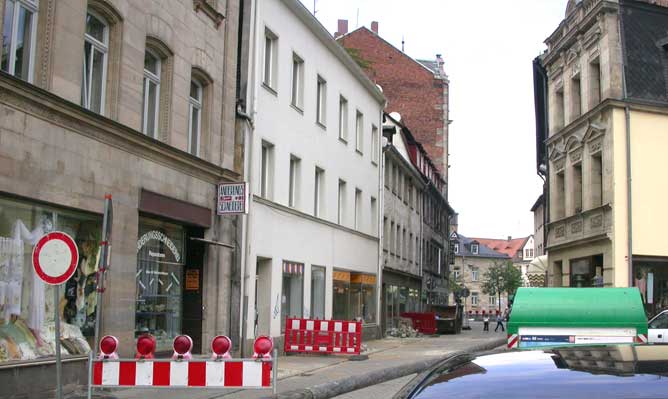
It may well be that at least at ground level it doesn’t look so bad, but I find it amazing that the Oberbürgermeister calls the demolished buildings ein Schandfleck (an eyesore, but the German term sounds even more derogatory). There’s a photograph of these harmless, unlisted buildings here, and here’s one I took in August:
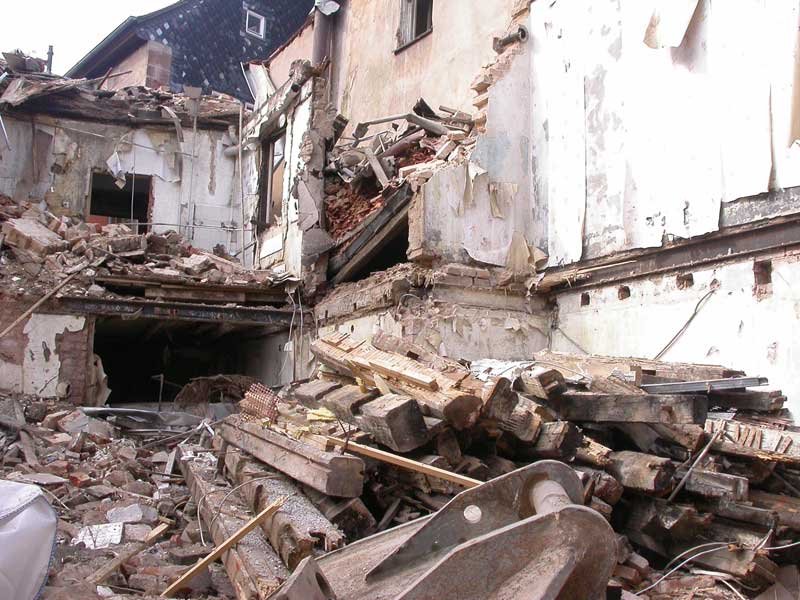
It may be that the eyesore was what the public couldn’t see – behind the façade:
Petitions against the building can be signed in the Ganesha shop opposite (Ludwig-Erhard-Straße). They are merely symbolic as protests should apparently have been made earlier.
(Thanks to Ralph for the tipoff).
Multibabel.
Babelizing means machine translating a text into one language, then back into English, then into another language, then back into English, and so on, until the meaning has been wrung out of it. I hadn’t actually tried it before but here it is:
Original text:
Come round any old time, make yourself at home. Put your feet on the mantelshelf, open the cupboard and help yourself.
Babelized version:
Come around at any time old, dice to form it he it house. If its feet
regulated in mantelshelf, to open the drawer and helped them.
Original text:
Einstein can’t be classed as witless.
He claimed atoms were the littlest.
When you did a bit of splitting-em-ness
Frighten everybody shitless.
(From Ian Dury, There ain’t half been some clever bastards)
Babelized version:
Einstein cannot be classified as stupid. It declared atoms was the
minor. When you it gave form to a small conclusion of the copiatura
of, the sustentation frightens shitless everything.
(Thanks to Ekkehard)
The Mail on Sunday reports that Pagan inmates are given a day off from work for Halloween.
Prison Service bosses have instructed staff to grant the convicts, who include Devil worshippers and Satanists, special privileges on Tuesday.
While fellow prisoners sew mail bags and undertake other jail work, the Pagans will be allowed to celebrate their ‘holiday’.
They can use certain artefacts, including rune stones, flexible twigs and hoodless robes, provided they are kept in their cells or worn during communal worship. Robes with hoods are banned for ‘security reasons’, however.
Obviously they will not be able to wear this Tchibo hoodie (Kapuzinerjacke), then.
The Home Office papers reveal that Pagans can choose a day off work on two dates from eight of their festivals each year.
These include the Spring Equinox on March 20, the Midsummer Solstice on June 21 and Hallowe’en – the Samhain, or Summer’s End, as it was known in Celtic times – on October 31. Christian prisoners are allowed three days off – on Good Friday, Easter Day and Christmas Day.
Muslims are entitled to the most time off – 26 days to pray, including the fast of Ramadan. Buddhists get three days, Hindus ten and Jews seven.
(Via Criminal Solicitor Dot Net and thanks to Paul for the hoodie)