This is what I was afraid of.


This is what I was afraid of.
I see that Obiter Dictum, das is now in the Duden.
(in einem Urteil eines obersten Gerichts) rechtliche Ausführungen zur Urteilsfindung, die über das Erforderliche hinausgehen und auf denen das Urteil dementsprechend nicht beruht
This had passed me by. And strictly speaking there is no hierarchy of binding decisions in case law in Germany, although it’s clear that some decisions are treated as binding the lower courts.
So here’s a quote from a decision of a Higher Administrative Court:
Oberverwaltungsgericht NRW, 16 E 648/15 (at marginal number 19!):
Denn der Beschluss des Bundesverfassungsgericht beschränkt sich auf ein obiter dictum, ohne die Bedenken näher zu begründen und ohne sich mit der seit langem gefestigten Rechtsprechung auseinanderzusetzen, die u. a. von verschiedenen Obergerichten eingehend mit der allgemeinen Bedeutung von Beweisverwertungsverboten im Gefahrenabwehrrecht begründet wird.
I don’t know if one would translate English obiter dictum as German Obiter Dictum – that depends on how familiar it has become and how much explanation the user of the translation needs.
The latest edition of Dietl/Lorenz EN-DE (7th) has the following – first you look under obiter and are sent to dictum – reminds me why paper bilingual law dictionaries are dreadful – I think Romain is even worse. Under dictum:
obiter dictum Lat (a saying by the way) gelegentliche Äußerung f, beiläufige Bemerkung f (e-r Rechtsansicht in den Entscheidungsgründen, auf der die Entscheidung selbst nicht beruht. Im Ggs. zu ratio decidendi nicht bindend).
And Romain EN-DE, 5th ed.
obiter dictum, dicta pl, lat Urteil Nebenbemerkung, nicht tragender Entscheidungsgrund
I don’t think Dietl is right to say that the obiter is found in the grounds for the decision. It is found somewhere in the text of the decision. Were it actually in the grounds, I wonder how obiter it would be?
via Burhoff Online
After I moved back to London in 2013 I attended a course on trees at the City Lit, I can now reveal. In five whole Sundays we were promised we could learn to recognize eight trees. I immediately saw the value to me. I had not thought much about trees till then, but I needed to get out walking and there are trees everywhere, so I thought it would be interesting to know something about them. And indeed I found the course quite fascinating. We used to go to Lincoln’s Inn Fields and pull leaves and flowers apart, and one member of the class put the bits in a bag, and the following week we had to identify them again. It was good that the course wasn’t restricted to Our Native Trees, because from gingkos to Tibetan cherries to unusual types of magnolia, London is full of immigrant vegetation.
I highly recommend the teacher, Letta Jones, who holds courses elsewhere. Her website www.lettajones.co.uk will not always be quite up to date, but I think an email should get a list of courses and walks.
At the time I got some books on trees. I must say that there is no one guide to identifying trees that covers everything, and they vary in the way they help identification. You have to put time into recognizing twigs and buds and leaves and bark.
But then there are other, more discursive books on trees. And this is where the story reaches the present day. I had read a bit of the German bestseller Das Geheime Leben der Bäume by Peter Wohlleben, and much to my surprise I heard a German talking about trees to Jo Good on BBC Radio London last week, and sure enough it was he! At the time of writing the clip can still be heard as part of Prue Leith and the Barking Hour at about 1.05 (who knew one could pronounce Wohlleben like vol-au-vent?). It seems that the book has just been published in English, by a Canadian publisher, translator unnamed, as The Hidden Life of Trees. I suppose Canada is the place for lumber. Anyway, Wohlleben was passing through London and is obviously selling his book.
On air, Wohlleben was a bit sniffy about non-native trees. He had obviously practised his tree English, but he didn’t know the word pollarding. Jo Good seemed obsessed by an allegedly particularly lonely plane tree outside The Dorchester (that tree is included in The Great Trees of London and was planted in the 1930s, it says. book, website). Other callers referred to the plane tree in Cheapside, but seemingly believed it is the oldest tree in London and survived the Great Fire of London. In other words, the programme wasn’t very informative.
When I started reading the German book last year it did occur to me it might be worth translating, because there are quite a number of books about trees in English and quite a readership – but not a readership that puts them in the top ten best-selling books. One explanation is that Wohlleben tells stories and gives trees feelings.
Wohlleben was a forester for 20 years, learning how to manage wood. Later he found himself conducting nature walks and making provision for woodland burials and began to see trees differently. He retired as a forester (giving up his civil service career) and it looks as if he has published a book every year since then – see his German Wikipedia entry. But it was with Das geheime Leben der Bäume that he hit the really big time. Funnily enough, Colin Tudge’s book The Secret Life of Trees covers a lot of the same ground and got great reviews in 2005. So Wohlleben’s book had to be given a different name in translation. I read most of Tudge and found it a good read full of memorable detail, but eventually there was so much memorable detail and I was remembering so little of it that I seem to have stopped at page 252. I think this was because of the six chapters on six different tree families all over the world – the last chapter I managed was ‘From Handkerchief Trees to Teak:The Daisy-like Eudicots’.
The thing about Wohlleben is that he is a great popularizer and anthropomorphist. Both authors’ books have their references to scientific articles – I can’t help thinking Wohlleben was influenced by Tudge, not in style or detail but in the idea of writing a book on this subject, but he doesn’t cite him.
An article by Christoph Schröder in Die Zeit
Im Duktus des Märchens entwirft Wohlleben das Bild eines bestens durchorganisierten sozialen Systems, in dem zwar einerseits das Recht des Stärkeren gilt, andererseits aber der Schwächere niemals allein gelassen, sondern aufgefangen und mitgetragen wird. So beseelt wie bei Wohlleben war der Wald selbst bei den Romantikern nicht. Man spricht miteinander, liebt sich, erzieht sich und hilft sich gegenseitig mit Mahlzeiten aus, wenn Not am Stamm ist.
Kobolde haben schlechte Karten
Kann es in aufgepeitschten und unruhigen Zeiten etwas Tröstlicheres geben als den Entwurf eines funktionierenden gesellschaftlichen Gefüges, das in gegenseitiger Achtung und in Solidarität und Generationengerechtigkeit lebt? Das ist der Wohlleben-Wald: ein nur von außen, durch den Menschen bedrohter utopischer Raum, in dem es keine Schuld gibt.
In the FAZ Bäume sind so tolle Lebewesen, Melanie Mühl also considers why Wohlleben’s book has been a bestseller for months: he has been practising how to explain trees to people for years, and people want stories and feelings.
Seit zwanzig Jahren führt Peter Wohlleben Menschen durch den Wald, zeigt, erklärt, erzählt. Zwanzig Jahre Marktforschung darüber, welchen Ton er anschlagen muss, damit die Wissensvermittlung funktioniert. Bei der trockenen Wissenschaftssprache jedenfalls, da schalten die meisten sofort ab. Menschen wollen Geschichten. Und Gefühle. Wohllebens rhetorische Vermenschlichungsstrategie ist lange erprobt.
In Wahrheit gibt Wohlleben den Deutschen nicht ihren Wald zurück. Er erklärt ihnen den Baum, damit sie den Wald besser verstehen. Er fragt nicht, wie die Romantiker und die Yogamattenausroller, was der Wald für unser Seelenheil tun kann, sondern was wir für den Wald tun können.
„Ich umarme keine Bäume, und ich spreche auch nicht mit ihnen“, sagt Wohlleben.
It will be interesting to see if the book is as successful in English as it is in German.
As a footnote, Christiane Bergfeld’s blog Übersetzung und Literatur, doch nicht nur has recently been taken over by tree photos.
Colin Tudge, The Secret Life of Trees. How they live and why they matter, 2005.
Oliver Rackham, Woodlands. 2006.
Oliver Rackham, Obituary :
He was also a gifted linguist, reading Latin verse for relaxation. During a field course on the Croatian island of Rab he sat next to the local priest on a bus and questioned him closely in Latin about the management of the local woods.
Peter A. Thomas, Trees. Their Natural History.
Juliette Scott’s legal translation blog From Words to Deeds has now followed its own motto and is holding a conference next year (A big announcement). Here’s the conference website.
The conference programme can be seen on that site. The conference will be held at Gray’s Inn on February 4 2017.
The Bodleian Library reprinted Instructions for British Servicemen in Germany, 1944 a couple of xears ago (there are others, and if you buy it from there don’t forget to look at their bookish Christmas cards). I missed this, and also the bilingual version now doing so well in Germany, which itself appeared over two years ago:
Christian Kracht und Helge Malchow (Hrsgs.): “Leitfaden für britische Soldaten in Deutschland 1944” (Kiepenheuer und Witsch) (via Denis Scheck, Druckfrisch).
The result is a remarkable booklet, often unintentionally humorous and sometimes crudely stereotypical, it reads by turns like a travel guide (advising on the excellence of German sausages and beer – ‘one of the pleasantest in Europe’) and a crash course in psychological warfare. It is very much a document of the period, revealing as much about British wartime attitudes towards Germany as it does about British hopes and fears.
‘If you have to give orders to German civilians, give them in a firm, military manner. The German civilian is used to it and expects it.’
There seem to be a whole series of hese books, including one on German invasion plans for the British Isles.
There’s even a German Wikipedia page, and the bilingual version is available for Kindle.
It looks as if the translator was Helge Malchow.
What Color is your C.F.R.? – PDF version free online – is a nice idea, alas very much a USA thing and not very full (yet) (via Open Law Lab, tweeted by Stéphane Cottin). C.F.R. is apparently the Code of Federal Regulations.
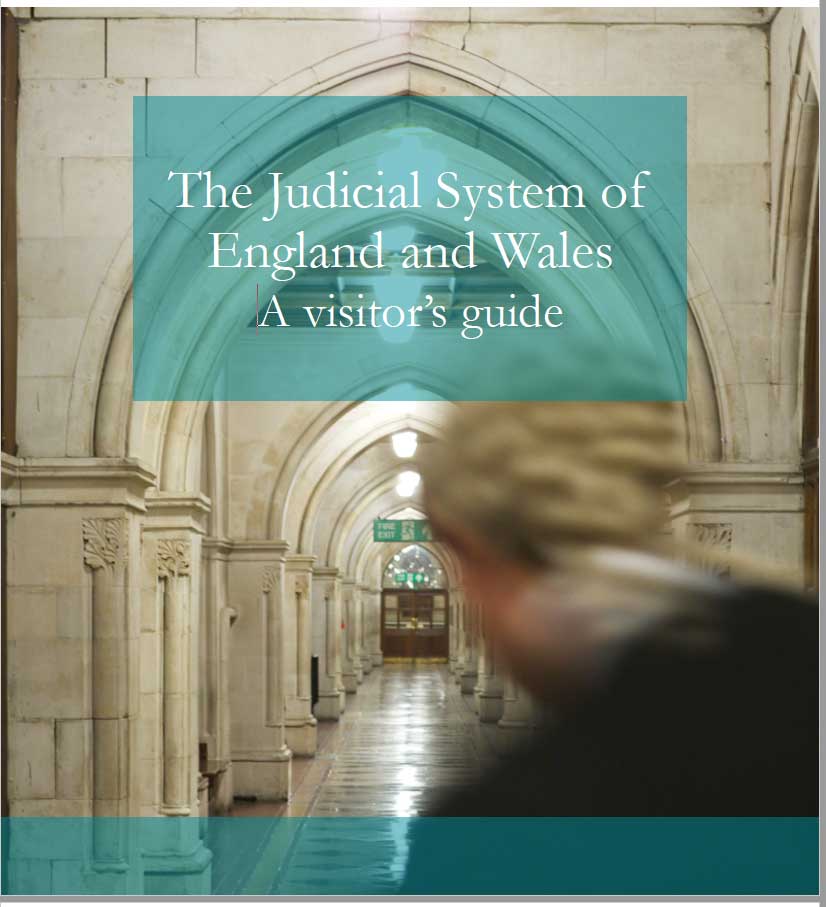
For something more British, The Judicial System of England and Wales: a visitor’s guide is another free downloadable PDF, published by the judiciary, probably of use not only to visitors. In particular, it has a great courts diagram. I especially like the photo on the title page: