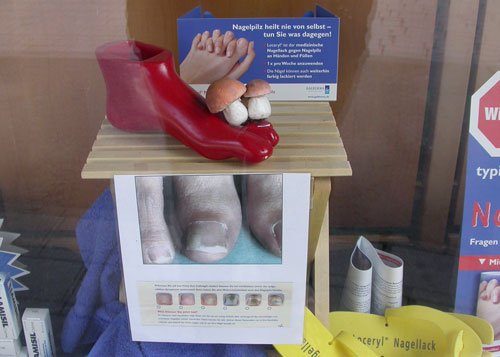
Athlete’s foot / Fusspilz
2

In 1911 the Mona Lisa was stolen by an Italian who cut it from its frame. Attempts to trace him failed. They were based on Alphonse Bertillon’s portrait parlé:
bq. He had devised a method of taking measurements of the nose, ears, eyes and so forth and, rightly claiming that the odds of two criminals having two of the same height were four to one. If a second measurement was taken the odds lengthened to 16 to one and if there were 11 identical measurements the mathematical probability was staggering. This was his so-called portrait parlé.
This is mystifying: how can you measure a criminal’s nose, ears, eyes etc. if you haven’t got him there?
Sir Francis Galton developed the science of fingerprinting, that is, classifying fingerprints. In this case, the thief had left a fingerprint on the frame and the police already had his fingerprints; he could therefore have been caught this way.
From an article by James Morton in the Law Gazette, the journal of the Law Society, the society of solicitors in England and Wales
(French / English site with wonderful pictures of fingerprints)

Dieses Jahr geht der britische Weidenfeld Preis für Übersetzung an Denis Jackson, früher bei Siemens, für Übersetzungen von Theodor Storm, dessen Werke in Großbritannien vergriffen waren. Jackson hat eine Storm-Website (Englisch, aber mit teilweise deutschen Links).
This is fun: Denis Jackson retired from Siemens 15 years ago and noticed that the only translations of Theodor Storm into English had appeared in 1900 and 1910 and were out of print. He compares Storm with Thomas Hardy, and set about translating him himself (mind you, Storm doesn’t have the length – but he does have poetry too).
This is via translation eXchange, which quotes the Isle of Wight County Press:
bq. The translations are done in the winter months using old 19th century dictionaries but Mr Jackson also has to contend with the local dialect and ‘low’ rather than ‘high’ German language.
“Before you can understand his work and translate it you have to learn the culture, language and environment,” said Mr Jackson, who used the prize money to buy a laptop computer.
This was all from the Literary Saloon, which mentions the other contenders too. Jackson has a Storm website.
BDÜ conditions for its members to have links to their websites put in the database:
BDÜ-Mitglieder können in der BDÜ-Datenbank einen Link zur eigenen Website setzen lassen. Voraussetzungen:
bq. Die Website muss den vollen bürgerlichen Namen des Mitglieds auf der Startseite enthalten und die Inhalte müssen in Einklang mit der Berufs- und Ehrenordnung des BDÜ stehen.
bq. Der Preis je Weblink beträgt 58,- inkl. MwSt. pro Kalenderjahr.
(Aus MDÜ 1/05)
Wie sieht es z.B. im Deutschen Anwaltverein oder in anderen Übersetzerverbänden aus?
Übersetzersuche / Finding a translator online
BDÜ (auf “Datenbank” klicken, oder auch auf Mitgliedsverbände, denn beim BDÜ BW gibt es z.B. eine lokalisierte Suche.
ADÜ-Nord
Aticom
Bonner Übersetzer- und Dolmetscherforum
ITI
IoL
ATA
Die Geschichte auf Deutsch: der winkelschreiber.
Friedrich der Große wanted statutes to be written in a simple narrative style:
bq. Der König erwartete von der Gesetzgebungskommission, dass die möglichste Deutlichkeit und Simplicité eines natürlichen und ungezwungenen Erzählerstyls erreicht werde und affectirte Wendungen, neu gemachte Worte … imgleichen Termini technici, wenn sie nicht allgemein bekannter Verständlichkeit seien, vermieden würden. Die Sprache des Gesetzbuchs, das dann nach dieser Direktive konzipiert wurde, galt unbestritten als volkstümlich, wie auch die Abfassung jedes Paragraphen in einem einfach und nachvollziehbar formulierten Satz gelungen war; …
This mean that the Prussian Allgemeines Landrecht, containing the whole of the law, not just civil law, was 19,000 paragraphs long. Some of it is online here (German).
In contrast, Maria Theresia went for extreme brevity in the Codex Theresianus (civil law). And she wanted all official decrees to be read out to a buta ember (Hungarian for ‘stupid person’) – not a real thickie, but someone with basic schooling and no particular knowledge of law and administration, who was then asked to repeat the contents of the text in his own words. If he didn’t succeed, the document had to be rewritten. Apparently this is anecdotal. And did it happen in Austria, or just in Hungary, with regard to legislation written in Hungarian?
In 1898, L. Günther published a book called “Recht und Sprache” which would be useful today.
bq. Angetreten im Kampf gegen die Sprachverwilderung bei den Juristen, hatte er es sich zur Aufgabe gesetzt, das Juristendeutsch näher auf seine Eigentümlichkeiten hin zu prüfen, von denen nur die wenigsten entschuldbare, die Mehrzahl derselben dagegen leider als Fehler, Unarten oder Untugenden zu bezeichnen sind; als solche kritisierte er die Bevorzugung der passiven Satzbildung vor der aktiven, die rücksichtslose Sucht nach Kürze des Ausdrucks, den unmittelbar damit verbundenen Telegramm- und Nominalstil, welcher gleichwohl Satzungeheuer und Bandwurmsätze nicht ausschließe, die häufige Kompositabildung, Schachtelsätze und Zopfstil sowie die Flut der Fremd- und Modewörter.
Via Der winkelschreiber (German)
The blogging lay magistrate of The Law West of Ealing Broadway reported a couple of weeks ago on dealing with a speeding summons with a Japanese defendant. The only reason he was in court was because his licence was not an EU one. I can’t imagine anything but justice was done. But I think it’s a good illustration of life with non-English-speaking defendants. Getting a Japanese-language interpreter seems out of proportion. Was the driving licence genuine? Who knows?
Of course, it’s easy to make fun of Japanese English, and I try not to do it.
Bei Bußgeldsachen wegen Überschreitung der zulässigen Geschwindigkeit müssen Fahrer ohne EU-Führerschein persönlich vor Gericht erscheinen. Ein Japaner wurde ohne Dolmetscher zu seinem Einkommen gehört, und sein Führerschein wurde überprüft. Wahrscheinlich ist alles gutgegangen, aber völlige Klarheit herrschte nicht.
Zumindest fahren Japaner nicht auf der falschen Straßenseite (Linksfahren in den blau markierten Ländern unten).
From Wikipedia (countries marked blue drive on the left):
