Use of English in German enterprises

The Financial Times (English edition) of 12 April 2005 has two articles on the use of English in German businesses: English is not always music to the ears, and The new lingua germanica.

They will be free online for a couple of days.

The first is about the over-use of English in the German corporate world. The second suggests that many Germans in business feel they cannot be upbeat and proactive in German, for a variety of historical reasons, so they use English.

bq. But he [Hubertus von Grünberg] adds: “Because of the rise of Nazism and its consequences, many Germans are shy about displaying patriotism and showing themselves to be in any way demagogic. As a result, a lot of Germans are scared about coming across as too strongly emotional. In a business setting this can mean German managers steer away from using any type of emotional language, when they want to try to motivate people. There is, therefore, a natural tendency to use English as an alternative.” …

bq. Mr Leibinger also sees the lingering effects of the wartime era, when many German words and phrases were “abused” for propaganda purposes. And later, says Mr Leibinger, words such as Freundschaft (German for friendship) were closely associated with the communist regime of former East Germany. In those times Freundschaft was used as a word of comradely greeting. The word is difficult for many ordinary Germans to use now, says Mr Leibinger, because it evokes memories of dictatorship.

There is discussion of the problems in that not all Germans understand English well, but not of the kind of English that is created in this way.

Thanks to Robin Bonthrone, via the pt mailing list at Yahoogroups.
Hands-free mouse

After my entry on ergonomic keyboards, I saw one of the Google ads here for SmartNAV, a hands-free mouse.

It’s a device that sits on top of the monitor and you steer it with a dot you glue to your forehead, the tip of your nose, your glasses or hat. Good for people with spinal injuries, it says. You can have a footswitch to click with your feet. There is more than one device there, and I haven’t read everything, but maybe this link is of interest to someone.

Very good English for lawyers/Sehr gute Englischkenntnisse als Anwalt

Alexander at Jurabilis links to the site e-fellows, which has a list of recruiting partners in big German law firms saying what qualities they look for if they are going to hire an associate.

Alexander points out that the statements don’t give much away. I was struck by the requirement of the big law firms for English:

Gute Englischkenntnisse.
Grundvoraussetzung sind gute Englischkenntnisse.

OK.
Sehr gute Englischkenntnisse (möglichst im Ausland erworben).
Sehr gute englische Sprachkenntnisse, die idealerweise im Ausland erworben wurden, sind erwünscht.
Einstellungsvoraussetzung sind sehr gute, im Ausland erworbene Englischkenntnisse. Eine zweite Fremdsprache ist wünschenswert.

Hmm. These people start learning English very early. Are they not allowed to learn in Germany when they’re ten or eleven? And does the progression from Gut to Sehr gut imply what it sounds like – a higher standard?
Sehr gute Englischkenntnisse, im englischsprachigen Ausland erworben.
Ah, that’s good. So English learnt in Poland won’t do?
Unabdingbar für die tägliche Arbeit ist verhandlungssicheres Englisch, idealerweise durch einen Auslandsaufenthalt vertieft.
Vertieft – now that makes sense.

Who judges this English, I wonder? Lawyers from a generation where these expectations weren’t evident?

Actually, I wrote ‘recruiting partner’. That was an over-simplification. These people were (in German):

Recruitment-Partner; Partner; Recruiting Manager; Recruiting-Partner; Recruitment, Human Resources; Personnel Manager; Managing Partner.

No wonder they need English.

Terminologieforum

Seit einigen Monaten gibt es ein Terminologieforum im Netz. Ich weiß nicht mehr, wo ich dies zuerst las.

bq. Dieses Forum ist für alle, die mit Terminologie zu tun haben: Übersetzer, Redakteure, Konstrukteure, Entwickler und, und, und
Es soll kein “Expertenforum” darstellen, sondern den Austausch untereinander fördern, unabhängig davon, ob es sich um allgemeine Fragen oder um eine Diskussion zu einem speziellen Aspekt handelt. Sie können z.B. bestimmte Themen abonnieren oder Umfragen starten.

Das Forum ist noch nicht sehr aktiv. Man muss sich registrieren, um Beiträge hinzuzufügen, ansonsten basiert die Site auf einem dieser Forum-Systeme (wer unvorsichtig ist, kommt z.B. mit Geburtsdatum in den Kalender).

Der Verein Deutscher Terminologie-Tag ist in diesem Zusammenhang vielleicht interessant. Man kann die Folien von der Konferenz 2004, Terminologie & Wissensmanagement, einsehen.

Ich habe Professor Schmitz’ “Die neuen Terminologiedatenbanken: online statt offline” überflogen und konnte nicht umhin, den Online-Austausch mit Multiterm beschrieben zu sehen. Da sieht man den Unterschied zwischen Theorie und Praxis – ich vermute, es gäbe Probleme hiermit, aber um das festzustellen, müsste die Verbindung erstmal ermöglicht werden, und das habe ich anders erlebt. To quote Molesworth: Enuff said.

German-language terminology forum. This is intended not for experts, but for all those involved in terminology work. It hasn’t really got off the ground yet. I could imagine that a serious question about terminology problems might reach a wider audience of specialists, or at least this would be my hope (not ‘How would you translate this word?’, but topics relating to the design or use of terminology software, the construction of definitions – but I’m finding it hard to think of useful questions).

There is an organization called Deutscher Terminologie-Tag, the main value of which seems to be its annual conference (and publications). I was a member for a while. They send out a huge pack of quite interesting scans of newspaper articles from various sources, publications in Germany and abroad, with a language connection, like a kind of cuttings service, and I didn’t always have time to process this.

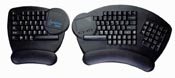
Ergonomic keyboards / Ergonomische Tastaturen

I find ergonomic keyboards fascinating, although I haven’t got one at the moment.

Translation in the Trenches mentions two unfamiliar to me. I’m sure they don’t mind me uploading pictures – it’s all advertising.

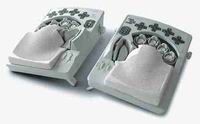
First, the Datahand:

Resize of proii1s2.jpg

DataHand systems say they reduce pain and typing fatigue. I’m sure they do. I think they probably train the brain too.

T in the Ts says you may want to get a model with remappable keys. Software remapping doesn’t work (this is if you want a different keyboard layout).

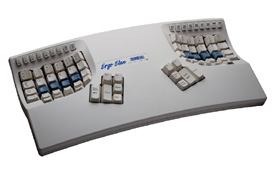
Then there’s the Ergo Elan, by Kinesis:

elan.jpg

This is a Kinesis Contoured keyboard. There are US and non-US versions.

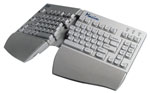
I had my eye on one, also by Kinesis. The angle of split can be varied, starting at nothing. If anyone else needs to use your computer, an ergonomic keyboard can be a problem. Kinesis has two. The Maxim is what I had heard of – it has no numeric keypad, but you can get a separate one.

maxim-sml.jpg

There’s a German one of these, and you can apparently also do stuff with a footswitch. Footswitches can be got to go with other computer keyboards too, and you can, for example, use a footswitch for a mouse click. This sounds very interesting. I would like to be able to move the mouse cursor by foot. After all, some people can draw pictures with the feet.

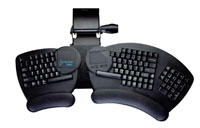
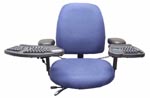
Kinesis also do an Evolution keyboard in three varieties.

evol_trak_sml.jpg

evol_chair_sml.jpg

evol_desk_sml.jpg

Choir with a Q

I’m glad I’ve got BBC World on this new digital cable service, because at least their reporters know who the people are arriving at Camilla and Charles’ wedding. It frees me from those long tracking shots accompanied by silence or irrelevancies.

But I have just heard for the umpteenth time, ‘This is the quire of St. George’s Chapel – quire with a q, confusingly, where the choir sing’.

I know the spelling quire is not incorrect for part of the building, but it’s very rare, isn’t it? Where do these people get their educations?

I’ve just looked at Collins English Dictionary and it says ‘quire: archaic spelling’. At first I thought that maybe the royal family are being silly and insist on the spelling, but Google doesn’t bear me out.

By the way, I heard about the clash with the Pope’s funeral, but not about the Grand National.