Bild vom 23. Juni 2004, vom Rathausturm aus gemacht.
Since the world’s largest solar power station was opened in Leipzig yesterday, I’d better throw in this photo of a solar project in Fürth before it gets left too far behind.
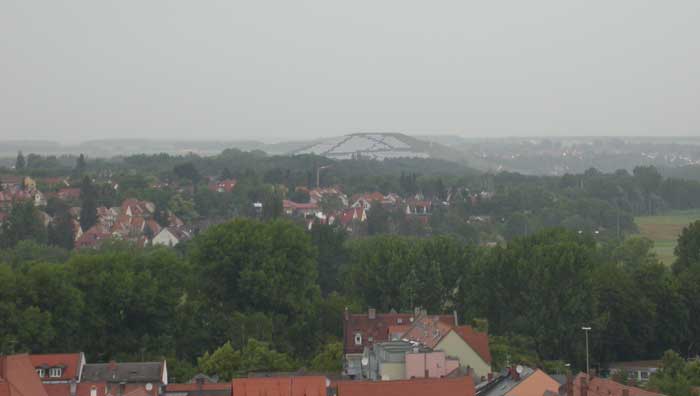

Bild vom 23. Juni 2004, vom Rathausturm aus gemacht.
Since the world’s largest solar power station was opened in Leipzig yesterday, I’d better throw in this photo of a solar project in Fürth before it gets left too far behind.
JuraBlogs.de – Juristisches Metablog sammelt Newsfeeds von deutschen juristischen Blogs, zu denen Transblawg aus Kulanz gehört. Hier bekommt man am einfachsten einen Überblick über die Blogs und die neuesten Einträge.
Für Feedreader-Programme hat Rainer Langenhan seit einiger Zeit eine OPML-Datei der “German Blawgs” bereit, die immer wieder (und immer öfter) auf den neuesten Stand gebracht wird. Die Details zur Einsetzung dieser Datei sind hier.
Clemens Kochinke vom German American Law Journal Weblog hat jetzt die Blogelei ins Leben gerufen, gedacht, einige Themen zur Technik des Bloggens, zu Software und rechtliche Probleme, an einem Ort zu sammeln:
bq. Als Dienst für alle deutschsprachigen Rechts-Bloginhaber ist die Blogelei konzipiert. Journalisten und Drucker berichten in der Zeitung nicht über ihre internen, organisatorischen und technischen Fragen, und im Rechtsblawg braucht auch nicht jedes technische Problem angesprochen zu werden.
bq. Gleich ob hier oder anderenorts, beispielsweise im JuraWiki, erschiene mir mir eine gemeinsame Sammel-, Nachschlage- und Eröterungsstelle geeignet, die einzelnen Blawgs etwas zu entmüllen, damit die eigentlichen Blawgthemen – und gelegentlich die wichtigsten Blogneuerungen – umso deutlicher hervortreten.
Here’s a blog by a British policeman: The Policeman’s Blog. Interesting links too. I got this via Random Acts of Reality, one of the general blogs I follow – the diary of Tom Reynolds, who works for the London ambulance service.
You can get the European arrest warrant in many languages here.
If you want to guess which language is which, on McDonalds literature, here is a quiz from Nicholas Whyte. Thanks to Desbladet. Languagehat refers to it too, and there are comments discussing the quiz.
Aus dem Lokalteil der FAZ vom 1.9: amerikanischer Pfarrer kritisiert britische Übersetzung der Beschilderung der Alten Nikolaikirche in Frankfurt (ich habe es nur auf Papier, konnte es nicht online finden).
This is so familiar!
This article appeared in the local section of the Frankfurter Allgemeine Zeitung on September 1st. Theoretically it should be possible to buy it online, but I couldnt find it.
The office for historical monuments Denkmalamt ordered British English translations of over 120 signs at the Alte Nikolaikirche on the Römerberg in Frankfurt am Main.
The parish priest, an American, Jeffrey Myers, wrote a letter of complaint, criticizing the German as well as the English, if I understand it right. He regretted that he and his church community had not been consulted, and said the English was rather wooden, and rather strange in parts. Getreidelager was translated as corn store (BE where wheat is stored, AmE where maize is sold). (Excellent English site of the church community).
Here is one example. I think the translator has done a really good job, whoever she was (apologies for any errors in dates, as the fax I have is not easy to read):
Alte Nikolaikirche
|Evangelische Pfarrkirche|Protestant Parish Church|
|Saalkirche um|1150|Hall church|
|Umbau zur gotischen|0|Structural alteration to|
|Hallenkirche um|1290|Gothic hall church about|
|Ergänzung von spätgotischer|1459-1467|Late Gothic roof gallery|
|Dachgalerie und|0|and tower storeys|
|Turmgeschossen|0|added|
|Baumeister H.v.Eich||Master builder H.v.Eich|
|Profanierung und Nutzung als|1530|Profanation and use as|
|Magazin und Getreidelager|0|warehouse and corn store|
|Gotisierende|1859|Gothicized rehabilitation|
|Wiederherstellung unter|0|under|
|Stadtbaumeister|0|municipal architect|
|J.F.Christian Hess|0|J.F.Christian Hess|
|Wiederherstellung|1951|Reconstruction|
|nach Kriegszerstörung|0|after wartime destruction|
|Portalplastik des|0|Portal sculpture of the|
|13. Jahrhunderts erhalten|0|13th century preserved|
Denkmalamt Frankfurt am Main
Not all translators would translate in this way. If I had been doing it, I would not have used the technically correct words profanation and rehabilitation: I would have gone for secularization and restoration. Incidentally, the OED says that rehabilitation meaning the restoration of church rights is archaic. I might even have written wheat, for the sake of any American tourists who think Frankfurt was surrounded by maizefields in 1530 – after all, they can’t help being ignorant. It’s unfortunate that the word about was not dropped by 1290: it doesn’t work unless the date is to the right of it. But it looks as if a lot of thought and work has gone into these signs. Good work by Andrea Hampel, who heads the Denkmalamt.
I know from my own experience how mean a reception translations get from people who regard a building as their life’s work, and it’s a difficult case where there is an English-speaking person, especially one who is a native speaker, attached to the church who has spent years describing it to others. These signs exist for the benefit of the public, not the local native speaker (I hasten to say that I have seen only one sign and am in no position to judge this situation except from the newspaper article).
Irish law updates is by Darius Whelan, of University College Cork Law Faculty.
He links to the Irish Law Site, which I have mentioned before but which is always worth mentioning.
(From the New on the Legal Internet section of Delia Venables’ site)
There is an Irish law blog already, by Seán Mac Cann, and I see there has been another posting on it.
I see Des of Desbladet (see September 3rd, Puntnings, Gherkins and Wald) went for a punt trip in the Spreewald area and tried some Spreewaldgurken, which he calls gherkins. (Does he realize that’s the Sorb area?)
Well, I’m sure they are correctly called gherkins. But at home I thought of gherkins as these, which the Germans call Cornichons:
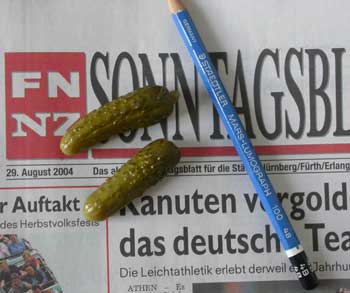
(Note the curious German word Kanuten for people in canoes – canoists?)
We only ever encountered the big ones in fish and chips shops, where they were called wallies, and where they still are called wallies, as I was able to confirm recently. But apparently it’s a Cockney term.
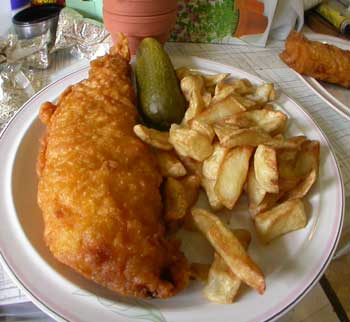
Those chips were better than they look. Incidentally, nearly all Germans believe you can’t eat fish and chips off a plate but have to have newspaper.
The other term I encountered for these was pickled cucumbers, which is a term used in Jewish cooking, as far as I can tell – there are many different types.
Finally, here are the pickle shelves in a not particularly big German supermarket.

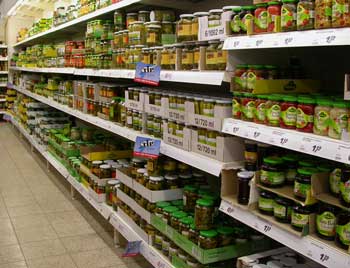
It sounds as if wallies were named after the brand name.