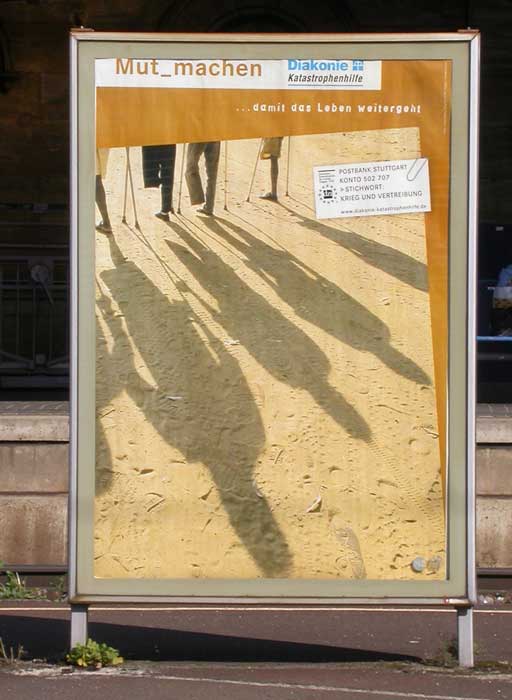
This poster is about helping victims of war to start living again. I can’t say I’m 100% taken with it. It makes me think of things like: why only the left leg?
(Seen at Erlangen railway station)

This poster is about helping victims of war to start living again. I can’t say I’m 100% taken with it. It makes me think of things like: why only the left leg?
(Seen at Erlangen railway station)
The translation weblog On-Time Updates, which always looked promising, has closed.
Steve Maas writes that he has been finding writing more of a chore than an enjoyment. He says his website will be continuing in other areas.
I wish Steve all the best (he’s disabled commenting because of spam). Of course, many of the weblogs I link publish very rarely and some are probably defunct, but I like the idea of making a statement to inform your readers. Maybe Steve will come back to blogging at some future time.
Myself, I find I’m not writing what I originally intended to write, nor am I taking much time to polish my English. If I took more time, I could write shorter and more elegant entries. I did two exemplary posts in the early days: one was a story (the layout is a bit heavy), and the other was a summary in outline form. I have written less on specific problems of translation than I intended to (I should keep a list of the terms people search for in my blog). But there is always something to report about translation or law or weblogs.
Andrew Joscelyne at Blogos reported recently that the European Patent Office is thinking of using machine translation to cut costs. Apparently it costs a lot more to file a patent with the EPO than elsewhere in the world, because patents have to be filed in English, French and German.
I must say the mind boggles somewhat. Why not computer-assisted translation? Repeated headings could be automatically translated but long sentences would be left for human translators (or as the Germans say, Humanübersetzer).
LeaseFacts ist ein Blog des Leasing- und Factoringrechts, von Bernd Helming (via Law-Blog).
LeaseFacts is a weblog on German leasing (in the sense of financial leasing) and factoring law, by Bernd Helming.
A very nice feature is the introduction of terms that are then collected alphabetically (a feature I’ve thought of introducing myself but not got around to). I’ll quote one in full (September 9th entry), but I won’t translate it at this time of night.
bq. Fungibilität
Die Fungibilität hat mit Pilzen oder Pizza nichts zu tun. Vielmehr geht es dabei um die Verwendbarkeit des Leasingobjektes durch Dritte, sei es im Fall der vorzeitigen Kündigung des Leasingvertrages oder nach Ablauf der regulären Vertragsdauer. Die Drittverwendbarkeit ist Voraussetzung dafür, dass das Leasingobjekt im wirtschaftlichen und rechtlichen Eigentum des Leasinggebers bleibt und dem Leasinggeber steuerrechtlich zugeordnet werden kann; ist das Leasingobjekt ausschließlich für die Belange des Leasingnehmers verwendbar, spricht man auch von Spezial-Leasing.
On Sonja Tomakovićs Translators Blog, there is an interesting entry on quality assurance for translators.
In Germany, we usually associate that with the DIN norm for translators, DIN 2345. (There are two Austrian norms too). It’s possible not only to buy the norm – there’s an English translation too – but even to register and put little stickers on your work to say it’s DIN certified. This just defines process. I don’t seem to have mentioned it before – perhaps because it’s one of those religious war topics for translators, like Word versus WordPerfect, Trados versus Déjà Vu, or whether you should translate into a language that isn’t your mother tongue. Some translators believe that the very existence of quality control norms has a detrimental effect, but I’ve forgotten the argument.
Anyway, what is much more interesting is how we check our own and others’ work, which has as much to do with content as with process. DIN 2345 lists six points the translator is to check before delivering, stating that the extent to which each of these points is checked will depend on the purpose of the translation as agreed with the client. I find the DIN norm quite intresting to read.
The entry discusses an article in the ATA Chronicle, which unfortunately I haven’t seen (would anyone like my fax number?), referring to SAE standards:
bq. The article is by Don Sirena who works as a language translation manager for General Motors, and who has implemented the SAE J2450 quality assurance process for the translation department of GM.
bq. He points out that proofreading as we know it, i.e. simply going through a translation to observe errors, omissions or parts that we would do differently can lead to extremely high costs. Furthermore, the old picture of QA is that either you sacrifice quality for the sake of turnaround time and cost, or you have to live with higher costs when attaching importance to comprehensive QA processes.
The article apparently defines seven types of errors that can be checked for, each of which can be major or minor. This is reminiscent of the discussion of grading translation tests. Apparently time can be saved by doing this, since the final ‘proofreading’ is no longer necessary. (Proofreading and editing are often misused words, not necessarily here, but it’s necessary to be careful how they are used).
Not having read the article, I can’t see how this would save time.
I’ve recently changed my own self-revision process after reading Brian Mossop’s Editing and Revision for Translators. I’ve already mentioned the series Translation Practices Explained from St. Jerome Publishing. It’s a long treatment and very down-to-earth, and I took the author’s advice on what to read first for a self-revision workshop. Chapter 10, The Revision Parameters, sets out the types of error, in four classes and twelve subclasses. What is interesting is the later discussion, in Chapter 11, on how far to check these twelve matters, since there will scarcely be time to go through the text twelve times. Chapter 12, Revision Procedures, deals with the sequence of checking, and this helped me. It suggests that many translators check completeness and accuracy as they go along. In my case, I usually work in STAR Transit, and it’s easy for me to check every few sentences. The next step is now reading the translation alone, for which Mossop presents good arguments.
I’ve started using this procedure with longer texts. Previously I went through the whole in Transit, then did a comparative check either in Transit (onscreen or printed out) or Word, and this was lethally boring – the more boring a process is, the more slapdash I probably am. The reading through the whole translation in English is not the last stage, but it’s more fruitful than it used to be. I think my results have become more readable and probably more accurate. That may be just the novelty factor!
Brian Mossop has worked as a translator, reviser and trainer for the Canadian Government for 27 years and has taught translation at Toronto University for 22 years, and the book shows his experience.
Die Süddeutsche Zeitung bietet “Das Spiel zum Oktoberfest“. Bekannte Figuren können niedergestreckt werden.
The Süddeutsche Zeitung has a game where you shoot down moving figures – the game extends on both sides of the stage too. Hit the figures, the bears/beer steins/ hearts only when they blink, and you can get on the list of high scores if you hit enough (with the mouse cursor).