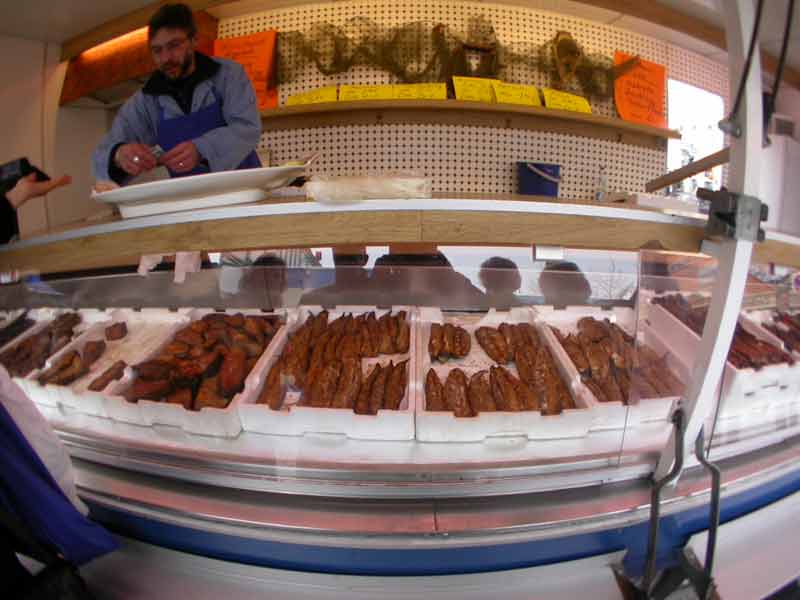
For some reason a travelling fish market sometimes stops here for a few days. It’s not all fish, though.
Smoked fish:
Bratwurst:

Kitchenware:
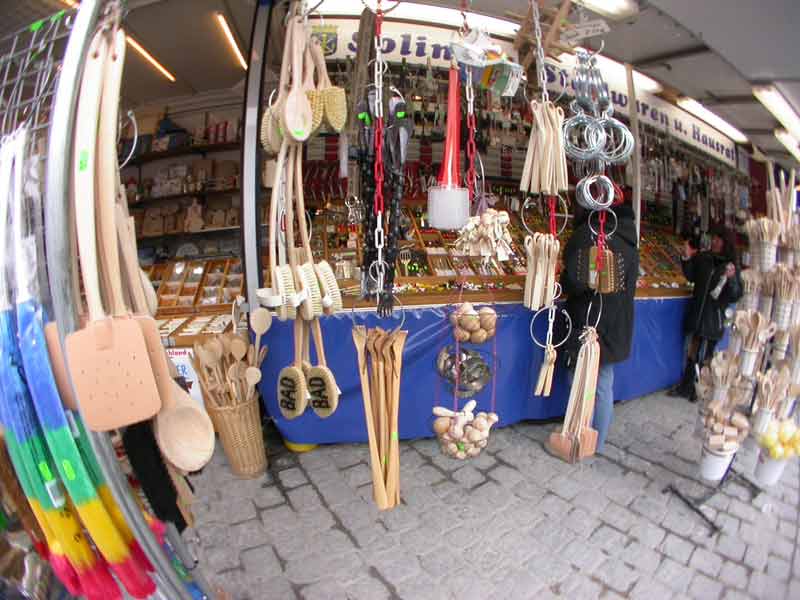

For some reason a travelling fish market sometimes stops here for a few days. It’s not all fish, though.
Smoked fish:
Bratwurst:
Kitchenware:
Heise Online berichtet von zwei “Volltextübersetzern”.
Danke an Rainer Langenhan von Handakte WebLAWg für den Tipp.
Machine translation systems are being presented at the CeBIT trade fair.
bq. Der St. Petersburger Übersetzungsspezialist Promt (Halle 6, Stand G39) und die Münchner Firma Linguatec (Halle 3, Stand E55) stellen auf der CeBIT neue Versionen ihrer jeweiligen Übersetzungssoftware vor.
bq. The St. Petersburg translation specialist Promt and the Munich firm Linguatec are presenting new versions of their translation software at CeBIT.
Promt’s onsite English is hard to understand:
bq. We offer to visit PROMT Download Center to try and buy @promt translation software
On the pt mailing list at Yahoo Groups, Victor Dewsbery used Promt to translate Promt’s own sentence:
bq. Original: Ab der Office-Version aufwärts enthalten die Übersetzer Spezialwörterbücher zu den Bereichen Wirtschaft, Recht und Computer.
Translation: From the office version upward the translators Spezialwörterbücher contain economy, right and computer to the areas.
Victor also linked to an English-language publication on machine translation (supplement to: MultiLingual Computing & Technology)
Victor Dewsbury (pt Mailingliste, Yahoo Groups) zitiert einen englischen Artikel zu MT. Unter anderem wird dort das Problem erwähnt: wer MÜ benutzt, um einen oberflächlichen Eindruck vom Inhalt eines Textes zu bekommen, muss eigentlich wissen, mit welcher Sprache er es zu tun hat.
An article by Reinhard Schäler in Ireland (Localisation Research Centre, University of Limerick) states:
bq. We are told that MT is most successfully being used not by language professionals, but by uninitiated office workers who just want to get the gist of a document that has been sent to them in a language they do not understand.
When it transpires that they are not even able to determine the language that the original document was written in and therefore they pick the wrong MT engine, it does not raise a red flag in our mind but, rather surprisingly,
just causes the expert and his audience to pity the poor simple-minded user.
The article is titled ‘A New Dawn for Machine Translation?’ but concludes with a query as to whether the red light we see is not the sunset.
Victor Dewsbery’s website (see above for link) has numerous resources for translators.
Victor Dewsbery is ein britischer Übersetzer in Berlin. Seine Website (Link siehe oben) enthält mehrere nützliche Dateien für Übersetzer.
Following some mutterings in the past days, the House of Lords has now voted against the bill to abolish the Lord Chancellor and create a new supreme court. The House of Lords can’t kill bills, but they can delay them, and when is there going to be time to reintroduce the bill? Not in this session (before summer). It is also very rare for the House of Lords to disagree to this extent with the Commons, and for the Commons to overrule the Lords. The Independent reports:
bq. In dramatic Parliamentary scenes, peers overruled the will of ministers and voted to delay a crucial part of the Government’s programme.
bq. The vote, being seen as an attempt to wreck the entire Bill, is a major setback for Tony Blair and may lead to a brutal showdown with the House of Lords.
bq. Baroness Amos, the leader of the House of Lords, told peers: “This House has taken a very serious step. By this vote, this House the unelected House has made it impossible for the democratically elected House of Commons to receive this Bill, promised in the Queen’s Speech in November, in time to consider it this session. That is very serious indeed, and the Government will consider what the consequences may be.”
Ein Artikel aus “Lebenden Sprachen” über deutsch-englische Übersetzung. Geoffrey Perrin war damals Übersetzer beim Bundesjustizministerium.
Dieser Artikel (es folgen andere) behandelt die Übersetzung des Wortes Rechtsverordnung. Seine Vorschläge sind immer noch nützlich, und er beschreibt auch die Vorgehensweise des Übersetzers beim Suchen des richtigen Wortes.
Two of the most interesting articles I have ever read on German-English legal translation were by Geoffrey Perrin and appeared in ‘Lebende Sprachen’ many years ago. When I eventually contacted Geoff, who was translating for the Bundesjustizministerium but is now more involved in teaching, he gave me permission to upload them and also some others. I am sorry I haven’t got round to it before.
This article first appeared in 1988 but is still relevant today. Its topic is how to translate the word Rechtsverordnung into English. We aren’t all happy with the word ordinance. But whatever word you prefer to use, this article describes the process of searching for an equivalent.
Paul Flynn MP writes on the kind of English encouraged by working in European institutions. From wood s lot via language hat.
bq. Even President Chirac has been infected. He is fond of saying that anything disagreeable is pas ma tasse de the. Tea? Not his glass of wine, would make better sense. The President should set an example and challenge the littering of his mother tongue
Hmm. I wonder what he’d make of Desbladet?
bq. Skihoppning is, of course, the second-finest sport in the world after cricket. And the second-best just got second-better, ‘cos now they’re letting wimmins play on the Big Slopes. Enjoy our slö-motion replay…
wood s lot also quotes netlex, but that is already in Euro lish! (immemorial purity? foreigness? contribute to give birth?)
(English below)
Das OLG München mit eigener Latte gemessen: A20 – Business pur sucht das Impressum des Gerichts, ohne großen Erfolg (über law blog).
Das Oberlandesgericht München hat bekanntlich entschieden, dass ein Impressum nicht “leicht erkennbar” ist, wenn man vier Bildschirmseiten herunterscrollen muss, um es zu finden. Von Vertretbar.de:
bq. Mit Urteil vom 12.02.2004 hat das OLG München entschieden, dass die Positionierung eines der Anbieterkennzeichnung i.S.d. § 6 S.1 TDG dienenden Impressums am unteren Seitenende, dass bei einer üblichen Bildschirmauflösung von 1024 x 768 Pixeln erst mittels Scrollen auf der vierten Bildschirmseite sichtbar wird, gegen die Erfordernisse der leichten Erkennbarkeit und der unmittelbaren Erreichbarkeit der Anbieterkennzeichnung i.S.d. § 6 S.1 TDG verstößt, denn die Informationen nach § 6 TDG müssen an gut wahrnehmbarer Stelle ohne langes Suchen jederzeit auffindbar sein. Im Übrigen stehe das Übereinanderbringen von Links mit der Bezeichnung “Über XXX.de” und “Impressum” einer leichten Erkennbarkeit entgegen, da hinter beiden Links nach der Verkehrsauffassung die Anbieterkennzeichnung vermutet werden könnte (AZ: 29 U 4564/03 – JurPC Web-Dok. 136/2004).
EU law requires contact and other details for commercial websites (see earlier entry and here). The page with this is called the Impressum in German – in English, Legal or About or Contact.
The problem in Germany is that there are lawyers who make a living from starting lawsuits against people who have not obeyed the letter of the law.
Under the German law of unfair competition, unlike in other EU countries, there is a very broad right to take action against firms involved in unfair competition. Details in German here part of the site of Abmahnwelle e.V.).
The German American Law Journal blog comments on this week’s decision by the Oberlandesgericht in Munich that it is too much to be expected to scroll down four screens to find a link to the Impressum.
A20 – Business pur (German) has now looked for the Impressum of the Munich Oberlandesgericht and had some trouble finding it (via law blog).