I love the graphics on this website of a Südtirol/Trentino law firm. (Are the two Eggers twins?)
Lawyers’ website
5

I love the graphics on this website of a Südtirol/Trentino law firm. (Are the two Eggers twins?)
A recent article in The Independent discusses the privacy of the jury room in England and Wales. Unlike in the USA, jurors are not allowed to say what went on in the jury room, even after the trial has ended. Section 8 of the 1981 Contempt of Court Act forbids research into how juries decided.
There was a borderline case a few years ago when the jury were in a hotel and used a Ouija board to try to communicate with the murder victim. Somehow this became known and the case had to be reheard.
The article recounts a case last summer when Richard Latham, QC, prosecuting, was handed a note from a woman juror saying, ‘What does a lady need to do to attract your attention?’
Appeals criticizing what went on in the jury deliberations are very restricted.
bq. [An appeal] involved an allegation that there was racial bias among jurors who convicted a man of indecent assault. Shabbir ali Mirza, a chef from east London, was jailed for four years after his conviction, by a majority verdict, in February 2001. After the trial, a juror wrote to his barrister alleging bias on the part of members of the jury. This woman, a nurse, claimed that fellow jurors had accused the defendant of being “devious” for using an interpreter when they thought he could understand English. When she objected she claimed that she was “shouted down” by “bigots”.
This sounds bad, although we can’t exclude the possibility that the defendant was being devious. Interpreters are sometimes used to buy time in international company negotiations: while the interpreter is speaking, the party ‘relying’ on the interpreter has time to consider how to react.
In this case, the appeal was dismissed, but the matter is being taken to the European Court of Rights.
When I posted on Burns Night, I was unfortunately unaware of anentry in Scots by a Scot in Germany (can’t find a permalink – look at January 25th) – main page here.
bq. The ither year, Burns nicht : me a ree ray in ma waddinbraws. Twa faikin fums (agnats) shue laik scowpers. I lerb twa jutes, muckle manky jutes, an gledge a redhieded peronall. Ah skleush ower tae her, fer tae splunt thae loorach. Wi thae fower bask jutes, ah thrammle like a kenspeckle kensy, an partle tae rush instead o ma whaisk frae sculduddery.
Since my mother’s side of the family are Scottish, I at least remember ‘Dinnae fash yersel!’ (related to French se fâcher), but I would need to work on the rest. I think he’s gone out of the way to confuse us Sassenachs. There are a number of Scots language links there too.
Via Armin’s Ministry of Propaganda.
You can download a paper called ‘Leximetrics: Why the Same Laws are Longer in Some Countries than Others’, by Robert D. Cooter, University of California at Berkeley School of Law, and Tom Ginsburg, University of Illinois College of Law.
Dieser Artikel vergleicht die Länge der Gesetze in verschiedenen Ländern.
bq. One well-known argument follows Weber and focuses on the common law-civil law distinction. The default set of rules in common law countries, goes the argument, is a massive body of caselaw. Compared to the great codes of continental tradition, the common law provides a less predictable set of rules because it is dynamic and because its sheer volume renders it imprecise. Therefore, legislators in common law countries must articulate their views with great precision, generating longer statutes. This argument, while suggestive, is incomplete. It does not account for differences across countries within the civil law or common law tradition, nor does it explain the growing convergence in the general principles of legal drafting between civil and common law countries, which is occurring in Europe under the force of the European Union.
Es wird oft argumentiert, dass angloamerikanische Gesetze regelmäßig länger sind als kontinentaleuropäische. Dieses Argument erklärt nicht die Unterschied innerhalb der zwei Rechtskreise.
Because of differences in language structure, Finnish uses the fewest words and Dutch the most. An analysis of translations of the Universal Declaration of Human Rights is used to establish normalized measurement figures.
Die finnische Sprache benutzt die wenigsten Wörter, die niederländische die meisten. Ein Vergleich verschiedener Übersetzungen der Allgemeinen Erklärung der Menschenrechte ergibt standardisierte Zahlen.
Analysis reveals that legal obligations are relatively more specific in the common law countries, the Benelux countries and the Iberian countries (the latter two groups were not expected), and relatively less specific in the Scandinavian countries and in France. Moreover, British legislation is considerably more specific than Irish.
Nach Untersuchungen stellt es sich heraus, dass Vorschriften verhältnismäßig spezifischer sind nicht nur in Ländern mit Common-Law-Rechtssystem, sondern auch in den Benelux-Ländern und in Spanien und Portugal (bei den letzten beiden Gruppen war dies nicht erwartet). Und englische Gesetze sind um einiges spezifischer als irische.
One of the reasons put forward for differing length is the relative difficulty of passing legislation: the easier, the shorter.
Ein Grund, der die verschiedene Länge erklären soll, ist die relative Schwierigkeit, Gesetze zu erlassen: wenn dieser Prozess leicht ist, sind die Gesetze kurz.
From / Von Solum via / über Weatherall’s Law.
The Law Blog had an interesting entry on January 26th about this green arrow.
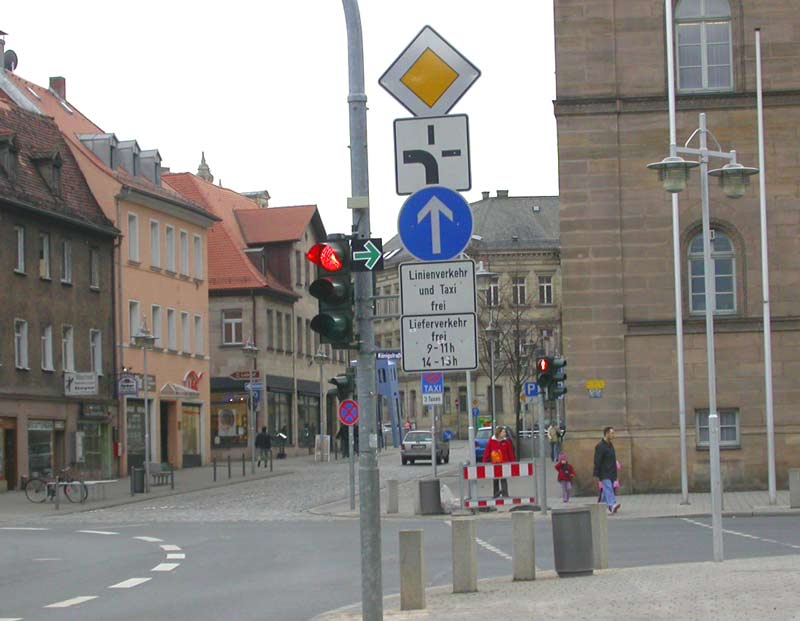
This was taken over from the German Democratic Republic. It permits a driver to turn right if the coast is clear (no pedestrians crossing; give way to those ahead turning left). But it does not oblige you to turn right.
The Highway Code, the official publication with all the British driving rules, is online. Much to my surprise, it says:
bq. A GREEN ARROW may be provided in addition to the full green signal if movement in a certain direction is allowed before or after the full green phase. If the way is clear you may go but only in the direction shown by the arrow. You may do this whatever other lights may be showing. White light signals may be provided for trams.
No picture there, but I found one here:
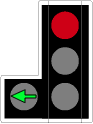
It’s called a green filter. Did that come from the GDR? Apparently, it’s especially intended for cyclists.
ABC News Online reports that the U.S. State Department has forbidden its standard typeface, Courier New 12, from use in official correspondence:
bq. In an internal memorandum distributed on Wednesday, the department declared “Courier New 12” – the font and size decreed for US diplomatic documents for years – to be obsolete and unacceptable after February 1.
Times New Roman 14 is to be used, to make the texts easier to read (I hope they don’t use block justification). The memo says TNR offers a ‘more modern look’. More modern than Courier, yes.
Courier is kind to the printer, if not the eyes, and is the best font to scan and OCR – I am often grateful to lawyers’ conservatism when I scan documents to process – but Times is OK too.
bq. There are only three exceptions to the draconian new typographical rules: telegrams, treaty materials prepared by the State Department’s legal affairs office and documents drawn up for the president’s signature, it [the memo] said.
(Via Ben Hammersley)