Homosexual Adultery
Reply

I have never managed to learn a phonetic alphabet, although it would be useful on the phone. But I know where to find them! In the Dark Ages I used to use the lists in the back of the two-volume Langenscheidt dictionary known as the big Muret-Sanders. But for some years I have used this list on the Internet, from Brian Kelk in Cambridge. Here is a very small part of it:
bq. The NATO phonetic alphabet:
Alpha Bravo Charlie Delta Echo Foxtrot Golf Hotel India
Juliet Kilo Lima Mike November Oscar Papa Quebec Romeo
Sierra Tango Uniform Victor Whiskey Xray Yankee Zulu
[This alphabet dates from about 1955 and is approved by the
International Civil Aviation Organization, the FAA and the
International Telecommunication Union; note that different
bodies prefer different spellings, so one also sees:
Alfa Juliett Juliette Oskar Viktor]
bq. [The alphabet above is from the Cambridge Encyclopedia of
Language. An alphabet with Alfa X-ray can be found in The
U.S. Department of Defense Dictionary of Military Terms.
Alfa Juliett X-ray, which is the ICAO version, appears in
A Concise Dictionary Of Slang And Unconventional English
and also two Langenscheidt dictionaries]
bq. [There is one report of UK police using Indigo instead
of India.
German army handbook 90/91: Alfa Foxtrott Juliett.
Italian version: Alfa Charly FoxTrot Giuliet Romio Wiskey.
An Indonesian phrase book: Beta Ultra Volvo Whisky X-ray.
A precursor of the present alphabet (1952?) had: Alfa Coca
Metro Nectar Siera Union Whisky Extra]
Actually, there’s a better version at Kelk’s own site. Better because it contains what Kelk calls ‘further material’. It contains superb links and also ‘silly alphabets’. This includes a group attempt to create the world’s worst phonetic alphabet, and a version of the Cockney alphabet:
bq. ‘Ay fer ‘orses
Beef or mutton
Seaforth highlanders
Deaf or dumb
‘Eave a brick
Effervescence
Chief of police
‘Ate yer for it
Eye fer an eye
J fer oranges
Kafe fer a cuppa
‘Ell fer leather
Emphasis
N fer a penny . . .
Over my dead body
Pee fer a penny
Q fer the flicks
‘arf a mo
S fer me
T fer two
Euphemism
Viva la France
Double you for it
Wife or girlfriend?
‘s ‘ead fer ‘s ‘at
Here’s another list, but it seems to lack the international ones.
JURIST reports that New Zealand’s judges for its new supreme court (see earlier entry here) have been appointed.
The New Zealand Ministry of Justice website has information on the courts, but it has not yet been updated – naturally, because the change doesn’t take effect till July 1, 2004.
On Saturday I received an invitation to vote for the Integrationsbeirat (integration committee) on December 7. I was mystified but then I saw the notices in 14 languages on the reverse (German, English, French, Greek, Italian, Portuguese, Russian, Romanian, Spanish, Turkish and four other Slavic languages which I assume are Czech, Polish, what we used to call Serbo-Croat and Slovenian (? Slede´ci izbori za Integracioni savet su u nedelju?)
So this was the Ausländerbeirat (Foreigners’ Committee)! Now I understand.
They said I could get information if I phoned up the town hall. I phoned up and they said they have stuff but I have to collect it myself.
I am wondering whether we have to be integrated now it’s called the integration committee, or if only the committee itself is integrated? I believe the benches in the pedestrian zone are gradually being removed because people aren’t integrated. They sit out very late with small children on summer evenings and make a noise.
There are other terms that puzzle me. It’s called Beirat für Integration und Migration. What is a migrant? Am I one? There was a firm of lawyers here in Fürth, one of whom was involved in a centre for migration studies at Bamberg University. However, that firm has now migrated to Nuremberg (I think they found the Kirchweih too loud). Another problem is the term ausländische Mitbürger (foreign fellow-citizens). Am I a foreign fellow-citizen, and if so, am I the fellow-citizen of a German or also the fellow-citizen of a Russian or Turk? And if I am not a citizen, how can I be a fellow-citizen? It must mean a citizen’s fellow rather than a co-citizen.
The town hall woman told me that in the Stadtzeitung, an official publication that is sent out occasionally, there is all the information about the Integrationsbeirat. That is all well and good, but since it didn’t occur to me that the Integrationsbeirat has anything to do with me, I didn’t read that bit.
One thing I will say for Nuremberg – it still has an Ausländerbeirat, although I’m not sure what the graphic is saying. You can even see photos of most of the members.
I have changed providers and am still experimenting so I will post this smiley generator.

I got this link and picture from Cory Doctorow at Boing Boing. You get a scale you can adjust to change the smiley’s facial expression.
The generator itself is here.
David Bernstein, of The Volokh Conspiracy, reports that the Royal Opera House, Covent Garden, is obliged by law to have signing for the deaf at some performances, quoting Andante(who in turn quotes the Mail on Sunday):
Now many opera-lovers, who pay up to £150 for their seats, are dismayed by the distracting gesticulations. One disgruntled visitor, author and former newspaper editor Max Hastings, accused the institution of ‘bootlicking’ after witnessing the disruption of a ‘brilliant’ performance of Madame Butterfly last month.
‘The evening was marred only by the distraction of a madwoman waving her arms at the edge of the stage,’ he wrote in The Spectator magazine. ‘To get money from New Labour, every arts institution must prove itself “accessible”.’
They do apparently have surtitles anyway (I’ve never experienced surtitles, but I found one picture of them at redludwig.com.
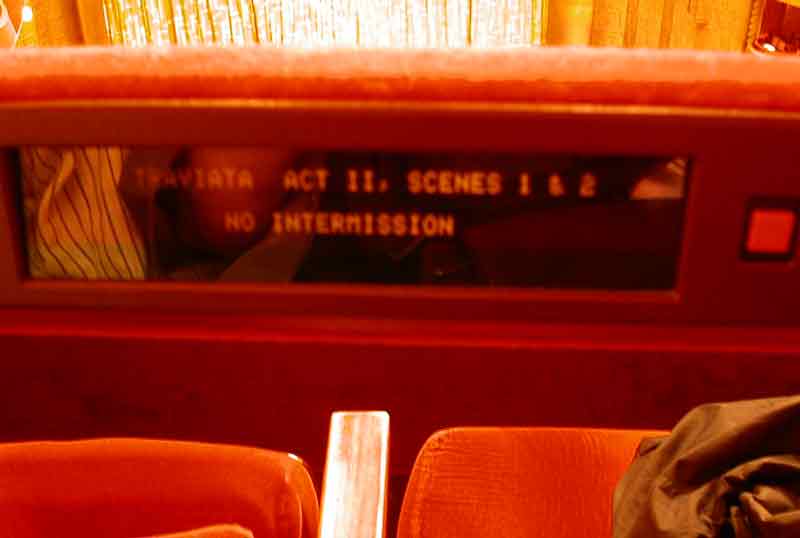
I will add a photograph of the system used in the Metropolitan Opera in New York, where there is a small screen in front of every seat in the house where you can choose to see titles if you want.