Der Standard

I have been reading Der Standard online for some time now, to have an Austrian view of things, but Handakte WebLAWg gives a different address, for Der Standard digital – you see a picture of each page in the paper edition, and click on articles for close-ups. It seems to be new, and it has icons to change the appearance on screen, change the configuration, download as PDF or text, display as PDF (it’s very nice to see the photographs). My link to it appears at the bottom of the screen (Windows XP Professional) as ‘ePaper Microsoft’, so there is something going on here that doesn’t just come from Der Standard.
Perhaps it became more evident today, since the Austrian printers’ strike meant that the paper appeared only online. But that’s the only way Der Standard is available in Fürth too; our papers in print are Fürther Nachrichten (as it has the Nürnberger Teil and the Fürther Teil, it has an advantage over the Nürnberger Nachrichten), all the other supra-regional German papers, three or four Turkish papers, and Russian papers, but those are probably only in the Russian shops (of which we have at least three or four).

Quoted from Der Standard, May 7: the digital version is identical to the print version. There will be a charge once the wrinkles are ironed out:

Seit Montag erscheint der digitale STANDARD, eine E-Paper-Version der gedruckten Tageszeitung, “eine neue Vertriebsform der Tageszeitung”, sagt STANDARD-Herausgeber Oscar Bronner zum neuen Angebot. Anders als die Onlineausgabe derStandard.at, die in einem eigenen Verlag mit eigenen Inhalten zusammen mit Inhalten der Tageszeitung erscheint, ist der digitale STANDARD in Aussehen und Inhalt ident mit der Zeitung des jeweiligen Tages. “Es wird kostenpflichtig werden, aber dazu müssen wir noch einiges lernen und verbessern”, erklärt Bronner.

ATA Legal Translation Conference 1

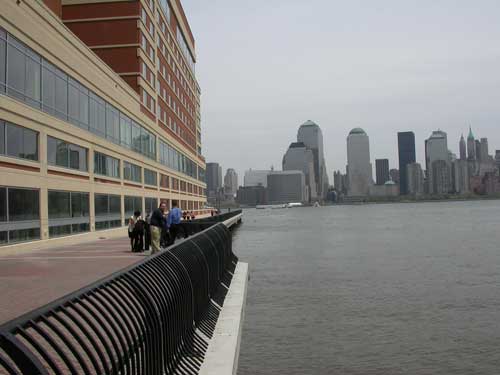
After one day at this conference, there are things I would like to research on the Internet, but on this TV Internet access system I can`t open two windows at once. So I will defer a link to the beautiful Hyatt Regency Hotel at Jersey City, whence the view of the financial district of Manhattan across the water is currently shrouded in rain. Also deferred is an investigation of the following: a notary in England may be a Latin notary, but how does one of those compare with a notary in South America, or indeed Germany (but Germany is really a minority language here – in fact I heard someone say that German in the USA is the new Japanese, that there is a shortage of translators and an increasing amount of work); is there such a thing in EnglishBritish legal usage as `leave to defend`, because in Israeli law there is, and many translators seem to use the term as a translation, but it is unfamiliar in the USA; Tom West, to whom (at Intermark Language Services) I will not today give a link, for technical reasons, said there is a big difference between the meaning of `provided that` (vorausgesetzt, dass) and `provided however that` (aber).

The selection of books on sale was good. For $50, for anyone interested in US business law (and more) by Davidson Knowles Forsythe (are those three names? I will supply a link later), a large book on Business Law, with many examples of documents, ISBN 0 538 86856 2. Interesting on legal French, b Beaudoin and Mailhot, Expressions juridiques en un clin d`oeuil / ISBN 2 89451 443 3 – perhaps Canadian? Beaudoin is speaking, but of course I will not hear him, because these talks are parallel. Yes, I see he has studied civil law and common law in Canada. Another book by him that looked particularly interesting was Les mots du droit (Legal Thesaurus). It consists of a list of common-law words that are especially difficult to translate into French, because polysemous, and a collection of `synonyms` in French that might be used to translate them.

I learned at lunch that it is OK to order a black-charred salmon and country artichoke club sandwich as a `salmon and artichoke sandwich`. There was a big language divide between the plain terms used by the orderers and the florid terminology of the waiter.

ATA Legal Translation Conference 1

After one day at this conference, there are things I would like to research on the Internet, but on this TV Internet access system I can’t open two windows at once. So I will defer a link to the beautiful Hyatt Regency Hotel at Jersey City, whence the view of the financial district of Manhattan across the water is currently shrouded in rain. Also deferred is an investigation of the following: a notary in England may be a Latin notary, but how does one of those compare with a notary in South America, or indeed Germany (but Germany is really a minority language here – in fact I heard someone say that German in the USA is the new Japanese, that there is a shortage of translators and an increasing amount of work); is there such a thing in English / British legal usage as ‘leave to defend’, because in Israeli law there is, and many translators seem to use the term as a translation, but it is unfamiliar in the USA; Tom West said there is a big difference between the meaning of ‘provided that’ (vorausgesetzt, dass) and ‘provided however that’ (aber).

The selection of books on sale was good. For $50, for anyone interested in US business law (and more) by Davidson Knowles Forsythe (are those three names? I will supply a link later), a large book on Business Law, with many examples of documents, ISBN 0 538 86856 2. Interesting on legal French, b Beaudoin and Mailhot, Expressions juridiques en un clin d`oeuil / ISBN 2 89451 443 3 – perhaps Canadian? Beaudoin is speaking, but of course I will not hear him, because these talks are parallel. Yes, I see he has studied civil law and common law in Canada. Another book by him that looked particularly interesting was Les mots du droit (Legal Thesaurus). It consists of a list of common-law words that are especially difficult to translate into French, because polysemous, and a collection of `synonyms` in French that might be used to translate them.

I learned at lunch that it is OK to order a black-charred salmon and country artichoke club sandwich as a `salmon and artichoke sandwich`. There was a big language divide between the plain terms used by the orderers and the florid terminology of the waiter.

German legal weblogs / Deutsche juristische Weblogs

Most sites that list international legal weblogs mention only two: Handakte WebLAWg by Rainer Langenhan, in German, and Walter Simon’s Simon’s Blawg (German with some English translations and summaries).
There is also one by Maximillian Dornseif, a postgraduate law student, in English, called disLEXia. His website gives more information about him, and the same goes for Langenhan and Simon.
Outside Germany is Professor Karl-Friedrich Lenz with Lenz Blog; he teaches German and European Law at a university in Tokyo.

These blogs contain a lot of interesting information on law relating to the Internet, not surprisingly. Not so another German blawg I found today: law blog by Udo Vetter, a German criminal lawyer. It consists of a series of little stories of everyday criminal defence and other episodes. Deserves to be quoted more often (all in German).

PROZESSORDNUNG

Hinweis eines Richters am Amtsgericht Herne:
„Die Versäumung richterlicher Fristen um weniger als 3 Werktage bleibt ohne Folgen, wenn die Partei darauf verzichtet, ihre Schriftsätze dem Gericht per Fax oder vorab per Fax zuzuleiten.“Die Idee ist ausbaufähig:
„Die Versäumung richterlicher Fristen um bis zu 5 Werktage bleibt ohne Folgen, wenn die Partei ihren Schriftsatz selbst locht, ihn persönlich vorbei bringt und an der richtigen Stelle in die Gerichtsakte einheftet.“
Oder:
„Die Partei, die am wenigsten schreibt, gewinnt den Prozess. Gefaxte Seiten zählen 5-fach.“’
(April 22nd)

Looking for the URL again, I find all listed at Saarbrücken. They also mention Der Jura-Channel, a legal news site, but without an RSS feed.

Posted in law

German Courts of Law / Deutsche Gerichtsnamen auf Englisch

It’s common knowledge among legal translators that there is a set of English, French and Spanish terms recommended by the Auswärtiges Amt as ‘translations’ of German court names. The terms are listed here, for example. Attempted standardization of outgoing translations is always fun, especially as a job-creating activity. But last year someone thrust into my hand a big A3 piece of paper with a full diagram of the courts, actually one page in German and another in English. It shows all the chambers and paths of appeal and contains a lot more vocabulary. I wanted to copy it to take to New Jersey (ATA legal translation conference) next week – it looks good on A4 too – but I couldn’t find a clean copy. Now I have actually found it appeared on the website of the German Ministry of Justice in February.
They always sneak something interesting onto that website. I remember an English version of the Criminal Code appearing. Today I found not only the Insolvency Act (they call it Insolvency Statute) – the German Law Archive announced that some time ago – but also the Völkerstrafgesetzbuch (Code of Crimes against International Law), and the Gerichtsverfassungsgesetz (Act on the Organization of the Courts or Judicature Act – they call it the Judiciary Act). Here’s one link, but searching around the site may help.

Looking briefly at the courts diagram, I note they like to use different words for Senat, Kammer and Gericht, although in my view all are chambers (but then again, a Senat may be larger than the number who sit). They have Panel for Senat in the Federal Court of Justice, Division for Kammer (I have an article by a U.S. law professor arguing in favour of division, but I tend to use division for Abteilung, e.g. criminal division of the Amtsgericht), and Court for Gericht.
The tricky word Schöffengericht is translated as Full Bench! I suppose it isn’t a bad idea, but then you have Extended Bench for Erweitertes Schöffengericht, which makes me wonder if someone has to sit on the floor. What about Schwurgericht? They simply omit it. It is a form of Große Strafkammer (Grand Criminal Division). For Schöffe they have lay judge, which I agree with. There’s a Rechtspfleger in the civil division of the Amtsgericht and that used to be easy to translate into British English as registrar, because there was a kind of sub-judge at the English county court called registrar. But when they were renamed district judges, the term registrar seemed too obscure or ambiguous. This BMJ list (does anyone know where it comes from?) leaves Rechtspfleger in German. I didn’t think we were supposed to do that… For ehrenamtlicher Richter, for instance in the courts of labour law, I don’t really like ‘honorary judge’: this is more like ‘unpaid’. Still, the diagram’s language is largely comprehensible.

Eine Geschichte / A Story

Es war mal eine deutsche Übersetzerin, die nach England zog. Eines Tages bat man sie, den Führer für eine berühmte Kirche ins Deutsche zu übersetzen. Sie sah, dass der Text machbar für sie war, allerdings mit ziemlich viel Recherche, und sie entschloss sich, den Auftrag anzunehmen. Sie holte sich Kirchenführer, die auf Deutsch geschrieben waren, und sie recherchierte in Büchern über Architektur, Geschichte, die Bibel, Kunst, Orgelbau und Religion. Zum Glück hatte sie eine Freundin, die Orgel spielte und auch Deutsch und Englisch konnte. Es gab auch zweisprachige Wörterbücher zu Architektur, aber wie alle zweisprachige Fachwörterbücher waren sie nicht ganz zuverlässig – sie musste den Fachwortschatz in beiden Sprachen in einsprachigen Büchern vergleichen. Eine Bibelkonkordanz war eine Hilfe. Manche Termini waren auch in großen, auch älteren, allgemeinen zweisprachigen Wörterbüchern erhalten. Sie sah sich auch die Kirche an. Der Text war nicht immer klar, und Fotos waren auch sehr nützlich. Sie klärte die letzten Fragen mit dem Autor. Am Ende wurde die Übersetzung für gut geheißen, und sie bekam weitere Aufträge für Kirchenführerübersetzungen.
Über die Jahre wurde sie erfahrener auf dem Gebiet, aber jeder Führer brachte neue Schwierigkeiten. Manchmal waren die Autoren Kunsthistoriker, manchmal nicht. Fast immer schienen sie eine geschwollene Sprache zu schreiben, und sie verwendeten lieber das seltene Wort als das alltägliche. Manchmal verwendeten sie auch das falsche Wort, man musste das Fachgebiet kennen, um zu wissen, was gemeint war. Die Übersetzerin versuchte, ein zwar förmliches aber nicht allzu hochgestochenes Deutsch zu schreiben. Es sollte ja eine Übersetzung sein, sie durfte den Ton und den Wortschatz des Autors nicht radikal umkrempeln.
Nun gibt es in Großbritannien sehr viele Leute, die Deutsch können. Manchmal konnte es der Autor, manchmal hatte er einen Bekannten, der Deutschlehrer war. Es ist auch hilfreich für eine Übersetzerin, wenn die Übersetzung von einer zweiten Person durchgelesen wird. Vielleicht fehlt doch ein Wort, vielleicht ist etwas falsch verstanden worden. So kam das Endlayout vom Verlag mit handschriftlichen Notizen zu ihr und sie konnte ihre Arbeit korrigieren.
Bei manchen Führern gab es aber große Probleme. Statt zehn Stellen waren über zweihundert angestrichen. Mal waren alle Zeitformen geändert, mal wollte der Korrektor einen Haufen Anglizismen in den Text bringen. Ein Deutschlehrer wollte längere Sätze und gehobenere Ausdrucke, eine Gruppe von Nonnen, die einen Führer mit abgehobenen Kunstbeschreibungen produziert hatten, behauptete, deutsche Touristen würden nur eine ganz einfache Sprache verstehen. Oft wurde der Satzbau so umgestellt, wie es auf Deutsch nicht möglich ist, und ein englischer Satzbau wurde vorgeschlagen, „weil es besser klingt“. Oder es wurde ein Synonym eingesetzt, da der Kritiker nur ein Wort kannte, nicht beide. Es kam auch vor, dass der Autor deutsche Bekannte hatte, die die verschiedensten Berufe hatten, aber nichts mit Schreiben zu tun, die aus dem Bauch heraus Fehler fanden, die normale Ausdrucke der deutschen Schriftsprache waren.
Die Übersetzerin hatte sich über lange Jahre in das Gebiet eingearbeitet. So oft sie konnte, wenn es zeitlich ging, besuchte sie die Kirche, um ihren Text zu überprüfen. Jetzt saß sie manchmal stundenlang und schrieb Rechtfertigungen ihres Verständnisses der deutschen Sprache an Kritiker, die selber nicht gut Deutsch schreiben konnten.
Das Schlimme dabei war, dass sie sich am Ende der Aktion immer wie eine Lügnerin vorkam, da sie allein auf weitem Feld ihr eigenes Deutsch befürwortete aber umgeben war von deutschsprechenden Engländern, die anderer Meinung waren.
Was stimmt nicht an dieser Geschichte?

Once upon a time there was a German translator who moved to England and one day was asked if she could translate a small guidebook to a famous church. She looked at the text carefully to see if she thought she could translate it, and she decided she could, albeit only with a lot of research. She collected church guides originally written in German, she researched in books on architecture, history, the Bible, art, organ building and religion. Fortunately she had a friend who could play the organ and spoke both English and German. There were also bilingual dictionarieis on architecture, but they were not very reliable: she had to research the terms of art in monolingual books. She started using a Bible concordance. Some of the vocabulary could be found in large general bilingual dictionaries, including those that were out of date. She also looked at the church. The text wasn’t always clear, and she found photos very useful too. She sorted out the last questions with the author, and finally the translation was accepted and she was offered more church guides to translate.
Over the years she became more and more experienced in these translations, but every text had its own difficulties. Sometimes the author was an art historian, sometimes not. They nearly always seemed to prefer a bombastic style, and they preferred unusual words to common ones. Sometimes they even used the wrong word, and it was necessary to know the subject field to understand what they meant. The transaltor tried to write formal but not pompous German. She had to deliver a translation, so she could not radically alter the style and vocabulary used by the author.
Now in Great Britain, there are very many people who can speak German. Sometimes the author spoke German, and sometimes he knew someone who was a German teacher. It is very useful for a translator if the translation is read over by someone else. She may haveleft out a word, or misunderstood something. So the final layout marked by the author was sent to her and she was able to correct her own work.
But with some guides there were great problems. Instead of ten words being queried, there were suddenly over two hundred comments. Sometimes all the tenses were changed, and sometimes the corrector wanted to introduce a lot of anglicisms. A German teacher wanted to have longer sentences and more elevated expressions, while a group of nuns who had written a guide with abstruse descriptions of art claimed that German tourists can only understand very simple language. The syntax was often altered in a way that was impossible in German and English syntax was suggested ‘because it sounds better’. Or a synonym was suggested, since the critic knew only the synonym, not the original word. Sometimes, too, the author knew Germans from the most varied walks of life, but who had nothing to do with writing. These acquaintances, relying on their own gut reaction to the text, found mistakes that were actually normal expressions in written German.
The translator had gradually learnt about the subject matter over long years. As often as she could, if she had time, she visited the church to check her text. Now she sometimes found herself sitting for hours writing justifications of her understanding of the German language, addressed to critics who themselves did not write good German.
The terrible thing was that at the end of all this she always felt like a liar, since she was the only person involved who approved of her own German, but she was surrounded by German-speaking English people who did not agree with her.
What is wrong with this story?