Economist on translation and the law

An article in The Economist on the growing demand for legal translation: Translating and the law.

It envisages this as a good prospect for underworked lawyers:

Specialised “e-discovery” software helps lawyers cull the masses of electronic data. But in international deals and lawsuits, such software must be run by cultural and linguistic experts to make sure the correct search terms are used and the right information is ferreted out. Translation is still something that computers do badly much of the time, especially when the topic (a drug patent, say) is a difficult one full of technical details.

The many law students wondering if the rotten legal job market will ever improve should take note. The twin forces of globalisation and technology may put many mediocre lawyers out of business. But those who master languages and computers may find themselves in demand.

There’s nothing wrong with lawyers translating – I am a Germanist who became a solicitor and spent 20 years teaching legal translation, for which there was at the beginning little demand and where I had to teach myself. But I hope those lawyers with language skills get some kind of training on what translation and working with related software involve, and above all have experience.

The article originates in New York and the discovery problems in the USA are particularly great. I think the patent translator Steve Vitek spends a lot of time telling his clients which Japanese patent documentation needs looking at more closely. I tell clients or potential clients what statutes or judgments are available in translation on the Internet and whether I think the translation is reliable. That sort of thing requires experience.

Tweeted by Helen Gibbons, retweeted by Kevin Lossner

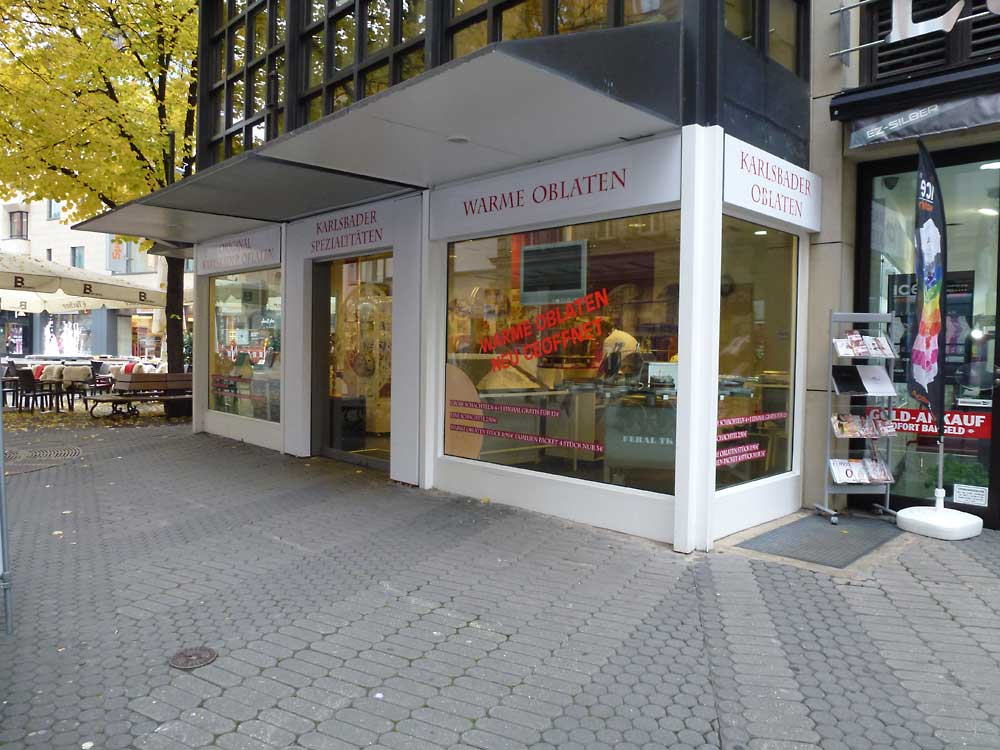
Karlsbader Oblaten shop in Nuremberg/Karlsbader-Oblatengeschäft in Nürnberg

I was surprised to see this shop selling Karlsbader Oblaten, cold and warm, in Nuremberg today, though they say they’ve been there for four months.

Here is a machine for making them:

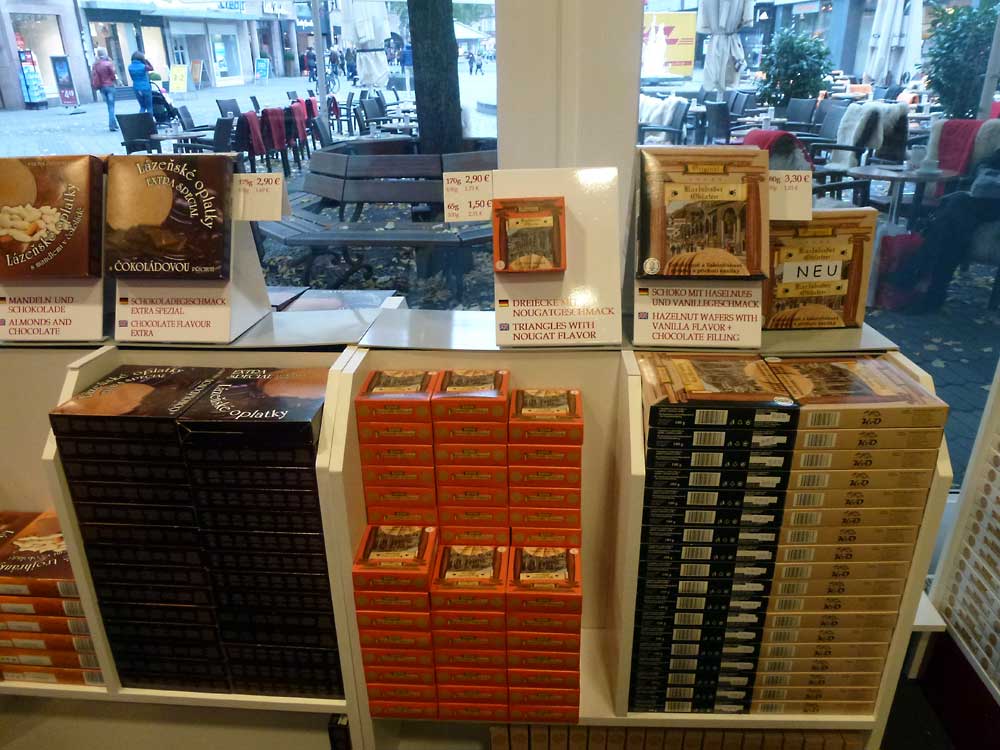
They have a huge range of flavours.

The firm is in Karlsbad – www.kvoplatky.cz

I have often encountered Karlsbader Oblaten – probably on my first trip to Prague in 1966 or my second in spring 1968, and certainly sold from a van in Karlsbad in 1990 or 1991. I have even been to Dillingen, where a former seminary is used for further training for Bavarian schoolteachers, and where the local industries include votive candles and German Karlsbader Oblaten, and visited Wetzel.

There has been a dispute between the Czech Republic and Germany on the use of the name, and I gather that the term Karlsbader Oblaten will be restricted in Germany, but firms like Wetzel which have registered it as a trademark can go on using it.

The statements of objection were declared admissible on the ground, inter alia, that registration of the proposed name would jeopardise the existence of a partly identical name, namely “Karlsbader Oblaten”, in so far that this name is used for a product and not protected under trade mark legislation. The evidence further shows that the name “Karlsbader Oblaten” originated from producers in the town formerly known as Karlsbad and that production of the wafer so named has continued for a considerable period of time. Moreover, the evidence shows that the uses of the name “Karlsbader Oblaten” referred to an authentic and traditional product having a common origin with “Karlovarské oplatky”, but was generally not meant to exploit the reputation of the latter name. For these reasons, and in the interests of fairness and traditional usage, the maximum transitional period foreseen by Article 13(3) of Regulation (EC) No 510/2006 should be foreseen.

I have only tried a small wafer with Nugat (gianduja) cream and it was better than Wetzel’s, I thought.

Albrecht Dürer

There was a good Dürer exhibition in Nuremberg this year, but it was very full. Fortunately I got there very early in the day, but still by eleven it was too full to read the rather well-done and succinct texts, especially with bifocals.

And I have still not visited the Albrecht-Dürer-Schwein in Hundshaupten.

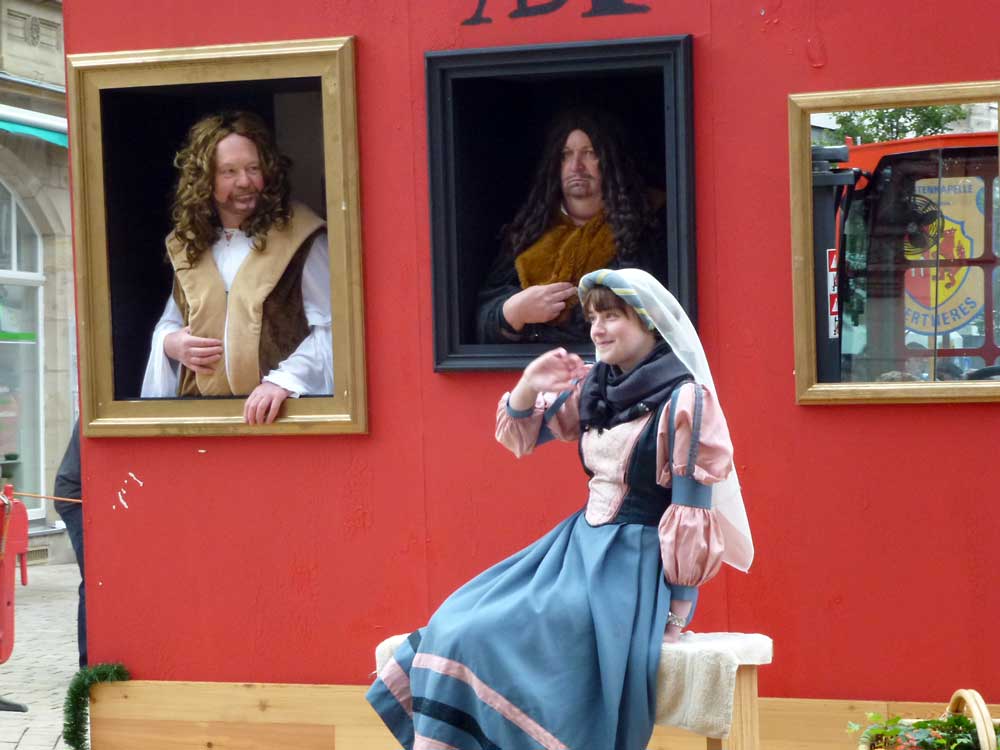
However, Dürer did appear on a float at the Fürth harvest festival procession last week:

The text is a reference to the refusal by the Alte Pinakothek in Munich to send a self-portrait to the exhibition because it was not suitable for transport.

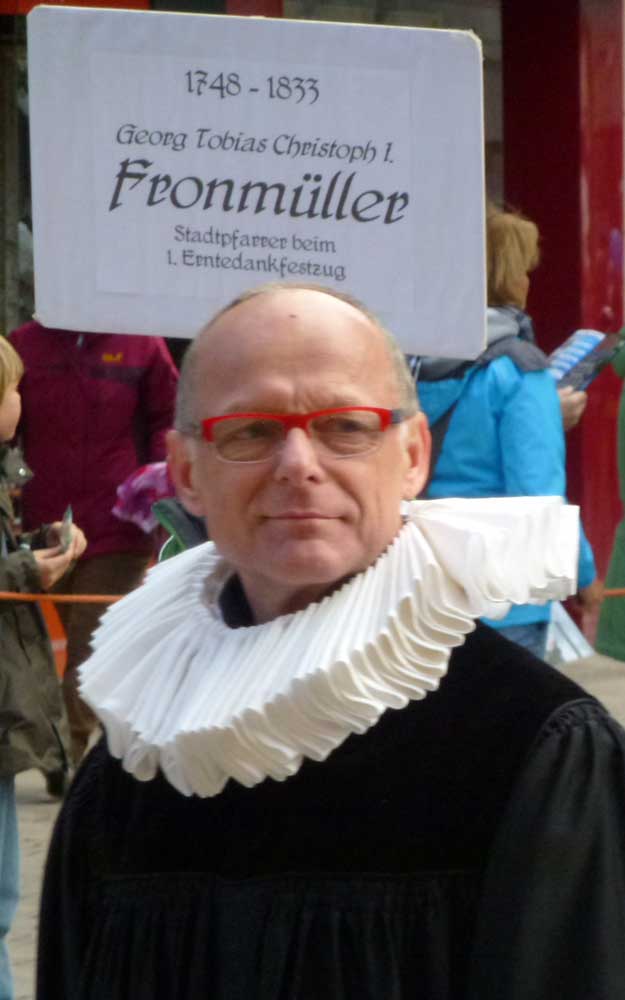
Here’s a Protestant church representative showing how exciting 18th-century glasses were:

Signing off on emails/Wie unterschreibe ich eine E-Mail?

Diamond Geezer has a great post on how to start and end an email, with 44 comments at present. It starts Hi Reader and ends Many thanks dg.
I think this shows that there is no easy answer to how to address people in both formal and informal emails.
I hope this post doesn’t come across as prescriptive, because I have great doubts about all forms of address and closing.
In German, the problem is just as great.

First, in letters (British English only):
Dear Sir or Madam … Yours faithfully
Dear Mr. Smith /Dear John … Yours sincerely

In the law firm I worked in, we had this closing for clients:
Kind regards

In formal emails, you might start
Dear…
And close:
Best regards
Kind regards

Is this right? I rarely write formal emails in English and I have been known to close
Yours sincerely

which may be a no-no in email.

Now the emails to friends, acquaintances and forums.
I usually start:
Hi
Some write
Hello

To a forum, I often start without a greeting.

To close, I usually write
Regards
Some write
Kind regards
Best regards

which seem awfully formal to me.
Then there are
Cheers
and if one wants an answer
Thanks
Many thanks
TIA
MTIA
Best wishes

I particularly liked dg’s comments on Take care.

Take care. Whereas this one’s not so good. It may be only eight letters long, but there’s an unspoken hint within that something terrible is about to take place. You might as well end your email with “Watch out!” instead. It’s much too negative for me, and I’d hope for you too.

But I suspect that Take care is more common among Americans.

Now about German. First, formal.
A potential new client might write:
Sehr geehrte Frau Marks … mit freundlichen Grüßen /freundlichen Gruß
or
Hallo Frau Marks
Guten Tag Frau Marks

This is less formal and might come from the secretary of a client one already knows.
After some time, the client might want to be more friendly:
Liebe Frau Marks
Hallo Frau Marks /Guten Tag Frau Marks

Beste Grüße
Herzliche Grüße
Viele Grüße

Not everyone likes Viele Grüße, but I quite like it, and in any case I follow the client’s lead.
Non-Germans should note that the ß character has not been abolished – Gruß/Grüße and Straße are the most common pitfalls (except in Switzerland, of course).

Now in German to friends, acquaintances and forums.
I do have a difficulty here, because I have found German forums more formal than American and British ones. Maybe that’s because I was on CompuServe much earlier than on German forums and they seemed slower to relax. I have had my knuckles rapped and been thought to be intentionally rude for writing to a forum without a greeting. This was obviously an offence against German netiquette. I don’t know if that is the case any more, but I have an uncomfortable feeling when I write to a German forum.
So some write
Liebes Forum
Liebe Mitglieder

or some variation on the forum’s name.
Otherwise it’s down to
Hallo
Moin
I don’t feel northern enough to use Moin (which is not limited to the morning)
I usually close with
Gruß
but always feeling it is a bit abrupt.
I have not got used to the increasingly common
Liebe Grüße
which feels overfriendly to me but is possibly becoming standard.
I have just checked my inbox and found one
Schöne Grüße
and one
Mit kollegialen Grüßen
(this reminds me a bit of Mit sozialistischem Gruß in Goodbye Lenin).
It’s also, I remember, fairly common to mention the weather in one’s location:
Mit verregneten Grüßen aus Köln
Mit sonnigen Grüßen aus München

or if one wants a reply to a question
Neugierige Grüße
Is this done in English? I certainly avoid it.

LATER NOTE:
It’s been pointed out by a commenter that MfG is a bit of a no-no, especially in formal correspondence.
That reminds me of some abbreviations widespread in informal contexts. Thnx rather irritated me because it’s scarcely shorter than Thanks.

Lawyers among themselves use Mit kollegialen Grüßen (see comment). I sometimes have to translate this into English, and the equivalent is just Yours sincerely or Best/Kind Regards. There’s a lovely heated discussion on this on the LEO forum.

And I forgot to mention the direct address I often use on forums: just the name of the person addressed, without any ‘Dear’.