Marital acquest/Zugewinn

In the recent entry on the Mills-McCartney divorce arrangements, I quoted this:

This is not a case where the principle of sharing of the “marital acquest” is engaged at all.

This term was new to me. It seems a good solution for Zugewinn in German law: the property acquired by both spouses from the date of marriage on, which may be divided fifty-fifty in Germany if so agreed or in default of a contract. The situation in England is different, but still it can be necessary to talk about this amount as one of the factors.

I find acquest in the OED:

3. Law. Property gained by purchase, or gift, or otherwise than by inheritance.

Used in this sense in French and in jurisprudence, it says in the etymology.

Google reveals 112 uses, and I think it must recently have been taken up. Probably it was one of the recent big cases where the concept needed to be discussed that used it and was widely reported.
Here‘s an example:

Increasingly on divorce (and the same principles are likely to apply on the dissolution of civil partnerships) the court is interested in ascertaining what has been described as the ‘marital acquest’, that is, the assets accumulated by the parties during their marriage.

I see it was quoted in Miller v. Miller.

This does not mean that, when exercising his discretion, a judge in this country must treat all property in the same way. The statute requires the court to have regard to all the circumstances of the case. One of the circumstances is that there is a real difference, a difference of source, between (1) property acquired during the marriage otherwise than by inheritance or gift, sometimes called the marital acquest but more usually the matrimonial property, and (2) other property.

Zugewinn is usually translated as accrued gains or surplus.

BILD on law/BILD-BGB

BILDblog corrects some legal advice given in BILD Zeitung, quoted as follows:

Laut Artikel 195 des Bundesgesetzbuches (BGB) können Sie Fehler von Handwerkern bis zu drei Jahre nach der Dienstleistung geltend machen.

Apart from the fact that the usual period for a Werkvertrag (loosely translated as contract for work and services) is two years, the misquotation of a Paragraf (section) of the Bürgerliches Gesetzbuch reminds me of a howler contained in a book of standard English translations of German legal texts that is sold by a translator in Germany, where at least at one time EGBGB (Einführungsgesetz zum BGB – Introductory Act to the Civil Code) was rendered as European Civil Code (we’re still waiting for that).

(Via der winkelschreiber)

Details of McCartney-Mills divorce/Details der McCartney-Mills-Scheidung

Yesterday’s judgment in the Paul McCartney – Heather Mills McCartney divorce has been released in full. Both the Guardian and the Independent have the full text online, and no doubt they are not alone.

There hasn’t yet been a divorce. Both parties have agreed to wait until after May 1, when they will have been separated for two years and can therefore base their divorce on the fact of separation rather than ‘unreasonable’ behaviour.

This judgment relates to the ancillary proceedings for maintenance pending divorce and for property arrangements. The English courts can decide themselves what is a fair division of property, guided by statute and precedent.

The husband’s case on financial provision for the wife is summarised at paragraph 9 of the opening note of Mr Mostyn QC as follows:
“We submit that fundamentally this is a straightforward case. Because of H’s enormous pre-marital wealth and because of the brief duration of this marriage W’s claim should be determined by reference to the principle of need alone. This is not a case where the principle of sharing of the “marital acquest” is engaged at all. Nor is it a case where the principle of compensation will arise. W’s needs fall to be fairly assessed, not predominantly by reference to the standard of living during the marriage. W’s award should be reduced to reflect her postseparation misconduct. That misconduct is based on three distinct episodes as explained in our Conduct Note.”

Heather Mills McCartney’s case was harder to summarize. She argued inter alia that she was wealthy when she met her future husband and gave up a lucrative career for his sake; he advised her against taking on job offers:

Countless lucrative business opportunities were made to me once Paul and I married. Sadly, Paul advised against 99% of all of them. He stated that they were only interested in me because of his name and that I should just stick to charity work and he would take car of me. When I was asked to design clothes, create a food line, write books, make a video, write music or do photography, Paul would almost always state something like “Oh no you can’t do that, Stella does that or Mary does that or Heather (his adopted daughter) used to do that or Linda did that.” even though I had been involved with fashion and modelling for years.

There is much more.

The Guardian reports that Mills confirmed to the press that she had poured a jug of water over Fiona Shackleton:

Mills also confirmed reports that she had poured water on Sir Paul’s lawyer, Fiona Shackleton. Mills said she approached the lawyer and said: “I’m not a loser” before tipping the water jug over her.

“I poured the whole jug of water on her head. I was very calm”, she said.

Unauthorized use of titles/Ermittlungen gegen Gebrauch eines US-Doktortitels

There’s been some excitement in the press about criminal investigation proceedings against some highly qualified Americans at the Max Planck Institute in Jena and elsewhere. They had the temerity to describe themselves as Dr. and Professor Dr. But in Germany, you can use Dr. as part of your name only if the doctorate is German.

What academic titles one can bear is governed by Land law. When I started teaching at a Bavarian Fachakademie in 1982, I was not allowed to call myself Frau Dr. Marks, although this did not stop my employer doing so. I was not even allowed to write Ph.D. after my name – I would have had to pay a sum of 83 DM, I think it was, to be allowed to do so. I may have broken this rule, because I certainly didn’t pay the money. I don’t know what the penalties were, but it was a matter of administrative law as far as I was concerned.

In recent years, the situation has been relaxed for EU citizens. I suppose Germany was forced to grant reciprocity. I was still told I might call myself Frau Dr. (London) Marks. Doesn’t exactly roll off the tongue, does it?

The Kultusministerium used to write to a British fellow-examiner, who was employed at the FIM Fachakademie in Munich, as Herr Dr. X. One day I found out while chatting to him on the phone that his Ph.D. was from Oxford! This was before the EU relaxation. Shortly afterwards I was able to leverage the forbidden title out of the Kultusministerium after I wrote them a letter (they had curtly told my school principal a few years before that a Kultusministerium cannot call a foreigner Dr.).

Anyway, the hoo-hah now relates to Americans and to section 132a of the German Criminal Code, which imposes a sentence of up to one year’s imprisonment or a fine on those who use German or foreign titles without authorization. § 132a German § 132a English.

The main purpose of this section is apparently to protect the general public against those falsely claiming expertise. Using the title on one’s business card is evidence, but I presume that if the person does not normally act in a manner likely to damage the public, the charges will be dropped.

See article in the Washington Post, Non-European PhDs In Germany Find Use Of ‘Doktor’ Verboten.

Ian Thomas Baldwin, a Cornell-educated researcher at the Max Planck Institute for Chemical Ecology in Jena, has stopped calling himself “Dr.” ever since he was summoned for interrogation by police two months ago on suspicion of “title abuse.”
“Coming from the States, I had assumed that when you get a letter from the criminal police, you’ve either murdered someone or embezzled something or done something serious,” said Baldwin, a molecular ecologist. “It is absurd. It’s totally absurd.”

Der Spiegel has the story in German.

In der Tat hatte sich der Amerikaner auf Visitenkarten, Briefpapier und der Internet-Präsenz seines Instituts als “Prof. Dr. Ian Baldwin” bezeichnet. Das hatte sich Baldwin so angewöhnt, weil ihn seine deutschen Kollegen exakt so angeschrieben hatten. An “Professor Dr. Ian T. Baldwin” etwa war der Brief adressiert, mit dem die Max-Planck-Gesellschaft ihren Neuzugang 1996 herzlich begrüßt hatte, einen von gleich drei Amerikanern, die sie für Jena gewinnen konnte. Auch Einladungen zu Vorträgen an Universitäten ergingen immer an den “Prof. Dr.”.

Der Spiegel says that the problem has probably been caused by a frustrated foreigner who is not allowed to call himself Dr. in Germany and who is taking his revenge by reporting Max Planck Institute scientists who do this to the police, who are then happy to pursue the complaints.

LATER NOTE: there are at present 77 comments on the Washington Post article. There are some wonderfully ignorant and ranting remarks: the term ‘reichsanwalt’ contributed by someone in Munich with a law degree, the suggestion that Germany only became a nation in the 1930s, the view that fascism has reigned in Europe since the Roman Empire and the EU was the first step towards ‘the end’, and ‘The Germans have been causing trouble as far back as the Goths’. Also some good sense on § 132 from Robert Gellately. Great irritation at Germany being the only country in the world to require a licence to play golf. And ‘not all bad, puts Condi Rice down a couple of pegs. Univ. of Denver prob wont even make the 200 school list when they relax the law.’

Via German American Law Journal blog, which points out that the press will have a wonderful anti-German field day with this.

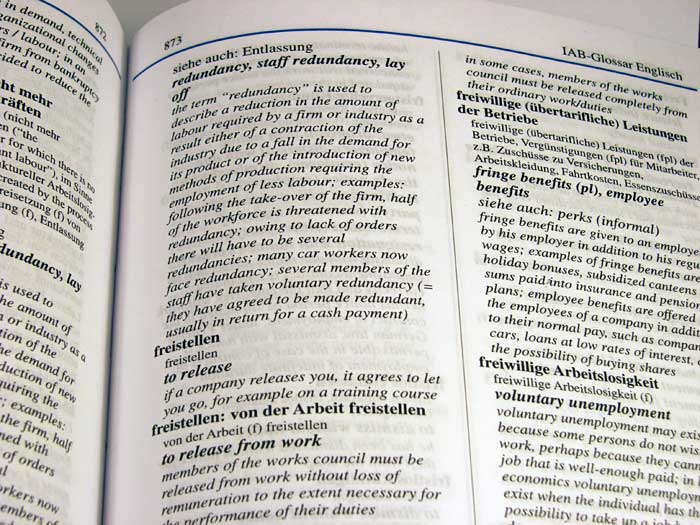
IAB Glossar

There was a discussion of the IAB Glossar on a translators’ mailing list recently. I was interested to know if anyone else found it useful. There came praise in the highest tones from an in-house ministry translator. I suspected the book was of most use to German civil servants who knew the topic and were working into English.

Here’s an entry on Freisetzung von Personal (click to enlarge):

It looks to me as if that definition is a definition of the German term, which happens to appear in English. The identical definition appears in the EN to DE half.

This sort of thing makes me uncomfortable. Where did they find their English definition? I’d have to research it. Dietl is completely different: in the DE to EN part, it will have a definition of Amtsgericht, for example, in both languages. And I know as the reader that that is Dietl’s definition summarizing the German situation. But the IAB approach is not good for people translating between two systems of law. If I don’t know which system is being referred to, how can I assess the quality of the suggestion?

Another thing I found odd was that the word Freistellung was not given in the garden leave sense, which is quite common nowadays, of preventing people from working out their notice.

I did post a query, but unfortunately it was misunderstood as a request for more information about gross misconduct:

Könntest Du mir ein Problem erklären, das ich mit diesen Glossaren habe: im EN>DE Teil (2004 Ausgabe) unter “gross misconduct” steht eine lange Definition auf Englisch: “gross misconduct represents a serious transgression of disciplinary rules, which is normally punished through dismissal without notice …”, ohne Quellangabe. Im DE>EN Teil steht unter grobes Fehlverhalten keine deutsche Definition, sondern genau die gleich englische Definition, wieder ohne Quellangabe. Unter “Verfehlung” steht zum dritten Mal genau die gleiche englische Definition, wieder ohne Quellangabe.

EN>DE steht “schwere, / grobe Verfehlung, grobes Fehlverhalten” als
Übersetzungen.

Ich habe den Eindruck, dass hier eine Definition aus dem deutschen Arbeitsrecht steht, aber da wäre es leicht, einen Paragrafen zu nennen. Und die deutsche Fassung der Definition müsste auch zu finden sein. Das ist mit ein Grund, warum ich das Buch selten öffne, gerade weil auch ich mich mit feinen Unterschieden beschäftigen und auskennen muss. Ich habe den Eindruck, hier ist ein internes Werk, das für Deutsche Beamten gedacht ist, die deutsches ins Englische übersetzen und denen die deutschen Definitionen bekannt sind, aber die gerne Hilfe bei der englischen Formulierung hätten.

(For details of this book, see earlier entry – it’s apparently available as a CD too now)