German-American Day Blawg Review

Andis Kaulins’ blawg review for German-American Day, recently mentioned here, has now appeared.

There are a large number of links on matters German, some of them German and law, for example the German American Law Journal (note in its English version an entry on an article by Dr. Jessica Ohle on Recent Trends in German Employee Compensation. And let’s not forget the similarly-named German Law Journal, another excellent resource.

Scroll down (passing the non-German law links) for a large number of further transatlantic links.

Famous German-Americans are mentioned, although not including the three famous bankers from Franconia: Lehmann, Goldmann and Sachs.

Drei Banker von Weltruhm – alle drei waren sie Juden, die keine Perspektive mehr sahen in Unterfranken, Mitte des 19. Jahrhundert. Keine Zukunft, kaum Spielraum – die Gesetze für Juden waren hier sehr streng. Jüdische Bürger konnten sich nicht einfach niederlassen oder heiraten, wenn sie wollten. Sie durften keinen Beruf erlernen. Zahlen mussten sie aber – Steuern und Sonderabgaben für alles und nichts. Heinrich Lehmann, Marcus Goldmann, beide Söhne von Viehhändler, wollten so nicht leben.

MoMiG

Gesetz zur Modernisierung des GmbH-Rechts und zur Bekämpfung von Missbräuchen MoMiG

Suggestions encountered:

Law for the Modernisation of the German Limited Liability Company Law and the Prevention of Misuse
Law for the Modernization of the Private Limited Companies Act and to Combat its Abuse
Act to Modernise the Law Governing Private Limited Companies and to Combat Abuses

I prefer the third one, which is from the Bundesjustizministerium. They might write ‘modernize’, but a lot of people seem to think ‘ise’ is de rigueur in the EU. Did the first two really confuse Recht with Gesetz, or was it an earlier title?

The German Law Journal has a special issue on the topic (no. 9 for 2008, if you read this later).

One of the probably most groundbreaking – and at the same time also most contentious – issues of the German reform of private limited companies by the Gesetz zur Modernisierung des GmbH-Rechts und zur Bekämpfung von Missbräuchen (MoMiG – Law for the Modernization of the Private Limited Companies Act and to Combat its Abuse)[1] is the introduction of the Unternehmergesellschaft (UG – Entrepreneurial Company). This new sub-type of the Gesellschaft mit beschränkter Haftung (GmbH – Private Limited Company) is specifically designed for entrepreneurs and has already unofficially been dubbed the “Mini-GmbH” and “GmbH light”. It can be seen as the centerpiece of the legislator’s overall aim to facilitate and accelerate the formation of companies and the underlying motive of increasing the international competitiveness of the German GmbH.

Borders/Grenzen

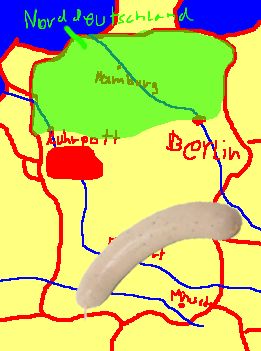
Weißwurstäquator, from the mysterious Kamelopedia (albeit misplacing Franconia vis-à-vis the WW):

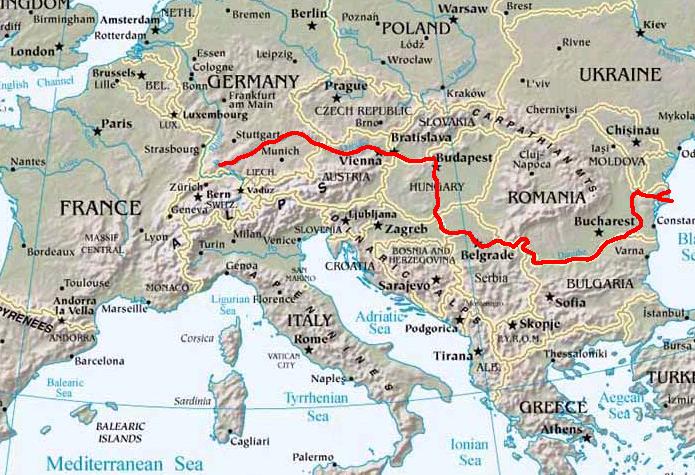
Within Germany, the dividing line is the River Danube, which puts me north of the equator. Wikipedia has a map showing the Danube, but the Weißwurst is not eaten everywhere south of the Danube, of course, only, at most, in the German bit (and there, ideally only before the cuckoo clock strikes midday).

Meanwhile, Strange Maps has a graphic image of the Swiss Röstigraben, and much information. Here is a more detailed map.

The language border dividing these two areas is known jestingly as the Röstigraben (in German) or the rideau de rösti (in French). A Graben is a ditch and a rideau is a curtain, so you get the idea of separation – but what a Rösti is and why it is significant, requires a bit more explanation.

This dish is made mainly by frying grated potatoes in a pan. It was formerly eaten as breakfast by farmers in the (German-speaking) Bern canton. The original conceit of the Röstigraben was that it constituted the western limit of the German Swiss culture, beyond which people spoke (and ate) differently.

The Rösti has gained popularity as a side dish all over Switzerland, but the language and cultural differences persist.

Another culinary division mentioned in comments to the above is the Gefilte Fish Line:

The “gefilte fish line” ran though eastern Poland.
Jews living to the west — most of Poland, as well as Germany and the rest of Western Europe — ate the sweet gefilte fish. Those to the east — Lithuania, Latvia and Russia — ate the peppery version.
But Steinlauf’s tale is not just a fish story. It’s also about language.
He said the “gefilte fish line” roughly overlaps another important line: a linguistic divide between two major variants of Yiddish.

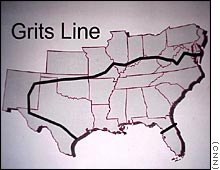
LATER NOTE: Here is a map showing the Grits Line (see comments). The map was originally from CNN but I found it in this forum.

Thanks to the Great Wall of Catalonia.

Unauthorized use of titles/Ermittlungen gegen Gebrauch eines US-Doktortitels

There’s been some excitement in the press about criminal investigation proceedings against some highly qualified Americans at the Max Planck Institute in Jena and elsewhere. They had the temerity to describe themselves as Dr. and Professor Dr. But in Germany, you can use Dr. as part of your name only if the doctorate is German.

What academic titles one can bear is governed by Land law. When I started teaching at a Bavarian Fachakademie in 1982, I was not allowed to call myself Frau Dr. Marks, although this did not stop my employer doing so. I was not even allowed to write Ph.D. after my name – I would have had to pay a sum of 83 DM, I think it was, to be allowed to do so. I may have broken this rule, because I certainly didn’t pay the money. I don’t know what the penalties were, but it was a matter of administrative law as far as I was concerned.

In recent years, the situation has been relaxed for EU citizens. I suppose Germany was forced to grant reciprocity. I was still told I might call myself Frau Dr. (London) Marks. Doesn’t exactly roll off the tongue, does it?

The Kultusministerium used to write to a British fellow-examiner, who was employed at the FIM Fachakademie in Munich, as Herr Dr. X. One day I found out while chatting to him on the phone that his Ph.D. was from Oxford! This was before the EU relaxation. Shortly afterwards I was able to leverage the forbidden title out of the Kultusministerium after I wrote them a letter (they had curtly told my school principal a few years before that a Kultusministerium cannot call a foreigner Dr.).

Anyway, the hoo-hah now relates to Americans and to section 132a of the German Criminal Code, which imposes a sentence of up to one year’s imprisonment or a fine on those who use German or foreign titles without authorization. § 132a German § 132a English.

The main purpose of this section is apparently to protect the general public against those falsely claiming expertise. Using the title on one’s business card is evidence, but I presume that if the person does not normally act in a manner likely to damage the public, the charges will be dropped.

See article in the Washington Post, Non-European PhDs In Germany Find Use Of ‘Doktor’ Verboten.

Ian Thomas Baldwin, a Cornell-educated researcher at the Max Planck Institute for Chemical Ecology in Jena, has stopped calling himself “Dr.” ever since he was summoned for interrogation by police two months ago on suspicion of “title abuse.”
“Coming from the States, I had assumed that when you get a letter from the criminal police, you’ve either murdered someone or embezzled something or done something serious,” said Baldwin, a molecular ecologist. “It is absurd. It’s totally absurd.”

Der Spiegel has the story in German.

In der Tat hatte sich der Amerikaner auf Visitenkarten, Briefpapier und der Internet-Präsenz seines Instituts als “Prof. Dr. Ian Baldwin” bezeichnet. Das hatte sich Baldwin so angewöhnt, weil ihn seine deutschen Kollegen exakt so angeschrieben hatten. An “Professor Dr. Ian T. Baldwin” etwa war der Brief adressiert, mit dem die Max-Planck-Gesellschaft ihren Neuzugang 1996 herzlich begrüßt hatte, einen von gleich drei Amerikanern, die sie für Jena gewinnen konnte. Auch Einladungen zu Vorträgen an Universitäten ergingen immer an den “Prof. Dr.”.

Der Spiegel says that the problem has probably been caused by a frustrated foreigner who is not allowed to call himself Dr. in Germany and who is taking his revenge by reporting Max Planck Institute scientists who do this to the police, who are then happy to pursue the complaints.

LATER NOTE: there are at present 77 comments on the Washington Post article. There are some wonderfully ignorant and ranting remarks: the term ‘reichsanwalt’ contributed by someone in Munich with a law degree, the suggestion that Germany only became a nation in the 1930s, the view that fascism has reigned in Europe since the Roman Empire and the EU was the first step towards ‘the end’, and ‘The Germans have been causing trouble as far back as the Goths’. Also some good sense on § 132 from Robert Gellately. Great irritation at Germany being the only country in the world to require a licence to play golf. And ‘not all bad, puts Condi Rice down a couple of pegs. Univ. of Denver prob wont even make the 200 school list when they relax the law.’

Via German American Law Journal blog, which points out that the press will have a wonderful anti-German field day with this.