The mysteries of blogging

From Reuters (via Breitbart.com, Semantic Compositions and kalebeul):

bq. A survey of British taxi drivers, pub landlords and hairdressers — often seen as barometers of popular trends — found that nearly 90 percent had no idea what a podcast is and more than 70 percent had never heard of blogging.
“When I asked the panel whether people were talking about blogging, they thought I meant dogging,” said Sarah Carter, the planning director at ad firm DDB London.
Dogging is the phenomenon of watching couples have sex in semi-secluded places such as out-of-town car parks. News of such events are often spread on Web sites or by using mobile phone text messages.

What do they call it if you watch dogs?

Acronyms and backronyms

An acronym is an abbreviation that can be read out like a word. Of course, you need to know that before you pronounce it. I had to get used to the way the Germans pronounce ‘VIPs’ (I say vee-eye-pees).

Anyway, here’s an acronym I missed out on:

The USA PATRIOT Act (Uniting and Strengthening America by Providing Appropriate Tools Required to Intercept and Obstruct Terrorism Act of 2001)

Wikipedia says:

bq. The USA PATRIOT Act is commonly referred to by its acronym (though it is an obvious backronym) as the USA PATRIOT Act, PATRIOT Act, or Patriot Act.

(via Translate This!)

Katrina and Rita / Was wir lernen können

Craig Morris (see earlier entry) was born in New Orleans and lives in Freiburg im Breisgau. Some people believe (apparently wrongly) that he used to have a translation weblog. On September 2, an adapted version of an article of his on New Orleans appeared in taz:

bq. Letzten Winter besuchte ich New Orleans zum ersten Mal seit fast acht Jahren. Als ich 1990 New Orleans verließ, habe ich die Stadt nicht vermisst. Ich zog nach Texas, um meinen Magister zu machen, und trauerte nur den unvergleichlich schönen Bäumen der Stadt nach. Letzten Winter machte ich meinen Frieden mit ihr, und als ich die Zeilen unten im Februar schrieb, ahnte ich nicht, dass ich die Stadt gerade rechtzeitig besucht hatte.

Article on Was Katrina und Rita uns gelehrt haben

English version: The lessons of Katrina and Rita

Woche der ausländischen Mitbürger

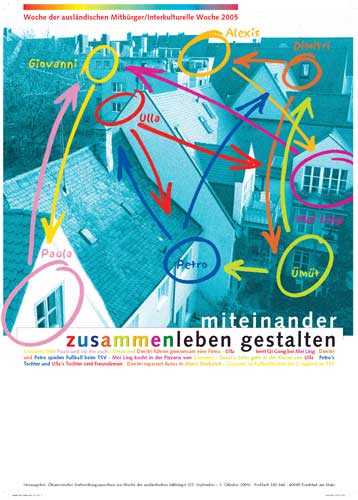
I know tomorrow is St. Jerome’s Day, and I know Monday was European Languages Day, but I only accidentally found out that this week is the Woche der ausländischen Mitbürger (Week of Foreign Fellow-Citizens).

Plakat2005w.jpg

According to the poster, these are Giovanni, Ulla, Alexis, Dimitri, Paolo, Petro, Ümüt and Mei Ling, and most of them live in the top storeys (perhaps there are no Hinterhofgebäude where the poster was made).

There is something in Erlangen called ‘Ich muss etwas von dem Eigenen in mir bewahren – um dem unbekannten Anderen gegenüber offen zu sein’, with no further details. Nothing else local. But I think there’s more on the programme than for the European Day of Languages.

(Actually I discovered elsewhere that events in Nuremberg are merged with those for the International Human Rights Prize).

Computerised German law/TakeLaw-System

Amazing electronic developments in Wismar:

bq. Wenn am 2. November 2005 der Justizminister des Landes Mecklenburg-Vorpommern, Erwin Sellering, im modernen Technologiezentrum in Wismar das TakeLaw-System eröffnet, dann könnte für die Welt der Rechtswissenschaft ein neues Zeitalter anbrechen. … Es geht darum, die oft unverständliche Sprache der Juristen in eine computergenerierte graphische Darstellungsform zu übersetzen. Diese Kunstsprache ist für die Rechtswissenschaft mit einem Kunstherz in der Medizin vergleichbar: Es sorgt dafür, dass der juristische Gedanke auch dann am Leben bleibt, wenn der eigentliche Motor der Rechtswissenschaft – die Fachsprache –nicht mehr verständlich ist. Die erforderliche Software dafür, der TakeLaw-Editor, wird ab dem 2. November 2005 über das Internet für jedermann frei zur Verfügung stehen (www.TakeLaw.de).

I will have to see this to have any idea what it means. Apparently software (freely available to all after November 2 on a site that at present offers nothing) will convert legal language by computer into a graphic form. This is compared with an artificial heart, because legal ideas remain alive even when the ‘real engine of jurisprudence, legal jargon,’ is no longer comprehensible.

What is more, it will enable automatic marking of tests:

bq. Nunmehr wird es möglich sein, juristische Übungsklausuren computergesteuert zu korrigieren. Die Korrektur ist mit einer ausführlichen Besprechung sofort verfügbar. Dazu vergleicht das System das Ergebnis der abgegebenen Arbeit mit der erwarteten Lösung und erläutert es dem Studenten. Dabei werden ihm nicht nur seine Fehler aufgezeigt, sondern auch die richtige Lösung über Lautsprecher oder Kopfhörer mitgeteilt. Gleichzeitig erkennt das TakeLaw-System Wissenslücken und stellt entsprechende multimediale Vorlesungen über das Internet zur Verfügung. Diese werden derzeit in Wismar in einem Tonstudio von insgesamt 12 Rechtsdozenten aus 9 Universitäten produziert.

bq. It will now be possible to mark legal tests electronically. The corrected version will be available immediately with a detailed discussion. This is produced by the system comparing the test submitted with the correct solution and explaining it to the student. The student is not only shown the errors – the correct version is also given, by loudspeaker or headphones. The TakeLaw system at the same time spots gaps in knowledge and provides multi-media lectures via Internet. These are being recorded now by a total of 12 law lecturers from 9 universities at a studio in Wismar.

All this sounds almost as difficult as machine translation. I imagine they can do multiple-choice questions online, and then supplement gaps in the person’s knowledge as seen by the system. But how can they translate legal jargon into graphics?

(Via Handakte WebLAWg)