Dietl review / Dietl-Rezension

Review of Dietl DE>EN (in German).

Ich wurde vom ADÜ-Nord gebeten, eine Rezension der neuen Auflage vom Dietl/Lorenz Rechtswörterbuch zu schreiben. Die Rezension steht in der neuesten Ausgabe des immer sehr interessanten und online zu findenden Infoblatts. Bei www.adue-nord.de zuerst auf Publikationen, dann auf Infoblatt klicken – und dabei nicht die anderen Angebote übersehen.

Darin noch unter anderem interessante Informationen zu Gerichtsentscheidung über Bezahlung an Übersetzer und Dolmetscher unter dem JVEG.

Full-bottomed wigs / Allongeperücken

Further to the last entry, Ede & Ravenscroft, who supply court dress, have an FAQ:

bq. Q: What is the difference between the judge’s bench wig and the judge’s full-bottomed wig?
A: Judges wear the bench wig when they are sitting in court. It is a short wig that is frizzed all over and has two tails at the back. The full-bottomed wig is only worn on ceremonial occasions with full ceremonial dress. It is not worn in court by judges when they are hearing a case.

(What is a red bag? was news to me)

Wonderful illustrations in this 78-page PDF booklet called Legal Habits.

I learnt from the FAQ that the pouch at the back of a barrister’s gown is not, after all, for fees, but used to hold a hood.

Here’s a shallower link, with more photos.

And here’s a German equivalent.

Criminal procedure in Europa / Strafprozesse in Europa

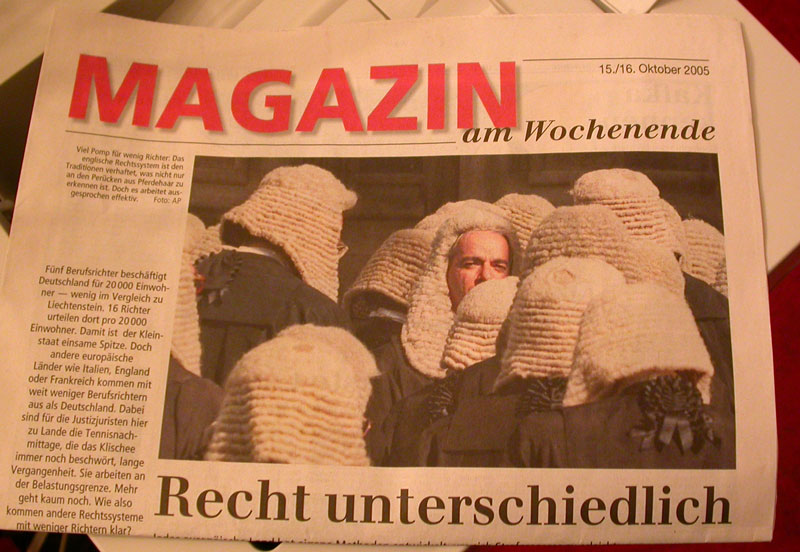
For some reason best know to itself, the local paper had an article comparing criminal procedure throughout Europe on the front of their Magazin section at the weekend (Click to enlarge).

judgesw.jpg

There is it again – that hackneyed old scene of the judges in their ceremonial wigs, probably at the Lord Chancellor’s Breakfast. I’m not sure what it tells us about criminal justice in Europe, though.

The topic of the article is: Germany has a very large proportion of judges, and they are overworked. So how do other countries manage with fewer (professional) judges?

German judges write more (in England you have the oral pronouncement of judgment, backed up by a transcript by a court reporter).

German courts have more witnesses physically present in court (at least in comparison with the Netherlands, Italy and France – I suspect not in comparison with Britain)

In German courts, it is easiest to use applications/motions to drag out proceedings

In Germany, special expedited proceedings are possible only for minor offences; elsewhere, if the accused agrees, expedited proceedings are possible when more is at stake.

Denglisch explained / Pseudoenglisch

Denglisch-Deutsches Wörterbuch (via Translationfound)

This Fruchtbringendes Wörterbuch could be very useful indeed. I have more than once had to translate Denglisch into English, and first of all I had to work out what it was supposed to mean. That can be difficult. It’s a shame that many contributors don’t know whether an English term is pseudo or not.

bq. Viele Wörter sehen aus, als wären sie englischen bzw. amerikanischen Ursprungs, werden aber von Menschen mit englischer Muttersprache nicht verstanden. Beispiele für pseudoenglische Wörter sind Showmaster, Handy, Oldtimer oder – besonders peinlich – Dressman.

Actually I missed the word Talkmaster, so I added it.

Some of the entries will be genuine English; in fact, far too many of them are. But that doesn’t matter to me as long as it gives good definitions of the words I need to translate (of course, it doesn’t always give good definitions, but that’s life, I suppose. It mentions Showmaster and defines it as Gastgeber. I defined Talkmaster as Moderator).

I noticed recently that Tchibo, who now sell in Britain too, were selling a magnetic notebook-holder, and in the picture someone had written ‘Toast’ as the first word of a shopping list. I suppose this was meant to work globally, but whereas a German might write ‘Toast’ or ‘Toastbrot’ on a shopping list, a British person wouldn’t.

Interpreter attacked in Munich court/Dolmetscherin wird von TV-Anwalt gerettet

Süddeutsche Zeitung über lawblog.

Giouri A., the defendant in a Munich court, charged with bewaffnetes Handeltreiben mit Betäubungsmitteln – armed drug dealing – on Tuesday morning suddenly produced a 20 cm (8″) nail, put a headlock on his Russian interpreter and pressed the nail against her neck. His defence counsel got the nail away from him before two court officers overpowered him.

The defence counsel, what’s more, was Sewarion Kirkitadse, a lawyer of Georgian extraction who appears on afternoon court TV shows in Germany. His photo shows his heroic qualities. *And* he has worked as an interpreter himself, for the fascinating Georgian language.

The Russian interpreter is described as Erina J., 50 (maybe Irina or Erika?). Since the defendant is in custody, one can’t help assuming he found the nail in the prison wall.

bq. Am Morgen war er mit einem Gefangenen-Transporter ins Gericht gebracht worden. Üblicherweise werden alle Häftlinge vor dem so genannten Schub noch einmal gründlich durchsucht. Ein Kripobeamter kündigte bereits „interne Ermittlungen“ zu dem Vorfall an.

I quoted that because I remember the ‘so genannten Schub’ – the trip by van to the prison, or the prison away from the court itself.