Ridiculous application questions/Lächerliche Fragen beim Vorstellungsgespräch

RollOnFriday is having a competition for the most ridiculous question put to an applicant in person or on an application form.

Apparently, Withers (a London law firm – bizarre website warning) asked the following question on a form:

bq. To which fictional character do you most relate, and why?

Someone on RollOnFriday’s discussion board suggested ‘the fatty who gets done from behind in Deliverance’.

Actually, it’s a tricky question. Presumably the novel you refer to may not be too highbrow nor too lowbrow. I remember applying for articles at a firm in Lincoln’s Inn Fields and being asked at the interview (at least Withers gives you time to think) what I’d read recently, and I mentioned ‘A Dance to the Music of Time’. I thought it was socially appropriate, but the interviewer had never heard of it.

While browsing the RollOnFriday discussion board, I discovered what ‘getting a desmond’ means. At first I thought: but Desmond Tutu went to my college, and surely he didn’t do that badly? I mean, I assume he did some work. And I thought ‘getting a Vorderman’ was the term for a third. But then I discovered from the Urban Dictionary it is a kind of rhyming slang:

First – Geoff (Geoff Hurst, footballer)
2:1 – Billy (Billy Gunn, wrestler)
2:2 – Desmond (Desmond Tutu, bishop)
Third – Thora (Thora Hird, actress)

To quote the discussion board:

bq. I know someone with a desmond and a tenancy

bq. He probably has other things going for him. Plus he’ll be at an absolutely cack set of chambers and will end up earning less per hour than a McWorker

Of course in Germany you may need the equivalent of an LL.D. (Dr. iur.).

LATER NOTE: Actually, you can find the Withers application form online at their recruitment site.
Workplace bullying / Mobbing

The word Mobbing in German annoys a lot of English speakers, who see it as a false anglicism. On the legal aspects I can recommend a wonderful book by Maga Petra Smutny, Richterin des Landesgerichts für Zivilrechtsachen in Vienna and Dr. Herbert Hopf, Hofrat des Obersten Gerichtshofs: Ausgemobbt! Wirksame Reaktionen gegen Mobbing (for links see below). It’s a book written for the person on the Vienna omnibus, but by well-informed judges.

The equivalent English terms are (workplace) bullying, harassment and (employee) abuse.

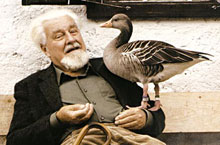
According to the book, Mobbing is an artificial word (Kunstwort) taken from the English (to mob = umringen / attackieren), but in the last instance from the Latin (vulgus mobile = aufgewiegelte Volksmenge). It was first used in a scientific sense in the 1950s, by Konrad Lorenz, referring to a group attack of geese on a single fox.

Lorenz02.jpg

In the 1960s and 1970s, the Swedish doctor Peter-Paul Heinemann applied the term to human conduct, group violence among children. And in the 1980s and 1990s, Heinz Leymann, in Sweden, applied it to adult working life, referring to an escalating type of conflict in the workplace.

Certain elements of Mobbing can be agreed on: it can originate from one person or a group. It is characterised by unequal power structures: boss against employee, group against individual. It is systematic. There must be a certain frequency and duration. The aim is to isolate and finally exclude the bullied person.

Smutny and Hopf cite a large number of cases and legal sources in German and Austrian law, and give advice for individuals.

In the German American Law Journal Blog, from the land where men are men and churches, drugstores and beer joints abound, in Prayer for Relief: Mobbing, Clemens rather pooh-poohs all this:

Relief for some such conduct should be sought in a church, drugstore or beer joint, but some perceive mobbing as so hurtful that they seek refuge in the law.

He refers to a ‘current discussion on legal boards’ which holds that ‘mobbing does not constitute a defined cause of action’. There is no tort of mobbing. That seems to be the case in Germany and Austria too. There doesn’t seem to be any one constellation that constitutes or defines the phenomenon.

One problem is that even if one tells a bullied or harassed individual to go for help elsewhere (but I think U.S. law does help the harassed), what solution is this for the company where this behaviour is escalating?

Here’s something about workplace bullying in the USA.

Smutny/Hopf: Ausgemobbt! Deutschland / Österreich

Semaphore alphabet/Winkeralphabet

Further to my last entry (enlarge the graphic there to see the image on the gold sticker):

There is a German semaphore alphabet (deutsches Winkeralphabet).
Here is T, for example:

t.gif

Then there is an international semaphore alphabet (scroll down; internationales Winkeralphabet). Here is T:

100px-Semaphore_Tango.svg.png

and here is H:

100px-Semaphore_Hotel.svg.png

The Trados symbol uses the German version. In English, Trados referred to the figure simply as Flagman (Wikipedia’s flagperson), without further explanation. Advertising from Trados came by email headed Flagman Calling!

Thus are the pitfalls of international communication. I think Monty Python could have done something with this. I have now added to my vocabulary: winkern, Winkspruch, Winkeralphabet, Winkflaggen, Winkverfahren and wig-wag flags (the predecessor).

There are also, of course, international maritime signal flags, but I won’t go into those.

Certification / Zertifizierung

wordmw.jpg

This is an SDL-Trados ad I saw in the ITI Bulletin, and it’s available online too. I am always impressed by the wonderful fingernail styling you see nowadays, and I wonder how easy it is to type with those nails (click to enlarge picture). However, the translator may use voice recognition software or, like Paul, typists (but I don’t think they’d show a male translator in an ad like this).

The text has a further heading: Demonstrate that you have what it takes to succeed in the Global Ecosystem.

SDL-Trados itself says the certification is very popular with clients:

bq. Corporate Language Departments and Language Service Providers are very positive, as they welcome a certification program that reduces the amount of time spent pre-qualifying translators on their expertise in translation technology and the practical application of the Create, Cleanse and Maintain (CCM) Methodology.

Create, Cleanse (I think that’s what they call Cleanen in German), Maintain. I use Star Transit and you don’t have to clean that. But my output is perhaps on the grubby side. And what about the Global Ecosystem: what if you drop out of it?

Prince Philip

Not only was a recent remark of Prince Philip’s in bad taste, it was too difficult for dpa to understand:

bq. Bei einem Empfang in Edinburgh äußerte sich der 85jährige verwundert darüber, wie viele Waisenhäuser es in dem osteuropäischen Land gebe. “Man hat den Eindruck, daß sie dort nur brüten, um sie (die Kinder) in die Waisenhäuser zu bringen”, sagte Prinz Philip nach einem Bericht der Zeitung “The Sun”.

LATER NOTE: After calls for the original, here is something from the Scotsman:

bq. After a winner said he had worked in Romania, the Duke reportedly replied: “Romania? You didn’t go across to help in one of those orphanages, did you?”
When the student said no, it was claimed the 85-year-old duke added: “Ah good, there’s so many over there you feel they breed them just to put in orphanages.”
(Gleaned from the u-forum mailing list)