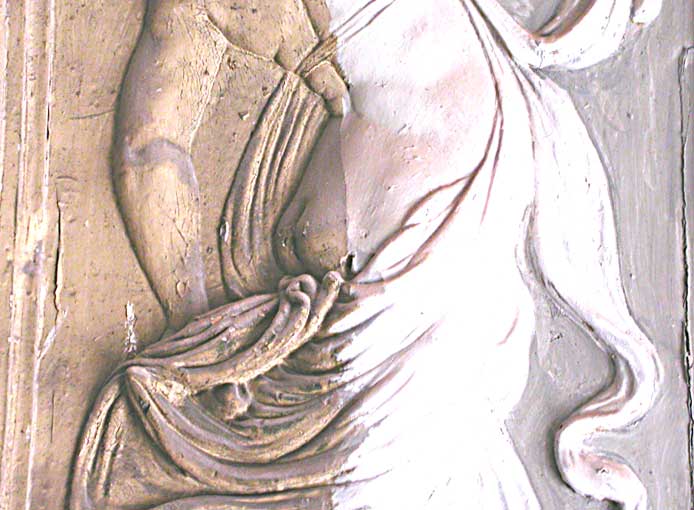
German brochure and online presentation on the 1000-year anniversary celebrations in Fürth in 2007.
Der Inhalt der Jubiläumsbroschüre ist auch online bei www.1000-Jahre-fuerth.de zu finden.
The first documentation of Fürth:


German brochure and online presentation on the 1000-year anniversary celebrations in Fürth in 2007.
Der Inhalt der Jubiläumsbroschüre ist auch online bei www.1000-Jahre-fuerth.de zu finden.
The first documentation of Fürth:
DORES, as I’ve mentioned before, stands for Dokumentation zu Recht und Sprache, a Swiss website that lists all the latest books on language and law. My attention was caught by these:
bq. Bernasconi, Michele / Wildhaber, Anne M. (Hrsg.) / Watter, Urs: Swiss Law Bibliography. English Language Materials on Swiss Law. Basel: Helbing & Lichtenhahn 2005, 379 S..
Verzeichnet (1) englische Übersetzungen von Schweizer Erlassen, (2) englische Literatur über schweizerisches Recht, (3) Internetadressen mit englischsprachigem schweizerischem Recht und englischsprachiger Literatur zu schweizerischem Recht. – This looks great. It costs the equivalent of 50 euros, as far as I can tell. Unfortunately it may not be in any of the libraries close to me.
bq. Weimann, Holger / Leppert, Norbert / Höbermann, Frauke: Gerichtsreporter. Praxis der Berichterstattung Berlin: ZV Zeitungs-Verlag 2005, 344 S.. – a book for journalists on how to write about court cases.
bq. Pommer, Sieglinde: Rechtsübersetzung und Rechtsvergleichung. Translatorische Fragen zur Interdisziplinarität. Bern / Berlin / Frankfurt a. M. etc.: Lang 2006, 172 S.. – an academic text on translation. Could it be a doctoral thesis? Frau Pommer will be speaking at the ATA conference in November (on Vagueness in Legal Terminology, whether there is creativity in legal translation (I belong to the school that says there is!) and Teaching and Researching Legal Translation: What Input from Comparative Law? Sounds interesting.
Those are not all the interesting entries, either. You may have to register (free of charge), and then, if you see an interesting title, click on the + sign beside it to see more details.
I am abjectly apologetic that I forgot to mention the fifteenth EDV-Gerichtstag in Saarbrücken from 13 to 15 September 2006. Well, it’s not quite over.
They kindly invited me to come, and I did at least promise to mention them. That just goes to show you can’t trust anybody.
It looks really well-organized too (here’s the online planning section).
While looking at reports of the conference, I noticed Juristische Begriffe. This is a site run by Enrico Krüger to collect the basic legal vocabulary plus definitions needed for German university law exams. There are also audio definitions as MP3 files. The collection is not huge, but a good place to check.
The project developed from the Jenaer Jura-Trainer and has some exchange with JuraWiki. The JuristenLatein section of JuraWiki should be useful, as legal Latin used in Germany differs from that used in England, and both differ from that used in the USA.
The Austrian paper Der Standard has a series called Winders Wörterbuch zur Gegenwart.
For instance, it discusses the word Gammelfleisch (see recent Bavarian meat scandals) and invites readers to answer the question: What did we call Gammelfleisch in the old days? One commenter notes the connection with German Gammler and suggests Austrian Sandlerfleisch (I’ll add a
English-language papers refer to putrid/ rotten/ spoiled/ bad meat.
Il quaderno dei vocaboli reports a discussion in 2005 of the U.S. expression ‘Get your arse over here’ (German heading Dein Arsch).
bq. Man hört es häufig in der deutschen Synchronfassung amerikanischer Filme, man hat es in den vergangenen Wochen oft in den Zeitungen gelesen, wenn die armen Einwohner von New Orleans zitiert wurden: Dass nämlich jemand endlich “seinen Arsch” herbeibewegen solle (im Falle von New Orleans: die Katastrophenhelfer im fernen Washington).
When American films are dubbed in German, you hear the un-German expression ‘sie sollen ihren Arsch herbeibewegen’ – for instance, it was used with reference to calls for helpers to come to New Orleans to help the flood victims. This results from the literal translation into German of ‘They should move their asses down here’.
bq. Wortwörtlich aber schlecht: In “American Slang”, einem bei Eichborn erschienenen Wörterbuch der amerikanischen Umgangssprache von Bernhard Schmid lesen wir dazu, dass “ass” in Verbindung mit dem Possessivpronomen keineswegs jene derbe Konnotation hat, welche ihm in der deutschen Übersetzung unterschoben wird, sondern lediglich soviel heißt wie “Person”. Schmid weiter: “In Sätzen wie ,Get your ass over here bedeutet ,ass nichts weiter als ,self, was den ,Arsch im Deutschen völlig überflüssig macht, vor allem weil er in den meisten dieser Fälle völlig unidiomatisch ist. Mach dass du herkommst genügt völlig.” Mit anderen Worten: Übersetzer und Redakteure täten gut daran, wenn sie ihren Zusehern und Lesern in Zukunft einige Ärsche ersparen würden.
Winder quotes an Eichborn slang dictionary that points out that here ‘ass’ means ‘yourself’.
Of course, there are many reasons why this kind of thing happens in dubbing: cost-cutting is the main one. A lot of dubbing is done from a script without the translator seeing the film. But another one is finding words to match the mouth movements.
There are 43 comments. One of them cites an American acquaintance who would translate ‘Move your ass down here’ as ‘Verdammt noch einmal, kommt doch endlich her’, and confirms that the word ass is less offensive in AmE than Arsch in German, whereas shit is stronger in AmE than Scheiße in German.
Other commenters wonder if it was a request for more donkeys in Louisiana (I would say that AmE rarely uses ass for Esel, unlike BE where we have the different spellings of arse and ass to distinguish the two).
Meanwhile, the large Langenscheidt (Muret-Sanders) leaves little choice:
bq. ass2 [], etc Am. vulg. für arse, etc: break ones ass sich den Arsch aufreißen sl.; kick ass a) mit der Faust auf den Tisch schlagen, b) ein Flitzer sein (Wagen)
© Langenscheidt KG, Berlin und München
To relate this to legal translation, we might wonder about the exclamation when someone is felt to have been given too lenient a custodial sentence, ‘Diese Strafe kann er auf der halben Arschbacke absitzen’. (See also Udos Wörterbuch)
Frau Kohlehydrat has sent me a meme, or as the Germans call it ein Stöckchen, or as the Austrians including Frau Kohlehydrat call it, ein Steckerl: to list the ten books that are gathering dust on my shelves because I bought them but haven’t read them.
I don’t usually do these, but this one seems highly suitable as I have even more than ten unread books. And for years, when I was teaching, I used to buy all sorts of books just to imagine how nice it would be to have time to read them.
Robert Underhill: Turkish Grammar
I am sure this is a brilliant grammar. Its idea is to take you through the grammar in thirty-eight lessons with a minimum vocabulary. You can get the vocabulary elsewhere. I spent nearly three years trying to learn Turkish, going to evening classes and hoping to expand my knowledge at home. It was a long time before I realized that my desire to be able to read Turkish newspapers was never going to be realized in those classes and with those books, because written Turkish is highly complex with sentences of German complexity but different structure, and we weren’t going to be taught that. There is also a good book on reading newspaper Turkish that showed me there was no point unless I went to Underhill. However, I seem to have abandoned it now. The Underhill costs the earth but I got it cheapish by using abebooks and having it sent from the USA by surface mail.
Marion Shoard: A survival guide to later life
This is only unread because I left my first copy with my aged relatives for whose sake I bought it. It takes months to get by post. It is a Daily Telegraph special, dated 2004. Marion Shoard wrote on environmental affairs for 25 years and when her mother, in her mid-80s, needed more help, she researched the situation for old people in the UK thoroughly. I think I need to read this. It is very specifically UK and explains the details of obtaining help and care, among much else.
Rob Eastaway: What is a googly?
An explanation of cricket for laypersons. I wanted some cricket on DVD to accompany reading this, but for some reason it took certain persons months and months to record some, by which time the book had gathered some dust. Glossary in the back.
Wolf Haas: Das ewige Leben
I have never read any of Haas’s crime novels, although I’ve seen a film or possibly two based on them. I’ve been told it’s not a pleasure to read because the language is so idiosyncratic, but I suspect I will read it. Here’s the first paragraph:
bq. Jetzt ist schon wieder was passiert. Und ob du es glaubst oder nicht. Zur Abwechslung einmal etwas Gutes. Weil erlebst du auf einer Intensivstation auch nicht jeden Tag, dass dir ein Hoffnungsloser noch einmal wird.
Tim Richardson: Sweets. A history of candy
This may be too heavy going. Why do books not mention pismaniye? It isn’t really candy floss, because it contains butter and flour as well as sugar.
Paul Celan: Die Gedichte. Kommentierte Gesamtausgabe
I think one can have too much Celan. Great stuff, but rather lugubrious. There is also a tendency for people to put him on a pedestal without understanding him. Apparently the members of Gruppe 47 laughed when he presented Die Todesfuge. Anyway, I feel enough drawn to some of his work that it seemed a good idea to read a commented edition, because there are so many references, often quite private ones. The big problem with this book is that the endnotes – there are 425 pages of end material – give the title of each poem, but not the page it is on. It’s therefore easier to pick some interesting notes and then trace the poem.
Richard Conniff: Spineless Wonders
This is subtitled ‘Strange tales from the invertebrate world’. I thought it would be a good follow-up to Goff’s A Fly for the Prosecution, but I’ve never got into it.
Wolfram von Eschenbach: Willehalm
I didn’t realize Willehalm had a great reputation till I went to the Wolfram museum in Wolframs Eschenbach. Unfinished, but a diatribe against the Crusades and a fairish view of the Muslims. I wanted to read some Middle High German again. My edition has modern German facing the original, and I think indecisiveness as to which to read slowed me down.
Karina Matejcek: Überleben ohne Sekretärin
I’m always a sucker for books on subjects I feel inadequate about. But a closer glance at this indicated that only parts were helpful and it was rather superficial. Nor does it look so good on my bookshelf as How to Succeed in Business without a Penis by Karen Salmansohn. This is also unread, but it may impress visitors.
Harry Mount: My Brief Career
The trials of a young lawyer. I forgot I even had this. It’s an account of a year as a pupil in barristers’ chambers. I must have got it in a bookshop, as I wouldn’t have bought it without leafing through and deciding it wasn’t too joky for me.
I am now supposed to pass this Steckerl on. I can’t send it to Des, as he seems otherwise occupied looking after a poeskat and preparing a wedding, and Trevor also seems otherwise occupied. If they wish then, to:
languagehat (but I’m sure Steve has read all his books)
liseuse
and isabella
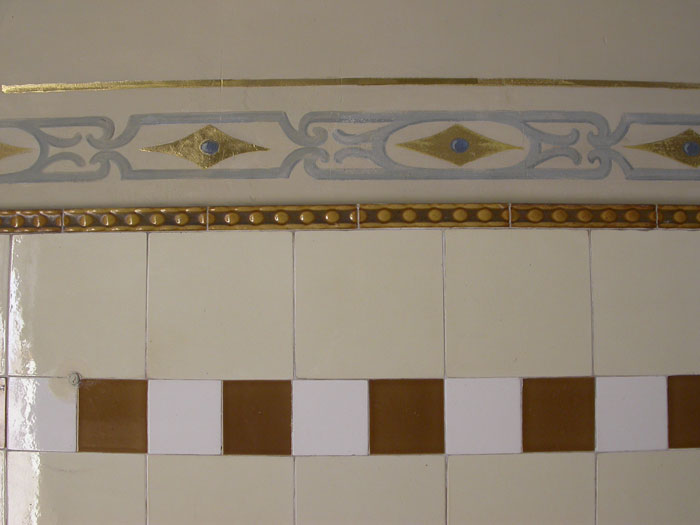
In Bavaria, the Tag des offenen Denkmals was moved forward to Saturday 9 September to avoid a clash with the Pope’s mass in Munich on Sunday. Other cities may have more (Open House London is on 16 and 17 September this year), but Fürth usually has something on the programme where architects and restorers explain some building they are working on – usually some private building one can’t usually get in.
Goldbeater’s house, Pfisterstraße 6 (and above):
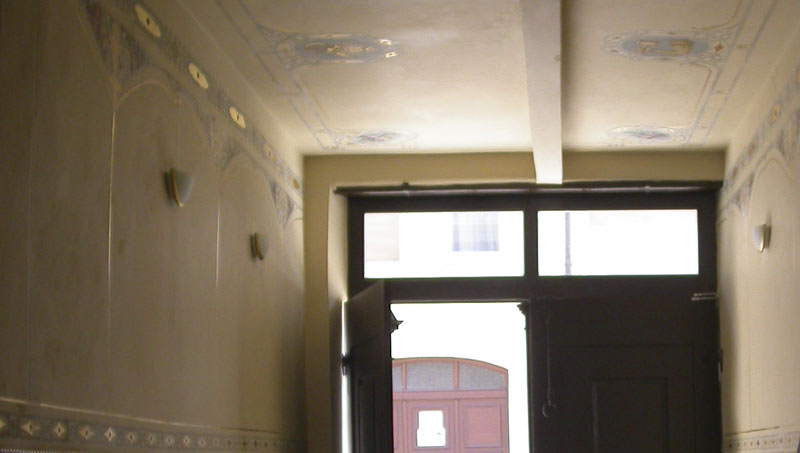
Figure showing various ideas for colour of restoration, and athletic elements, Blumenstraße 32: