
wordsandmore: Portal für Deutsch

German page on Sabine Cretella’s terminology wiki Wordsandmore.

Wer deutsche Terminologie zu diesem Wiki beitragen möchte, findet jetzt hier ein deutsches Portal mit allen Erklärungen, wie es geht:
http://wordsandmore.org/index.php?title=Portal:deu

Das kommt aus einer Zusammenarbeit zwischen Sabine Cretella und einem Mitglied der pt-Gruppe bei Yahoo, ist aber benutzbar von allen. Ich zitiere aus der Mailingliste:

Wir haben uns vor allem bemüht, das Portal so zu gestalten, dass jede(r), der/die es aktiv oder passiv nutzen möchte, sich möglichst schnell zurechtfindet. Unter “Zum Einstieg” findet Ihr ein Online-Tutorial, eine erweiterbare FAQ und eine selbsterklärende Schnellablage: Wenn Ihr einfach schnell Inhalte im Portal hinterlegen wollt, ohne ein Benutzerkonto anzulegen oder Euch mit den Besonderheiten
eines Wikis vertraut zu machen, klickt Ihr einfach auf den Link zur Schnellablage und folgt den Anweisungen – voilà. Die Einordnung und Formatierung übernehmen dann andere Benutzer. Unter “Themen” gibt es die Bereiche “Sprachliches”, “Geschäftliches”, “Computer” und “Weiterbildung”, die sich nach und nach mit Inhalten füllen werden. Einige wenige gibt es schon – klickt beispielsweise unter “Ressourcen” mal auf “Mailinglisten und Foren”.

LATER NOTE: Correction – this is not a terminology portal. Thanks for the work to Anselm Buehling – I didn’t name him before as I didn’t know if he would mind. Here is his correction, copied from the comments:

Eine kleine Korrektur: Das Deutsch-Portal unter Wordsandmore ist kein Terminologie-Wiki. Es hat Platz für alle Themen und Informationen rund um das Übersetzen ins Deutsche und aus dem Deutschen. Dazu gehören natürlich auch terminologische Fragen.
Das spezielle Terminologie-Wiki ist aber das “OmegaWiki” von Sabine, das unter wordsandmore auch verlinkt ist. Die Adresse des deutschen OmegaWiki-Portals ist:
http://omegawiki.org/Portal:deu
Das OmegaWiki ist noch im Prototypstadium; das Anlegen und Bearbeiten von Wörterbucheinträgen ist also noch nicht möglich. Andere Bereiche können aber bearbeitet werden.
Zur Mitarbeit am wordsandmore-Portal, das im Eintrag oben verlinkt ist, sind alle Interessierten herzlich eingeladen.
Horst Schlämmer Führerschein-Blog

For anyone who would like to hear some more German: Horst Schlämmer’s videoblog about his attempts to get a driving licence (in order to be more attractive to women).

For those outside Germany: Hape Kerkeling created HS, the editor of a fictitious paper called the Gravenbroicher Tagblatt.

For some reason this kind of thing reminds me of Marlene Jaschke, a short film of whom can be seen on her website.

Payment of literary translators /”Übersetzerstreit”

Burkhart Kroeber was given a chance to defend literary translators in the Neue Zürcher Zeitung today.

He points out that the figure of 1,000 euros a month is not what an inexperienced and badly-off translator would get, but what an experienced and respected translator like himself gets for a normal month of 40-hour weeks.

I’m very glad this article has appeared, as it saves me writing a defence. I understand that publishers are badly off too, but I have read three or four articles this week where the figure of 1,000 euros was disputed. One reason seems to be that people overestimate the number of pages per day that can be done. Kroeber says 5 pages a day and 100 pages a month is normal.

There was an article in Die Welt by Uwe Wittstock on February 7 that not only disputed the figure, but also said that the Munich Landgericht I had calculated that a translator earned 3,100 to 3,300 euros per month. Does anyone know what case this refers to? I can only believe it was a non-literary translator:

Allerdings hat das dem VdÜ durchaus gewogene Landgericht München I in einer ersten Entscheidung für einen im Rhythmus der 40-Stunden-Woche arbeitenden Übersetzer ein monatliches Bruttoeinkommen von gut 3100 bis 3300 Euro ermittelt – und also keine Erhöhung der gültigen Pauschalhonorare gefordert.

And in the Süddeutsche Zeitung today (print edition) there was an article by Dirk Stempel from the publishers’ point of view. It repeated both the claim that 1,000 euros is not credible, and something else that has been said more than once: that authors sometimes earn less than translators:

bq. In dem Verlag, in dem ich arbeite, sind in den letzten Jahren allein vier theoretische Bücher zu Fragen des Übersetzens erschienen. Wir kennen die Besonderheiten und Schwierigkeiten des Übersetzens sehr wohl. Und wir wissen auch, dass unsere Übersetzer weiß Gott keine fürstlichen Einkommen haben. Wir kennen auch die Nöte unserer Autoren, wenn sie bei 40 (!) publizierten Büchern eine Jahresabrechnung erhalten, die ihnen ein monatliches Einkommen von 500 Euro ermöglicht.

That may well be the case – I’ve certainly translated art guides where the author has got less than I did – but in some ways it’s easier being an author, and the translator is engaged to do a job of work. Supposing I were good at metalwork and created a wonderful bath all on my own – would I then expect to pay the plumber less for mending it?

Stadtmuseum Ludwig Erhard opened/eröffnet

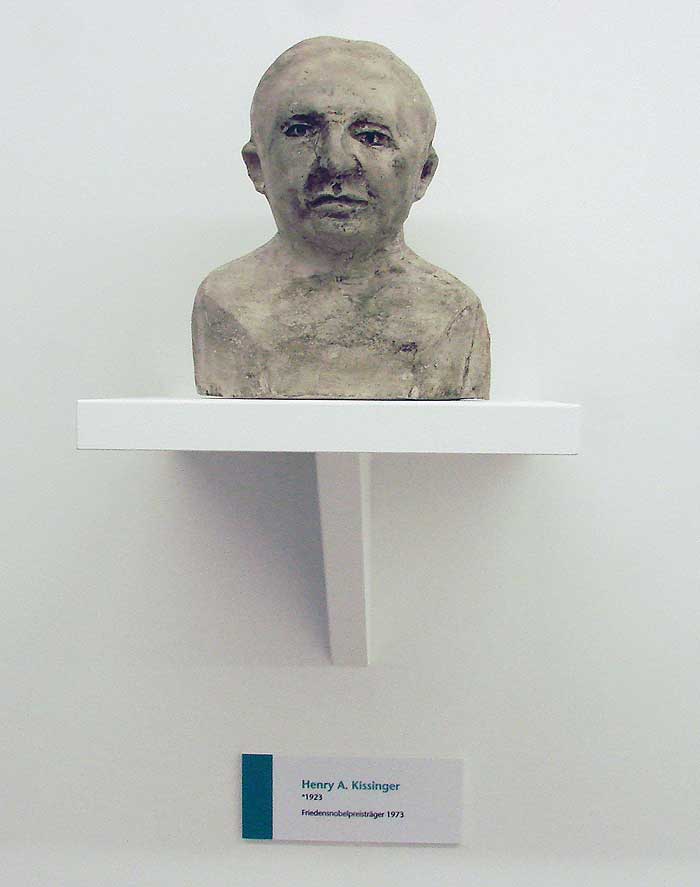
The Fürth town museum has moved from Schloss Burgfarnbach to Ottostraße and opened this morning.

20070210fue027w.jpg

Some of the busts of famous Fürthers were more convincing than this one.
The exhibition is Aus den Hinterhöfen zur Weltspitze. It’s not exactly anything to write home about, but then it’s practically next door.

Mysteriously, the odd English translation of a title appeared, even though the text below (a list of crafts and trades, for example) would need to be translated too. Perhaps this was in the spirit of ‘Just so you know what you’re missing’. I thought the following header:

Das Handwerk zu Beginn des Königreichs
Craft At The Beginning Of The Kingdom

(capitalization theirs) perhaps conveyed little. But this is carping. It is a nice museum and some of the permanent exhibits are interesting.

Here’s a pane of the Fürth window at the Germanisches Nationalmuseum – note Fürth skyline, Frau Fürth with clover leaf and Frau Nuremberg (with the town wall round its hat) holding the Adler, the first train in Germany.

20070210fue041w.jpg

LATER NOTE: Zonebattler links to the articles in the local paper, and I see the big exhibition is by the Haus der Bayerischen Geschichte – well, I knew that really, but it sounds as if this is just a temporary state of affairs (the exhibition had some good things, but it was hard to read the texts and there was a heavy sense of boredom about the whole thing, very reminiscent of the exhibition on 200 years of Franconia in Bavaria, which I had the misfortune to see last week. The small Fürth permanent exhibition, on the other hand, was put together in only one month by the new director of archives, Sabine Brenner-Wilczek, after someone else dropped out because of illness. And it’s excellent.

Miscellaneous snippets/Verschiedene Links

Ben Hammersley’s blog first turned into a photo collection and then briefly flirted with reading translations of Rilke – he gave a link to translations of 100 Rilke poems.

The importance of language in not being regarded as dumb is illustrated in this story shamelessly pinched from Trevor.

I have knitted two fairly reasonable cat beds to date, but have yet to perfect the skill. Here is a gallery of various-sized cats and beds.

Have I already mentioned the (German) Photoshop weblog?

In Der Schweizer als Reisemangel, Blogwiese reports on a story from the Westdeutsche Allgemeine Zeitung (dated January 2007, but reporting a 1993 case) of a Caribbean cruise which Germans (no more than 60 of them) were looking forward to but which turned out to be for 500 Swiss and have a large Swiss German (dialect) element. In fact the Germans had been promised Caribbean music and the Swiss had been promised Swiss folk music. The Frankfurt am Main Landgericht held that the cruise had been defective. See also here:

bq. So stellt es laut dem Frankfurter Landgericht (LG) einen Mangel einer Kreuzfahrtreise in die Karibik dar, wenn das Kreuzfahrtschiff fast ausschließlich einer Sonderveranstaltung durch Schweizer Folkloregruppen dient, die in erheblichem Umfang das Unterhaltungsprogramm durch Veranstaltungen mit schweizerischem Volkscharakter (Blasmusik, Jodeln, Alphornblasen, Trachtentänze, Chörli-Singen, etc.) prägen, denen der Reisende nicht ausweichen kann. Die Reisenden erhielten 40 Prozent Minderung, 25 Prozent davon allein wegen der Beeinträchtigung durch die Folkloreveranstaltungen und weitere 15 Prozent auf das deshalb zumindest teilweise ausgefallene Bordprogramm in Form lateinamerikanischer Musik (Urteil des LG Frankfurt vom 19.04.1993, Aktenzeichen: 2/24 S 341/92).

Text & Blog weblog

Text & Blog (mentioned in the last entry) is the weblog of Markus Trapp, a literary translator and web designer in Hamburg. It has a picture of Romans in the header that takes me back to I, Claudius – I don’t know which of them is the blogger.

The blog has been around for a few years. I imagine Markus Trapp translates from Spanish. He doesn’t often write directly about translation, but has good links to the current dispute and advice on Internet resources.