Easter walk/Osterspaziergang

Das zweisprachige Handbuch für Deutschland, das neulich für uns Migranten veröffentlicht wurde, enthält einen Auszug aus Goethes “Osterspaziergang”, allerdings nicht ins Englische übersetzt, was auch sehr schwer wäre.

The other word of the day, or word of yesterday, is Osterspaziergang: Easter walk. The Manual for Germany mentioned in an earlier entry quotes fourteen lines from Goethe’s ‘Osterspaziergang’, which is actually from Faust I. The text of the book online is much shorter and does not include the poem.

The two-language copy I received does not attempt to translate the piece into English, perhaps fortunately (I have had to accept that the English is rocky in parts). It does entitle the passage ‘Easter Stroll’, although a moment later it has ‘Easter-Day Walk’.

The text is available online in English and German (translation into English by Edgar Alfred Bowring). The English is not good. Perhaps the contents sound a bit pedestrian, but the German has a bouncy rhythm (and the text must be seen as part of a play, not a free-standing poem).

The description in the manual of Easter is a bit shaky. ‘Ancient Germanic custom states [sic] that the egg is the origin of life. … Easter Eggs, chocolate bunnies and other sweets are hidden in the garden or in the apartment by parents on Easter Sunday for the children to hunt and find.’ (We don’t actually hunt eggs, do we?) ‘Sometimes Straw puppets are burned to symbolise the end of winter.’ Eggs and Straw with capitals. Is this Jack Straw, following in the tradition of Guy Fawkes? And ‘puppets’ – are they glove puppets, marionettes, or what? – I don’t like to be so negative, but the list of country and capitals is also odd (p. 11). I know that towns are often left in their original spelling, but what is this: Ucrain Ukraine, Slowakia Slowakei, Icland Island. Belarus or Belorussia etc. has been omitted altogether.

However, the attempt to communicate in icons on the cover is still more mystifying:

manualw.jpg

What does the symbol on the left mean – it suggests ‘Is this the men’s or the women’s lavatory?’ And then there is the empty third square.

Read on for the German Goethe text and the translation: Continue reading

Indent/Teilstrich

Das Wort Teilstrich scheint in Österreich statt Spiegelstrich benutzt zu sein, aber vielleicht sind die zwei Wörter Synonyme? Im Stasi-Unterlagen-Gesetz wird es auch benutzt, laut Berliner Senatsverwaltung für Justiz: § 32 Abs. 1 Nr. 3 erster Teilstrich StUG . Hier § 32 bis zum zweiten Teilstrich:

bq. (1) Für die Forschung zum Zwecke der politischen und historischen Aufarbeitung der Tätigkeit des Staatssicherheitsdienstes sowie für Zwecke der politischen Bildung stellt der Bundesbeauftragte folgende Unterlagen zur Verfügung:
1. Unterlagen, die keine personenbezogenen Informationen enthalten,2. Duplikate von Unterlagen, in denen die personenbezogenen Informationen anonymisiert worden sind, es sei denn, die Informationen sind offenkundig,3. Unterlagen mit personenbezogenen Informationen über – Mitarbeiter des Staatssicherheitsdienstes, soweit es sich nicht um Tätigkeiten für den Staatssicherheitsdienst vor Vollendung des 18. Lebensjahres gehandelt hat, oder – Begünstigte des Staatssicherheitsdienstes,

The word Teilstrich seems to be used in Austria instead of the German Spiegelstrich, but it can’t be, because Google with site:at indicates both are used in Austria too. Are they alternatives? The usual EU English term is indent, rather than bullet point, although when I looked up a German statute (see above), one site had bullet points and the other little dashes.

Luther on translation/Luther zu Übersetzung

Gail (openbrackets) zitierte Martin Luthers Sendbrief zum Dolmetschen. Deutscher Text hier.

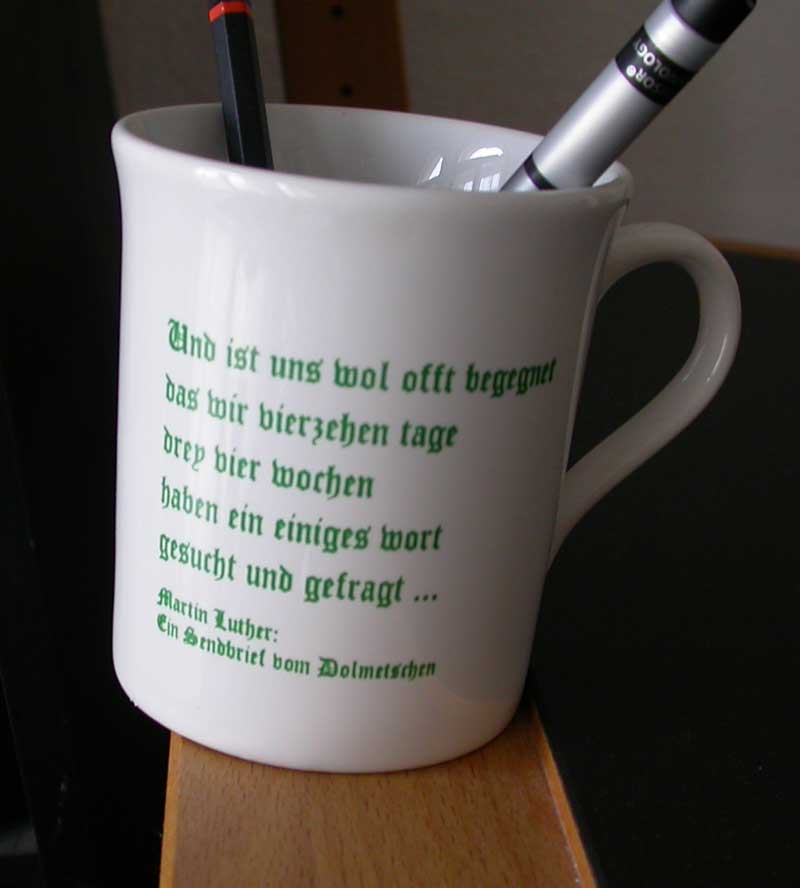
Ein Zitat aus eben diesem Text zierte ein Jubiläumskaffeepott des Instituts für Fremdsprachen in Erlangen.

Gail at openbrackets printed a large section of Martin Luther’s open letter on translation. His subject there is writing the German used by the ordinary people.

I seem to have missed that it was written in Nuremberg.

The Institut für Fremdsprachen in Erlangen (irritating splash screen), where I used to teach, had two jubilee mugs, one with a Goethe quote (Goethe at his worst) and one with a Luther quote from this very text:

bq. Und ist uns sehr oft begegnet, daß wir vierzehn Tage, drei, vier Wochen haben ein einziges Wort gesucht und gefragt …

(omitting the end: ‘haben’s dennoch zuweilen nicht gefunden.’!)

In Gary Mann’s translation:

bq. It has happened that I have sometimes searched and inquired about a single word for three or four weeks… (It goes on, ‘Sometimes I have not found it even then.’!)

luthmugw.jpg

(click to enlarge)

instmugw.jpg

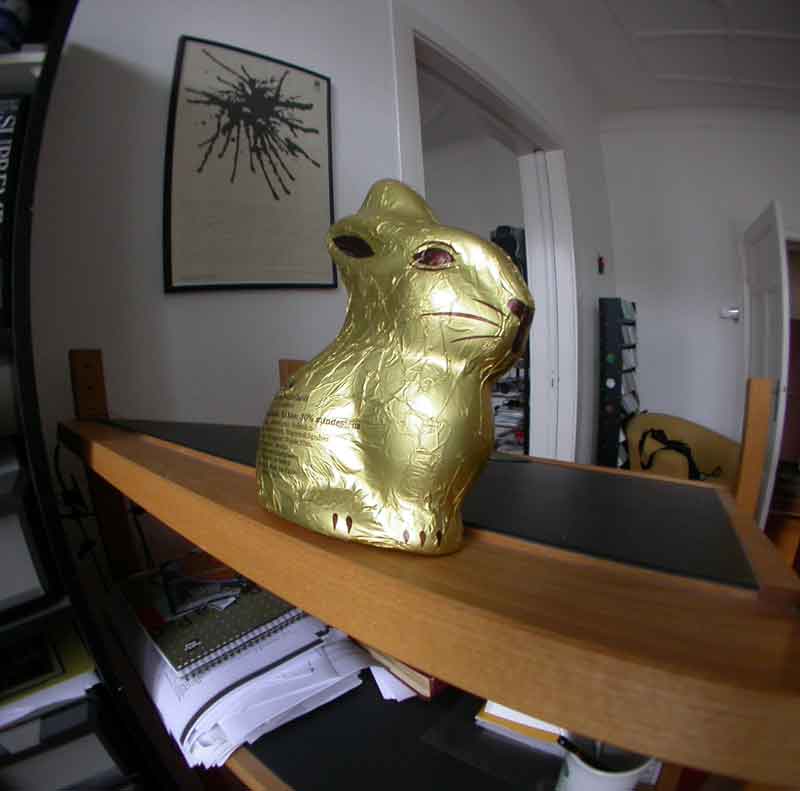
Dieses Bild zeigt den Tintenklecks, der angeblich entstand, als Luther beim Übersetzen den Tintenfass nach dem Teufel warf (DDR-Plakat, erworben als ich verschiedenen Broschüren über die Wartburg übersetzte).

This picture shows the ink blot on the wall of Luther’s study at the Wartburg, where he translated the Bible. He is said to have thrown his inkpot at the Devil. I suppose I would have to throw the mouse. Or a copy of von Beseler-Jacobs-Wüstefeld’s law dictionary might be effective.

inkblotw.jpg

Britannia Coco-Nut Dancers of Bacup/Englischer Ostertanz

Die Coco-Nut-Tänzer von Bacup in Nordengland tanzen jedes Jahr am Ostersamstag durch ein paar Orte, zehn Stunden lang (Anfangsstation ist die Kneipe Travellers Rest). Hier der Weg. Hier ihre offizielle Website. Es erinnert sich keiner an den Anfang dieser Tradition; die Tänze werden von Vater an Sohn weitergegeben. Die Holzplatten an Händen, Knien usw. sind vielleicht von Schutzkleidung im Bergwerk abgeleitet. Angeblich waren die ersten Tänzer maurische Seeräuber, die zuerst in den Silberbergwerken in Cornwall arbeiteten und dann zu den Kohlebergwerken im Norden zogen.

I’ve borrowed this picture from this site, courtesy of Mrs Sheila Riley:

coco1-1.jpg

Video

The Britannia Coco-Nut Dancers of Bacup dance their way from the Travellers Rest pub in Rochdale (I think) for 10 hours every Easter Saturday.
The Guardian has a short report.

bq. The dances are centuries old, passed down by word of mouth. Even the nutters aren’t sure of their history, but believe that the blackened face tradition and much of the costume may stem from Moorish pirates who worked the tin mines in Cornwall before bringing their labour north.

They are a bit reminiscent of morris dancers, at least to the ignorant like me.

The Moriskentänzer figures in the Munich Stadtmuseum must be some kind of morris dancers.

Knitting, sewing and cooking weblogs/Weblogs zu Stricken, Nähen und Kochen

Alexander Hartmann stellt einen Webring für Stricker vor. Ich wusste nicht, dass es sowas auf deutsch gibt – Weblogs für Stricker sind bekannt in den USA und England. (Via plasticthinking) Deutscher Strickbloggerinnen.

I’ve long been fascinated by knitting weblogs. I haven’t had any time to knit for the last twenty years (although there was a period of a couple of years where half the class was knitting while I was teaching). But if I did, I would find the weblogs useful. There are photos of projects in progress, and the comments can be enlightening too.

I think there is more than one English-language knitting weblog webring. There’s even a queer knitters’ webring.

Now Alexander Hartmann, via plasticthinking (links above), points out that there is a German knitting weblog ring.

Because of the pictures, I suppose even those who speak no German might be interested to look.

Here’s an American living in Norway, plus Norwegian for knitters. Here’s a knitting club in Britain (the shop has some bizarre patterns, such as knitted shoelaces and an exfoliating cover for a bath sponge).

Some English/German knitting vocabulary here , here and here – Google will find more.

Here’s a sewing weblog started by Mena Trott of Movable Type.

Cooking weblogs have actually made it to my link list: Appetites (Robert D. Peyton, if I remember right a lawyer in New Orleans, including restaurant reviews, with links to other food blogs), La Grand Bouffe (German, from Vienna, by a student from Südtirol/Alto Adige – or somewhere around there), and I was just really very hungry, by Makiko Itoh, who is Japanese, grew up in Britain and the USA, lived in Japan and now lives in Switzerland, also with good links).

I suppose there must be weblogs on carpentry and home decorating and stopping leaking taps too.