Free-range Scotch eggs

I am surely not the first person to wonder how far free-range eggs (Eier aus Freilandhaltung) actually range.

See Down with free-range chickens! Up with free-range eggs! (quoting Thomas More):

They breed an infinite multitude of chickens in a very curious manner; for the hens do not sit and hatch them, but a vast number of eggs are laid in a gentle and equal heat in order to be hatched, and they are no sooner out of the shell, and able to stir about, but they seem to consider those that feed them as their mothers, and follow them as other chickens do the hen that hatched them.

I don’t think More foresaw these:

scotchegg

It seems you can also get free-range pickled eggs, albeit from England – but after today’s referendum that might be necessary.

Book on German corporate law

Schulz/Wasmeier: The Law of Business Organizations. A Concise Overview of German Corporate Law. Springer Verlag 2012

Look Inside at amazon.

I haven’t read much of this book, but mainly the first chapter, which covers the background on conducting business in Germany, German business law, and German insolvency law. The other chapters deal with AG, GmbH, corporate acquisitions and cross-border corporate activities. At the back are ‘convenience translations’ of extracts from statutes, articles of association of a GmbH and so on.

The introduction of a large amount of terminology, with the original German in brackets, looks very sound. The text occasionally has a slight German feel to it (discussing the advantages and disadvantages of ‘the Ltd.’ rather than ‘the limited company’, for example, or promising in the preface ‘to make German law comprehensive for a foreign reader’; heavy use of ‘so-called’), but the terminology introduced strikes me as excellent.

It looks as if Professor Schulz was the main mover and shaker and Oliver Wasmeier, now Dr. Oliver Wasmeier, was a trainee doing a stage of his training as ‘a legal clerk at the lower district court of Freiburg im Breisgau’, whatever that means (Amtsgericht?). The main body of the book looks sounder to me.

I could have done without the familiar German textbook tactic of introducing each chapter with a ‘Case Study’, which is virtually universal in university books. For instance:

Case Study
A-Corporation (A) is incorporated in the state of Delaware, USA, with its headquarters in Wilmington …John B. (B), the CEO of A, is interested in Germany in particular …B calls Peter C. (C), head of A’s legal department, to ask him to prepare a memorandum …

I suppose these case studies are intended to help the student see the law in practical terms, but students should be able to do that on their own! So I don’t know who the audience is – the preface refers to ‘business practitioners and international students’, but whether those would expect case studies I don’t know.

But this isn’t meant to be a negative review. A few years ago there was a rash of books in English on German law, but that seems to have died down, and I thought this was a good candidate for those considering how to translate terminology in context.

How not to market yourself as a translator

‘Cold email’ from another translator, beginning ‘Hello’ (without my name), offering services, enquiring about my ‘specialisms’, offering 20% off his book (on how to improve one’s translation sales!), and ending with a link to ‘unsubscribe’.

Also advertising a ‘manually vetted translator database and project management system (under development, open for applications that will be processed in October – feel free to browse the site in its current state)’.

I seem out of line with some colleagues once again, although the author’s website quotes only part of Isabel Hurtado de Mendoza’s review in the ITI Bulletin but omits the following:

…I’m sorry to say that The translation sales handbook felt to me like a ‘work in progress’. …I believe that its potential is not fully developed. …A professional editor could possibly spot typos, detect repetitions, indicate the lack of relevance of certain sections …

It looks as if the email was sent to many ITI translators. Reactions varied but were on the whole not positive.

Dangerous zeppelins

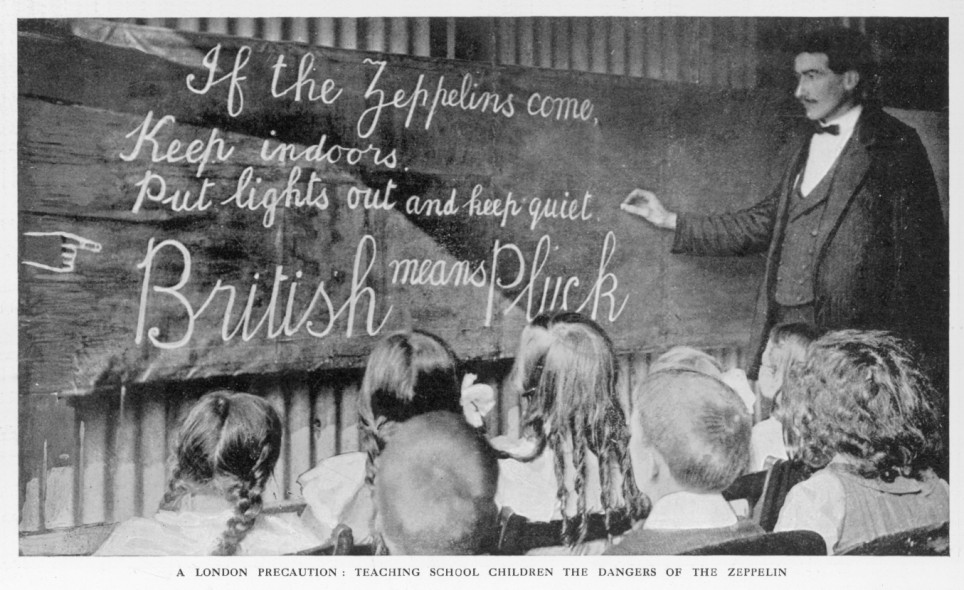
In memory of the First World War: children being warned of zeppelins.

WWI/ZEPPELIN DANGER

If the zeppelins come, keep indoors. Put lights out and keep quiet. British means Pluck.

Apparently it did take a while to develop effective anti-airship measures.

Making mistakes in German (Raed Saleh, Erasmus students in Austria)

1. Raed Saleh is a German SPD politician, who was born in the West Bank (Westjordanland) but grew up in Germany. He is a potential next mayor of Berlin, but it seems a large number of journalists believe his German is too bad. An article in taz, Ein dubioses Hörproblem (with a video clip so you can hear Saleh speaking), disagreed: it analysed the transcript of a TV interview and counted up the errors made by Saleh and the two interviewers. I wouldn’t say Saleh has a foreign accent, but some say he has, and it appears that he can’t be mentioned without the word ‘migrant’ being used, and more errors are heard in his German than are there.

As some of the commenters rightly say, if he does speak excellent German it still doesn’t qualify him to be the mayor of Berlin!

(Via Sprachlog)

2. Linz University has an (Upper) Austrian – German – English dictionary to help visiting Erasmus students (Zur besseren Verständigung zwischen (ober)österreichischen Studenten und Erasmus-Studenten).
The entries are marked as rural (L: ländlicher Raum), urban (S: städtischer Raum) and urban/Viennese (W: wienerisch/städtisch), and also as positive, negative and neutral, though these terms are not explained in English. Red marks language that should not be used.
It seems to refer to spoken language. The English looks fine, although defeated by Leberkäs (‘a type of meat popular in Austria’). And I feel some of the vocabulary is chosen because it’s funny, although it’s probably rare (Beamtenforelle, Holzpyjama – and how often in Linz do they talk about a schöne Leich nowadays?). It’s not all Austrian (den Löffel abgeben) and some is just pronunciation/spelling (moanen: meinen).

Notting Hill carnival – not

I didn’t go to the Notting Hill Carnival because it was pouring with rain (might have meant less of a crush though) and I was going to a Chinese film anyway. I was also disturbed by Time Out’s recommendation that you shouldn’t take a digital camera in case it gets stolen.

Canon Deutschland has just sent me a newsletter recommending the carnival, which it claims takes place on the last weekend in August every year (that would be tomorrow), and suggesting that I should get there early to get a good photography position. But surely not eleven-and-a-half months early?

Eine andere Veranstaltung, die einen Besuch wert ist, ist der Notting Hill Carnival, das größte Straßenfestival Europas, das jedes Jahr am letzten Wochenende im August stattfindet. Das zweitägige Festival zieht über eine Million Feiernde an und erweckt mit viel Musik und Tanz die sonst verschlafenen Straßen des Londoner Künstlerviertels zum Leben. Das Tolle daran: Die Veranstaltung ist kostenlos.

Der Notting Hill Carnival wurde 1965 von der schwarzen Gemeinde Londons ins Leben gerufen mit dem Ziel, die Menschen zusammenzubringen und die Musik und Kultur der Karibik zu feiern. Er bot den Londonern die Möglichkeit, in eindrucksvoll verzierten Kostümen auf den Straßen zu tanzen und zu feiern. In unserem neuen Kurzfilm, der die Einführung unseres Fotomanagement-Services irista feiert, erfahren Sie mehr über das Festival und eines seiner Gründungsmitglieder.

Im Laufe seiner 50-jährigen Geschichte ist der Notting Hill Carnival immer größer geworden. Er ist ein unvergleichliches Erlebnis und bietet Fotografen mit seinen farbenprächtigen Kostümen, weltoffenen Feiernden und inspirierenden Atmosphäre viele tolle Gelegenheiten für Schnappschüsse. Wenn Sie etwas früher kommen, finden Sie noch einen guten Platz, um die atemberaubenden Kostüme der Hauptparade zu fotografieren. Oder stürzen Sie sich bei Sonnenuntergang in die tanzenden Menschenmassen und halten Sie das Geschehen bei wunderschönem, fast magischem Licht fest.