How to address a judge

Via Joshua Rozenberg’s newsletter – the free version – at A Lawyer Writes – nowadays most judges can be addressed as “Judge” rather than “Sir” or “Madam”. I suppose this avoids gender problems and wonder if that was the reason for the change (announced on December 1 2022).

You should still address lay magistrates as Sir or Madam. If you are not sure which is appropriate, try Your Worship. That also works as a collective: Your Worships. Many magistrates will tell you they have been addressed as Your Holiness by confused defendants or those hoping for a more benign sentence.

The diagram What do I call a judge? makes it no clearer. I love the surnames used – “District Judge Kherallah” or “First-tier Tribunal Judge Curry”.


In response to a comment unexpectedly received, here is a longer quote from Rozenberg’s newsletter (i.e. virtually the whole thing):

How do you address a judge in court? Top judges are addressed as My Lord or My Lady. Most circuit judges are addressed as Your Honour. I was taught to address any High court master as Master. And until yesterday some of the most junior judges in England and Wales were simply called Sir or Madam.


That’s all gone. From now onwards, any judge in one of the following categories is to be addressed simply as Judge:

  • Masters
  • Upper Tribunal Judges
  • Judges of the Employment Appeal Tribunal
  • District Judges
  • District Judges (Magistrates Courts)
  • First-Tier Tribunal Judges
  • Employment Judges

Why? According to the lord chief justice and the senior president of tribunals,

the move away from “Sir or Madam” involves modern and simple terminology, reflecting the important judicial role whilst maintaining the necessary degree of respect.

We also hope this change in language will assist litigants-in-person involved in court and tribunal proceedings.


And, I suppose, it will reduces the risk of misgendering judges.

Calling a judge “Judge” may sound a bit disrespectful. But it’s how you address them formally when they’re not sitting in open court.

You should still address lay magistrates as Sir or Madam. If you are not sure which is appropriate, try Your Worship. That also works as a collective: Your Worships. Many magistrates will tell you they have been addressed as Your Holiness by confused defendants or those hoping for a more benign sentence.

And Sir or Madam remains appropriate for lay members of a tribunal. High Court registrars should be addressed as Registrar, which is inconsistent and a bit harder to say.

The changes apply only to the way in which judges are addressed in court or at tribunals. It does not affect judicial titles.


I have now found my copy of The Language of Advocacy by Keith Evans, one of my favourite books and not just about England and Wales. It is dated 1998 (but still in print), so before the House of Lords became the Supreme Court. Evans writes that “no appeal court Justice will ever take offence at being called simply ‘Judge’. It’s an illustration of the old truism that those who matter don#t care, and those who care don’t matter.”

Of course, now the judges of the Supreme Court are called justices, which might not alter the relevance of the above but did prompt the judges of the German Constitutional Court to wish to be called “justices” in English translations.


There is also a post on this on free movement.

Miscellaneous

A number of bits of news.

  1. An article in the Law Gazette on April 19 2022: Official court judgments database goes live
    https://www.lawgazette.co.uk/law/official-court-judgments-database-goes-live/5112223.article

I haven’t had occasion to use this yet. It’s worth looking at the comments to see its possible limitations. Till now, we have been very happy to use BAILII, but it’s good to have an official initiative and I think the two may complement each other. Note on the BAILII website there are links to other collections.

2. New German phonetic alphabet: https://www.n-tv.de/panorama/Weg-mit-den-Nazi-Bezuegen-DIN-veroeffentlicht-neue-Buchstabiertafel-article23330727.html

Stuttgart hat es nicht geschafft, auch Augsburg blieb auf der Strecke. Und Bremen ist als einziges Bundesland nicht dabei. Buchstabiert wird künftig von A wie Aachen bis Z wie Zwickau.

Wikipedia has a table showing Switzerland and Austria too. It doesn’t worry me that the towns are all in Germany rather than Switzerland and Austria, as long as they’re comprehensible on the phone. At one time the table contained D for David (older Germans are often suspicious about the name David), N for Nathan and Z for Zechariah. The Nazis replaced these with Dora, Nordpol and Zeppelin, but they are now Düsseldorf, Nürnberg and Zwickau.

https://www.bbc.co.uk/news/world-europe-55186459

https://de.wikipedia.org/wiki/Buchstabiertafel

3. I dare hardly dip a toe into the problem of making German gender-neutral. Someone posted a shot of a page of this book on Twitter: Wie schreibe ich divers? Wie spreche ich gendergerecht? Ein Praxis-Handbuch zu Gender und Sprache, by Lann Hornscheidt and Ja’n Sammla (whether the authors’ names are as they appeared on their birth certificates it doesn’t say). Here’s a quote from an amazon review:

Wenn es nach Hornscheidt und Sammla geht, gehe ich zukünftig nicht mit meiner Mutter, sondern mit meinens Meema zur Familienfeier. Dort treffe ich nicht meinen Opa und eine Tante, sondern meinex Opmex und ens Tonkel. – Was hier aussieht als wäre eine Katze über die Tastatur gelaufen, wird so wirklich und ernsthaft vorgeschlagen. (S.95 Tabelle 1) Sprache wird hier, um eine andere Rezension zu zitieren, “wie Knetmasse” behandelt, die sich nach Belieben verformen lässt. Ein lächerlicher und irgendwo schon fast bemitleidenswerter Ansatz an der völlig falschen Stelle.

Wir haben uns jedenfalls köstlich amüsiert, wie hier doch allen Ernstes erwartet wird, dass man die “böse Hexe” in einem Märchen zur “sehr weisen Person” umformuliert.

Tweet with screenshot

Marc Prior has created a website, gendern.eu, with an article on the problem of feminine/masculine, which considers the possibility of generic neuter.

5. Professor Dr. Tinka Reichmann of Leipzig University has linked some diagrams of the German court system with translations into various languages. There doesn’t seem to be anything new here though.

We used to have diagrams, now outdated, from a book on German law for schools, in which the number of judges was indicated by little human figures in various numbers, which seemed easier to look at. I would be confused by one of these diagrams in English alone and wonder what the significance of panels vs. chambers was.

This and that

I have almost given up this blog, but here are a few legal/translation points while I am passing through.

Divorce vocabulary

This week English law at last provided a possibility of no-fault divorce. Previously the only way to get a divorce relatively promptly involved spouses accusing each other of behaviour of various kinds (‘unreasonable behaviour’, meaning behaviour the other spouse could not reasonably be expected to live with). (No-fault divorce is possible in Scotland though).

New divorce laws will come into force from 06 April 2022

So just to make things more interesting for translators, some of the vocabulary has changed. A divorce petition becomes an application, a petitioner an applicant, a decree nisi a conditional order and a divorce decree a divorce order.

Thanks to Laura Elvin for pointing that out.

Beziehungsweise / bzw.

I don’t think I’ve written much about this, but it is a problem to translate.

Without warming up the long discussion on translators’ forums, I would like to quote what a colleague read in a German Patent Office examination report:

“Das Bindewort beziehungsweise (bzw.) ist nicht zur Schaffung zweifelsfreier Rechte geeignet, da es als und, oder oder auch als und/oder verstanden werden kann.”

I love this. I like the bit where they say “… da es als und, oder oder auch als und/oder verstanden werden kann.”
So there is a difference between “und, oder” and “und/oder”.
They could have written “…da es als und, oder bzw. als und/oder verstanden werden kann”, couldn’t they?

Speeding fines based on income

Juliette Scott in her blog From Words to Deeds finds it odd that speeding fines in Finland are based on income.

But it isn’t so odd. In Germany too, and no doubt in other countries outside the UK, the amount of the fine varies between the rich and the poor. So you get a number of points, called Tagessätze, and what a point is worth depends on your income. It makes sense to me.

There used to be problems translating the word Tagessätze. It seemed poor grammar to call it daily rates. I now write daily units. This is because the term was used when the system was briefly introduced in the UK. The problem arises if you write in the papers the exact sum the rich person has to pay, rather than the number of units or the percentage of income used. I suppose that the average newspaper reader is not aware how much richer some people are than others.

This is all so long ago that I’ve forgotten the details. In fact I note that in 2021 and presumably 2022 too, the most egregious speeding fines were related to income. Speeding fines 2021.

Forensic linguistics in German criminal procedure

The latest edition of Language and Law/Linguagem e Direito is a special issue arising from a one day symposium looking at the way expert evidence is handled in different jurisdictions.

It contains an article by Sabine Ehrhardt of the Bundeskriminalamt looking at how forensic linguistic evidence and experts are handled in the German criminal court system. Forensic Linguistics in German law enforcement.

The main emphasis is on a case where forensic linguistics evidence was required to analyse text messages sent to the victim’s mother before and after the victim’s disappearance, answering the question: no body has been found, but did her husband kill her and fake the circumstances of her disappearance? The case was based on circumstantial evidence, of which the text messages were only part.

It was striking but perhaps not surprising that in the 200-page summary of the judgment, the judge seems to have completely misunderstood some of the expert’s arguments. The article queries whether German lawyers receive enough training in forensic linguistics.

Incidentally, the English of the article was good, but I really dislike the translation of Nebenklägerin – taken straight from Dietl – as joint plaintiff. My suggestion is private co-prosecutor. This refers to the role of the victim’s mother. I know the German “Kläger(in)” is closer to plaintiff than prosecutor, but it seems odd in a criminal court. – Romain has additional private prosecutor, which is better, although it seems to suggest that there are multiple private prosecutors, unless you put commas in.

iDivorce

It’s only a few months before divorce law in England and Wales becomes more sensible. But currently, if you want a fairly quick divorce, the easiest way is to prove that your spouse’s behaviour is ‘unreasonable’, that is, not reasonably acceptable to you.

In times of iSmash, iBroken and so on, it’s not surprising that there is a firm called iDivorce. A judge has recently rapped them over the knuckles for having 28 clients with virtually identical wording with regard to the respondents’ behaviour.

Judge spots clowntown divorce factory using identical wording in 28 petitions (RollOnFriday):

IDivorces’ efficient but unlawful approach had resulted in declarations that were untrue, said The judge. “If I needed to give an example, it would be to say that it would be incredible if all twenty eight respondents ignored the twenty eight petitioners and declined to communicate with them on about two days per week”, he said.

Lord Chancellor’s Breakfast 2021

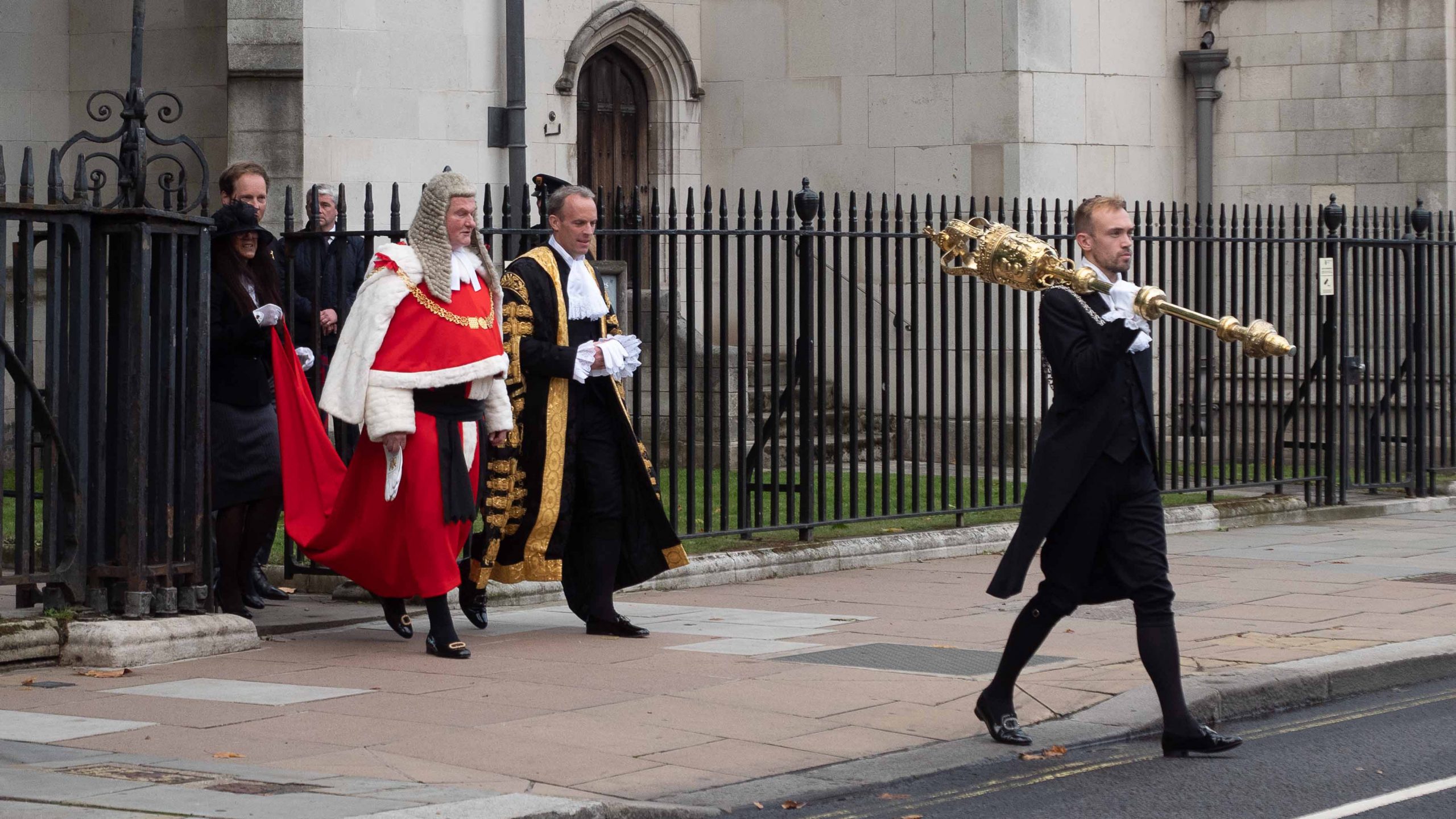
Lord Chief Justice, left, with train-bearer; Lord Chancellor; mace-bearer

It took place this year, but with some masked and with fewer judges than usual.

I’m not sure I will do this again, because the peculiarities of post-lockdown meant that I accidentally joined the professional photographers, though I did not have a press pass. The light is so much better from the other side! I doubt I could wing it again. But I will investigate getting a press pass or waving my RPS membership card.

As always, I have difficulties working out who is who. First appears the Lord Chancellor, Dominic Rudd (at least he studied law – Liz Truss wasn’t even capable of attacking the tabloid press on ‘Enemies of the People’), together with the Lord Chief Justice, currently Lord Burnett of Maldon, the most important judge after him, who wears the High Court red but with the extra detail of a train, which here a woman has to carry. There is a man with no apparent function too.

After this come a mixture of both justices of the Supreme Court and the Court of Appeal. There is a certain order of priority. Thus, first come a few in full-bottomed wigs – these are the heads of division. The one in front here is Dame Victoria Sharp, the President of the Queen’s Bench Division:

I read that she had four children in five years and did not take any leave at all, because as a barrister she would only get work if she was present in chambers. This might be one of those children, just a guess. Behind her is probably Sir Geoffrey Vos, the Master of the Rolls, but I am not sure. I am just guessing he would be next.

The mystery is: who is the gentleman in the tricorne hat? I am thinking possibly a Canadian judge, but then why so early in the procession? The umbrella-bearer may be a guest of the man on the left. The UK Parliament website says:

Guests include:

  • judges from England and Wales
  • senior judicial officers
  • the Law Officers of the Crown
  • Queen’s Counsel (QCs)
  • overseas judges and lawyers
  • members of the European Court, and
  • Government ministers.