They don’t do this in Germany.
Category Archives: law
Transblawg hits the big time
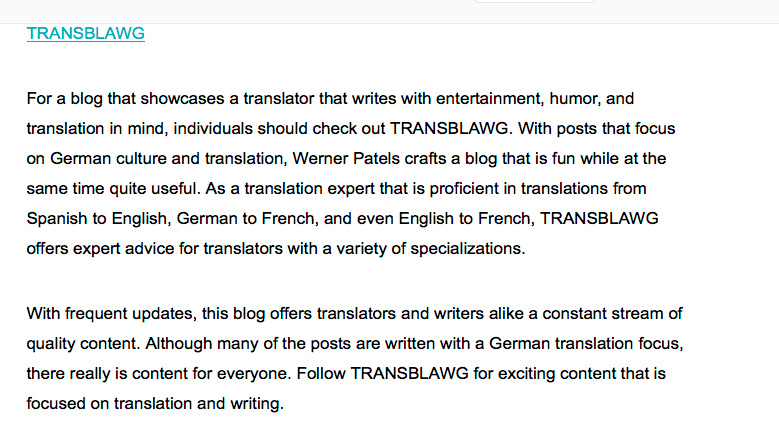
Fame at last! One hour translations have devoted at least an hour to describing Transblawg. Here’s a screenshot – spot the deliberate errors:

Werner has become a political commentator now and I fear he would not be impressed to be described as Transblawg’s author.
It’s unusual for me to get this kind of accolade, since I never get an award as Best Translation Blog or the like (possibly because I don’t advertise the chance of voting for me on the site advertising the competition).
Thanks to Kevin Lossner of Translation Tribulations for this. Sadly his blog didn’t make the list.
Why are litigation letters often so dreadful?
I picked this old article up from a tweet by Jack of Kent (David Allen Green), the author.
It’s reminiscent of the kind of tone I sometimes hit when translating similar correspondence by German lawyers.
The authors of this dreadful correspondence will invariably profess themselves “surprised” or “astonished” (or even “surprised and astonished”). They are “bewildered” and “confused” and sometimes “shocked”. If any of these assertions were literally true then the dispute resolution departments of many law firms must be in a constant state of noisy hyper-ventilation. It would be close to a national medical emergency.
The comments are good too. Anonymous writes:
David,
I am dismayed and surprised to read this post. The allegations are bewildering when they are not misconceived and illiberal.
I await your response within fourteen days.
I wonder if Rupert Haigh’s Oxford Handbook of Legal Correspondence advises this kind of thing.
Schleierfahndung
When the word Schleierfahndung first began to be used, I tried to pin down its meaning for a translation (I don’t seem to have blogged it, though – this was in the mid-90s, which predates the blog).
The phenomenon seems similar to ‘stop and search’ – stopping and searching people although there is no reason to suspect them. There have been calls for it to be extended since border controls were removed in the Schengen area (which now comprises 26 European countries, not all in the EU, but not the UK and Ireland).
How the word – literally ‘veil search’ – was coined I am not sure.
Neusprech has now taken up the term. It refers to something called ein Verdachtsschleier – a veil of suspicion. The typical search takes place after vehicles have been seen crossing the border and are followed and stopped inside the border.
Das ist eine Suche auf gut Glück, bei der Menschen gerne allein deswegen schikaniert werden, weil sie fremd aussehen und bei der jeder zum Verdächtigen wird. Der Ausdruck S. lässt dabei offen, ob hier Bösewichte entschleiert, oder ob umstrittene Überwachungen verschleiert werden sollen. Die Fakten sprechen für das Letztere. Denn die S. hat weder etwas mit Fahndung noch mit Schleiern zu tun und vernebelt, dass hier Menschen grundlos durchsucht und ihrer Freiheit beraubt werden.
It’s sometimes translated by the term dragnet, but that means searching a large area thoroughly searching for one particular person. It appears the word dragnet reminded some translators of the word Schleierfahndung, but it doesn’t work like that!
More in the Alternatives Wörterbuch:
Herkunft: gegen Ende des 20. Jh. vom Frankfurter Strafverteidiger und Bürgerrechtler Dr. Sebastian Cobler geprägter Begriff; Schleier: Bed. in diesem Zusammenhang ungeklärt, wohl von der Idee her, dass keine spezifische Fahndung, sondern eine Art verdeckte oder eben „verschleierte“ Fahndung in Form einer allgemeinen Fahndung durchgeführt wird {Spek. FAL}; Fahndung: in der Bed. von „polizeiliche Suche nach Verdächtigen“, zu fanden, wohl aus dem Niederdeutschen, von mniederd. vanden = aufsuchen, besuchen

The pilcrow’s partner in crime: §
Keith Houston, of the Shady Characters book, turns his attention to the section symbol.
I’ve always known it as the section sign, or section symbol; Robert Bringhurst (The Elements of Typographic Style)[1] and Theodore Rosendorf (The Typographic Desk Reference),[2] my go-to typographic references, agree. It seems odd, though, that this eminently shady character has no other name. Have you come across any other names for the pilcrow’s partner in crime?
It’s called the paragraph sign in German, and it symbolizes law. It’s used in US statutes too, but there called the section symbol.
The commenter Erik writes:
It’s a symbol I used heavily (as a mathematical symbol) in my PhD thesis, and many other people who use it in the same way I did referred to it as “paragraph” which always drove me nuts because to me, the “paragraph symbol” is the pilcrow. But sadly that name is out there. I always called it the “section symbol”.
Typography for Lawyers reminds us to use a non-breaking space after these symbols.
On the book:
If Eats, Shoots & Leaves whetted your appetite on the subject of punctuation, then you have a treat in store. Shady Characters is an authoritative, witty, and fascinating tour of the history and rationale behind such lesser known marks as the ampersand, manicule, the pilcrow, and the interrobang. Keith Houston also explains the octothorpe — otherwise known as the hashtag — and my final comment on his book is #awesome.
Ben Yagoda, author of How to Not Write Bad
Cat-ladder in prison/JVA Aichach Katzenleiter
Many years ago I found this story, I think in Stern, about men prisoners feeding cats in the Aichach prison:
Fortunately I have found my old copy and sent it to Jimmy’s Catladder blog.
I can’t find anything about it now. Possibly the ladders have gone. I think the big windows at the ends of blocks are the kitchens where the prisoners can make themselves food in their break times and presumably fed cats too. It’s mainly a women’s prison, but I think it was in the men’s section that the cats were.