French and Yiddish in American law

Is it correct to translate ‘Quel jeu doit-on jouer vis-à-vis des autorités de Californie?’ as ‘What game must we play with the California authorities?’

This question came up for consideration by a United States District Judge recently. He certainly felt competent to answer the question with the help of a bilingual dictionary (I think I could work twice as fast if I had the self-confidence about legal translation that some judges have). I can’t really judge this French, though.

bq. 10/02/2005 : John Garamendi, vs. Altus Finance S.A., et al. – Order Denying MAAF’s Motion to Preclude the French Phrase “Quel jeu Doit-on Jouer Vis-a-Vis Des Autorities De Californie?” as Used in Mr. Simonet’s Notes From Being Translated as “What Game Must We Play With the California Authorities?” [Motion 12] Case No. CV 99-2829 AHM (CWx)

Eugene Volokh writes that French will never rise to the importance of Yiddish in court opinions. Here is a paper on that subject by Volokh and Judge Alex Kozinski

bq. The more likely explanation is that Yiddish is quickly supplanting Latin as the spice in American legal argot. As recently as 1970, a federal court not only felt the need to define “bagels”; it misdefined them, calling them “hard rolls shaped like doughnuts.” All right-thinking people know good bagels are rather soft. (Day-old bagels are rather hard, but right-thinking people do not eat day-olds, even when they are only 10 cents each.) We’ve come a long way since then.

(Thanks to Chris Durban. Netlex blog (French)
One grants himself otherwise naught / Man gönnt sich ja sonst nichts

Familien-Landhotel Moerisch, Towersuite/Chimneysuite:

bq. Elegant suite with Italian style furniture in the 3rd cane, large living room, equipped with minus bar, desk, telephone, internet connection, safe, Sat-TV, south balcony. Bathroom with Whirlbowl and large panorama window, divided shower, WC, make-up mirror and hair blower. The bedroom is in the terminated upwards and controls Sat-TV.
Furthermore in that upwards: infrared sauna, shower and extra WC… One grants himself otherwise naught….

bq. My grandfather Sigismund Eduard opened an inn with a Gemischtwarenhandel with its woman Elisabeth in the between wartime and he managed the agriculture. My father Sigismund Albert in the year 1955 harbored the first guests – at that time yet as a bachelor with its mother. Instead of large bathroom, there were Waschschuesseln and water pitcher at the room.

But Power Walking should not have become Power Whale King, should it? Or Golfpauschale Gulf Lump Sum. Or die verschiedensten Wanderwege as the most deceased.

Advent

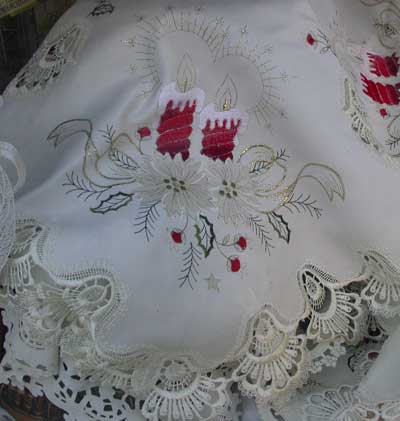
adv1_20051210w.jpg

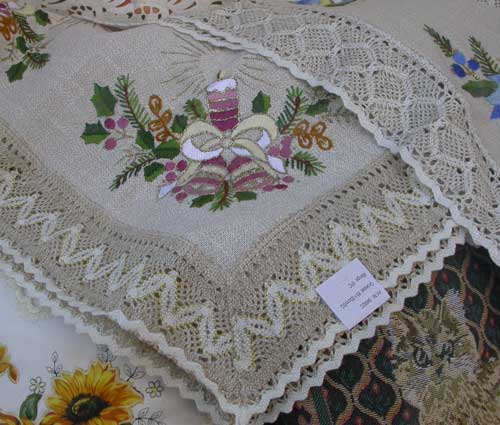
adv2_20051210w.jpg

These are German Advent tablecloths. You don’t often see them except in December. Each of the four corners stands for one of the four Sundays in Advent. At the end of the day, the corner for that Sunday is ceremonially burnt, so after the fourth Sunday, there is only a charred heap remaining, and at the beginning of January embroidery starts on the one for the following December.

Civil partnerships / Lebenspartnerschaften

The Civil Partnerships Act came into force in the UK on December 5 – after a period of notice, the first ceremonies will take place in England and Wales on December 21, and in Scotland on December 20. (The Guardian). This is not a marriage, but it contains most of the rights associated with marriage. Another Guardian article:

bq. Gay couples who register as civil partners will take on the obligation to support each other financially, even after the relationship ends. To split, they will have to go through a “divorce” process, with the courts dividing up the assets regardless of ownership if they fail to reach a settlement. They will be exempt from inheritance tax when the first partner dies, and will have the same pension rights as married couples.

Statutory heir / Gesetzlicher Erbe 3

To sum up: in German law, there are Erben whether a person made a will or not. (Gesetzliche Erbfolgegewillkürte Erbfolge) So sometimes the term gesetzlicher Erbe needs to be translated. What do you do, when it really matters?

Strictly speaking, statutory heir or heir on intestacy is almost too much of a good thing, since in common-law systems the word heir implies that there was no will.

I had to translate this and asked a number of other legal translators which they liked. The most popular answer was ‘I don’t know much about inheritance law’.

I wanted to use the term intestacy, but I’m told statutory heir is normal usage in the USA. I did eventually get a lot of information from one US legal translator, who shall be nameless unless he would prefer to be outed. He suggested Google searches on
“statutory heirs” “uniform probate code”
Other ways of getting US sites are site:edu and site:us

I have to repeat that the word heirs is not used in English law at all. Hence comparing results for heirs on intestacy might be misleading. I also reject the suggestion of intestate heir, because it sounds to me as if the heir has neglected to make a will, which may or may not be true. But this term too is encountered on US sites. Heir on intestacy is comprehensible in the US, but sounds a bit odd, according to my informant (but I regard it as an advantage if a translation relating to German law sounds a bit un-American – I wouldn’t want people to think it referred to American law).

Finally, I looked at Tony Weir’s translation in German Private and Commercial Law. An Introduction, by Horn, Kötz and Leser – 1982 but still the best. It has a heading Statutory Intestate Succession! Michael Jewell’s translation of Gerhard Robbers, An Introduction to German Law, refers to beneficiaries on intestacy, and when it comes to distinguishing Erbe and Vermächtnisnehmer, it has residuary beneficiary and specific beneficiary.