This site has links to resources on canon law in a large number of countries and the EU.
Too late. I just hope to God I never need it again!
About the site and webmaster Dieter Krause at the ECJ in Luxembourg (in German)
(Via Handakte WebLAWg)

This site has links to resources on canon law in a large number of countries and the EU.
Too late. I just hope to God I never need it again!
About the site and webmaster Dieter Krause at the ECJ in Luxembourg (in German)
(Via Handakte WebLAWg)
Here is the vocabulary used nowadays for those who inherit:
Germany
Testament: Erbe, Vermächtnisnehmer
Gesetzliche Erbfolge: Erbe
England
Will: beneficiary
Intestate succession: beneficiary
USA
Will: beneficiary (devisee: of real estate, legatee: of personal property)
Intestate succession: heir (or real estate)
distributee / next of kin (of personal property)
In both EN and USA: devise: a gift of real property
legacy / bequest: a gift of personal property
gift: either real or personal property
You can draw a little table with this information, but it doesn’t mean you can translate Erbe as beneficiary or Vermächtnisnehmer as legatee.
Note the distinction in EN and USA law between real property and personal property
Mark Reutlinger: Wills, Trusts, and Estates. Essential Terms and Concepts – on US law of succession
Still not finished …
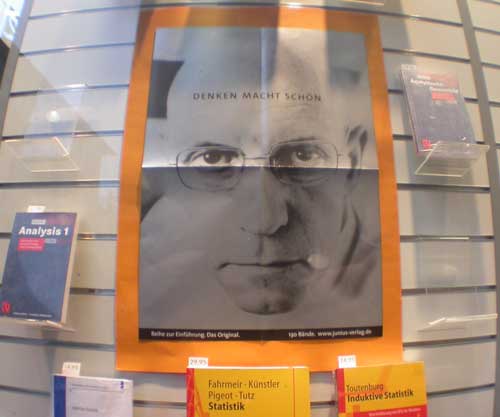
Bookshop, Schellingstraße, Munich

Some problems here:
In US law, there is an heir
bq. Gifis: heirs: strictly, those whom statutory law would appoint to inherit an estate should the ancestor die without a will. Synonyms: heirs at law, rightful heir, legal heirs. The term is often applied indiscriminately to those who inherit by will or deed as well as by operation of law.
In English law, there has been no heir since 1927 – only beneficiaries.
bq. Oxford Law Dictionary: heir: before 1926, the person entitled under common law and statutory rules to inherit the freehold land of one who died intestate.
In everyday English, the term may be understood to mean the person who inherits on intestacy. There is an heir to the throne, who automatically inherits the throne in a similar way to the German manner of succession – see below.
But under the common law, originally, a testator could exclude anyone from succession by will. All kinds of devices have been introduced to protect spouses, children, and dependants from being disinherited, but still, there is no heir under a will.
BUT in German law, the Erbe (a word related to heir), singular or plural, exists whether there is a will or not. You could say that this is because you can’t exclude your heirs.
bq. Alpmann-Brockhaus Erbe: jede erbfähige (Erbfähigkeit) natürliche oder juristische Person, auf die mit dem Tod des Erblassers das Vermögen kraft Gesetzes oder kraft Verfügung des Erblassers als Ganzes übergeht, und die in dessen gesamte Rechts- und Pflichtenstellung eintritt (Gesamtrechtsnachfolge). Der Erbe wird damit Eigentümer der Nachlassgegenstände, Gläubiger der Nachlassforderungen und Schuldner der Nachlassverbindlichkeiten. Der Erbe ist vom Vermächtnisnehmer zu unterscheiden, der gegen den Beschwerten nur einen schuldrechtlichen Anspruch auf die entsprechende Leistung hat (§2174 BGB).
© Alpmann Brockhaus Fachlexikon Recht, 2004 [CD-ROM].
(Not quite as good as Creifelds, but much better software, and runs together with the Muret-Sanders e-Großwörterbuch)
To be continued…