Austrian: Es war wie im Spruch zu entscheiden

From an Austrian judgment: Es war wie im Spruch zu entscheiden. My translation: The case was decided as in the operative part of this judgment.

Judgments are divided into named sections, for instance in Germany Tenor means the operative part – Spruch is the Austrian equivalent. These words are printed in the judgment, but they are used in referring to it, and Austrian judgments happen to use it in this way.

This standard wording has been discussed by translators on the internet too. Literally, it means It was necessary to decide (es war … zu entscheiden), not It was decided. Personally, I don’t think that adds any shade of meaning to the more usual English It was decided.

Repetitorium Hofmann, a cramming institute, has a very nice PDF file for trainee lawyers on the structure and wording of judgments. Probably worth saving to disc – link may not work for ever.

There’s apparently a similar expression, Es war spruchgemäß zu entscheiden. A LEO discussion has a comment containing this:

“Es war daher spruchgemäß zu entscheiden” bedeutet sinngemäß: Es war daher so zu entscheiden, wie es das Gericht getan hat. Oder: Die Entscheidung war so zu treffen, wie sie im Urteilsspruch niedergelegt ist.Die Formulierung wird üblicherweise am Ende der Urteilsgründe verwendet, um zur Abrundung noch einmal auf den Tenor (also den Kern der gerichtlichen Entscheidung, der ganz oben über der Begründung steht) Bezug zu nehmen. Der Satz besagt im Grunde genommen gar nichts und ist vollkommen überflüssig.
Controlling/DE>EN Übersetzung

A colleague’s query:
Einkaufscontrolling/Personalcontrolling
Controlling is a German word. One suggestion for the English equivalent was purchase controlling/personnel controlling. But that isn’t English either!

This isn’t my speciality, but for Controlling I have recorded management accounting. That doesn’t work for the other two, though, which are departments of German companies. A colleague recommended procurement tracking and personnel tracking, found at www.intersense.com, which sounded good to me – but on checking the link, I got the impression they were tracing / following the personnel in a GPS-like way.

Another colleague recommended a discussion at LEO, which is helpful – not all the LEO discussions are.

Martin Crellin at False friends, good and bad translation is usually good on this kind of thing, but he doesn’t seem to have tackled this word yet.

I am inclined to use purchasing management and personnel management. There’s some support for this at ProZ, where personnel management or human resources management is suggested.

Ancillary copyright/Leistungsschutzrecht

Urheberrecht (the right of an author, which under German law cannot be assigned): copyright
Leistungsschutzrecht (the right protecting commercial activity in connection with copyright, for example publishing): ancillary copyright

Leistungsschutzrecht, literally ‘right protecting performance’, is not easy to translate into English. It’s sometimes called a neighbouring right, which is OK if you realize it’s neighbouring copyright. Ancillary copyright is commonly used, but perhaps misleading, in that the right is not actually copyright. Uexküll’s dictionary has wettbewerbsrechtlicher Leistungsschutz: accomplishment-related protection under German law. It’s a form of industrial property right, not really a form of intellectual property right.

The term has been in the news recently because a draft bill has been presented to the Bundestag for an amendment of the German Copyright Act (Urheberrechtsgesetz) giving (mainly newspaper) publishers a year-long right protecting their publications from commercial online use, and it obviously affects bloggers. This was part of the coalition agreement of the present German government.

‘Hobby bloggers’ are OK. However, I am not a hobby blogger under this bill, because I blog on translation, which is what I earn my living from. Even though I no longer display Google ads, nor even links to amazon, I am therefore a commercial blogger. If this bill becomes law, I will be allowed to link at will, but if I copy even the smallest part of a newspaper article, I will have to get a licence to do so, or presumably action may be taken against me. And there have been lawyers in Germany in the past who earned part of their living from sending warning letters to webmasters, for instance for not having an Impressum.

It’s true that section 51 of the Copyright Act allows quotation to some extent, but it’s probably safer simply not to quote newspapers at all if the bill becomes law.

What isn’t clear to me is whether as a commercial blogger I actually become a publisher so that I could sell licences myself. I don’t regard this as likely to interest anyone, I am just not clear on the point. What about a service like jurablogs? I find it useful because it shows me the topics of a huge number of German law blogs which I might not otherwise see. Presumably it would be threatened by this law. And what about Perlentaucher?

Fortunately it’s rather late in the parliamentary session, so maybe this won’t come to anything.

Books and bookshop/Bücher und Buchhandlung

1. Fabio Said recommends Five Great Books on German Legal Terminology. I particularly recommend the first two: Ulrich Daum’s Gerichts- und Behördenterminologie, and Corinna Schlüter-Ellner’s Juristendeutsch verständlich gemacht/Treffende Verben in der deutschen Rechtssprache.

The former is a book I discovered when I was doing the Bavarian state translators’ exam in Munich – there used to be a fill-in-the-gaps etc. exam on Gerichts- und Behördenterminologie at that time, since whatever your main subject, the exam qualifies you to translate for the courts. The book has been updated since then.

The latter starts with a list of heavy German legal vocabulary and explains it in simpler language. You won’t find all these terms in dictionaries. The Treffende Verben may be of more use to those translating into German.

The other three books I don’t possess because I have others they overlap with, but a good recommendation.

2. Wildy & Sons is a great legal bookshop in London. They also have an online shop. The London shop has a good selection of second-hand law books too, both students’ books and antiquarian stuff. On their website you can see a virtual tour of the shop (to find their link, scroll down at the left). This needs navigating in Google Maps. You can see the books, but also leave the corridor-like part of the shop with new books and navigate through to the office and second-hand departments.

Bratwurst Röslein discrimination/Englische Übersetzung lückenhaft

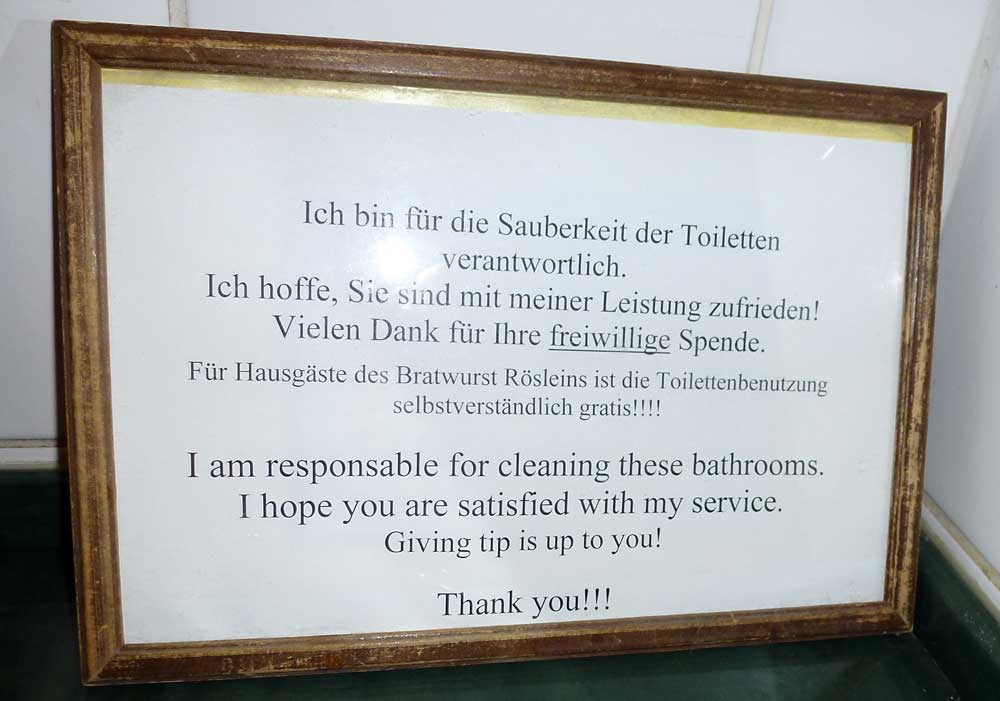
I was a bit surprised after lunch at Bratwurst Röslein to find a woman collecting tips for the lavatory. But at least I should have read the German, which says that bona fide restaurant customers don’t have to pay. That bit hasn’t been translated into English.

I realize they must get a lot of people dropping in just for the lavatory, but how about a notice to the effect that we’re happy to let you use our facilities even if you don’t eat the sausages if you pay 50 cents?