Liet International/Eurovision für Minderheitensprachen

Sorry to be so late on this – the competition was held on November 19 and was won by a Dutch Frisian:

Young Frisian singer-songwriter Janna Eijer from the village of Jobbegea has won the eight edition of songcontest Liet International. Janna Eijer impressed the jury in the packed Teatro Nuovo Giovanni da Udine with the song ‘Ien klap’. The Coffeeshock Company, a Croatian band from Burgenland in Austria won the public award. It is the very first time that a Frisian contestant wins Liet International.

Liet International is the big international song contest for contemporary songs in European minority languages. Alongside Frisian, the other contestants in Udine came from Ireland, Austria (Burgenland Croats), Val Badia (Ladinians), Scotland, Karelia in Russia, Udmurt in Russia, Friulian in Italy, Switzerland, Norwegian Sápmi, and the Basque Country and Asturias in Spain. Janna Eijer was sent to Udine as the winner of the Frisian song contest Liet earlier this year. She was the only soloist of the twelve contestants. At Liet International songs were in Irish, Croatian, Gaelic, Sápmi, Ladinian, Vepsian (Karelia), Ladinian (South Tyrol), Udmurtian (a Finno-Ugric language in Russia), Friulian, Rumantsch (Switzerland), Basque and Asturian.

Is the Romansh singer really called Rezia Ladina, or is that a pseudonym?

In this competition, songs must be in one of the minority languages, not (unlike in the Eurovision Song Contest) in English. Still, the site has English translations of the lyrics. you can hear at least some of the songs on YouTube.

You! Basque-speaker!
become a megaphone
explodes the basque language with shouts
thousand borders, thousand tones!

Why have I never heard of this competition? It would surely be just as much fun on TV as the Eurovision one.

Found in this article on Romansh (containing the curious and apparently US term a singing tilt).

Advent/Advent, Advent, eine LED brennt

This is one of those times of year when Germans say everything should be besinnlich (thoughtful, contemplative, peaceful). It goes right up to December 24. Some excitement is allowed on December 25 and 26, then comes the time zwischen den Jahren (between the years) when it all goes besinnlich again. On December 31, however, you can buy fireworks and terrify the neighbourhood – rockets shot horizontally from first-floor balconies are the worst. It occurs to me that the violence of Silvester may directly result from too much Besinnlichkeit beforehand.

I don’t usually experience the four Advent Sundays, where first one candle, then two, three and finally four are lit on the Advent wreath, but now I can. Yesterday I was queueing for a long time (is there any other) in the post office, to return a Philips radio alarm clock which doesn’t work with your iPod Touch if it’s in its case, when I was able to snaffle these four LED teawarmer lights, with a flickering effect. Price only 2.99 euros. I admit that my copy of Romain needs a bit of repair.

Pope prosecuted/Papst angezeigt

I am eventually mentioning this incident because it’s being reported erroneously as Pope Sued (BoingBoing, quoting Lowering the Bar. The latter says:

Sundermann’s client surely does not have standing to sue to enforce the seatbelt law, and even if he did the Papst would have diplomatic immunity as a head of state.

Well, yes, he probably does have diplomatic immunity, but this related to criminal offences and anzeigen is what we call in England laying an information or reporting someone to the police. And why would anyone not have standing (the US term, which I prefer to the English locus standi) to make a criminal complaint?

Lowering the Bar links to a German report in Der Westen and to an English report in the Irish Times, and even the latter has the facts right – it refers to a misdemeanour, a term also familiar in American criminal law.

Lawyer Johannes Christian Sundermann has filed papers in Dortmund on behalf of his unnamed client, charging the Pope with “repeated breaches” of Germany’s seat belt law.
“Herr Joseph Ratzinger, born 16 April 1927 in Marktl/Altötting” travelled on September 24th and 25th “for the duration of more than an hour” without a seat belt, the lawyer states in documents.
Mr Sundermann and his client say they can prove the repeated misdemeanour during his visit to Freiburg – using videos from YouTube.

I don’t think much of the Irish Times’ closing line:

In Germany, rules are rules.

One does love one’s national prejudices. But I think it is quite conceivable for something like this to happen in the UK, assuming (improbably) that a British cleric with highly conservative views became Pope and kept his British passport.

Pickled walnuts/Eingelegte Walnüsse

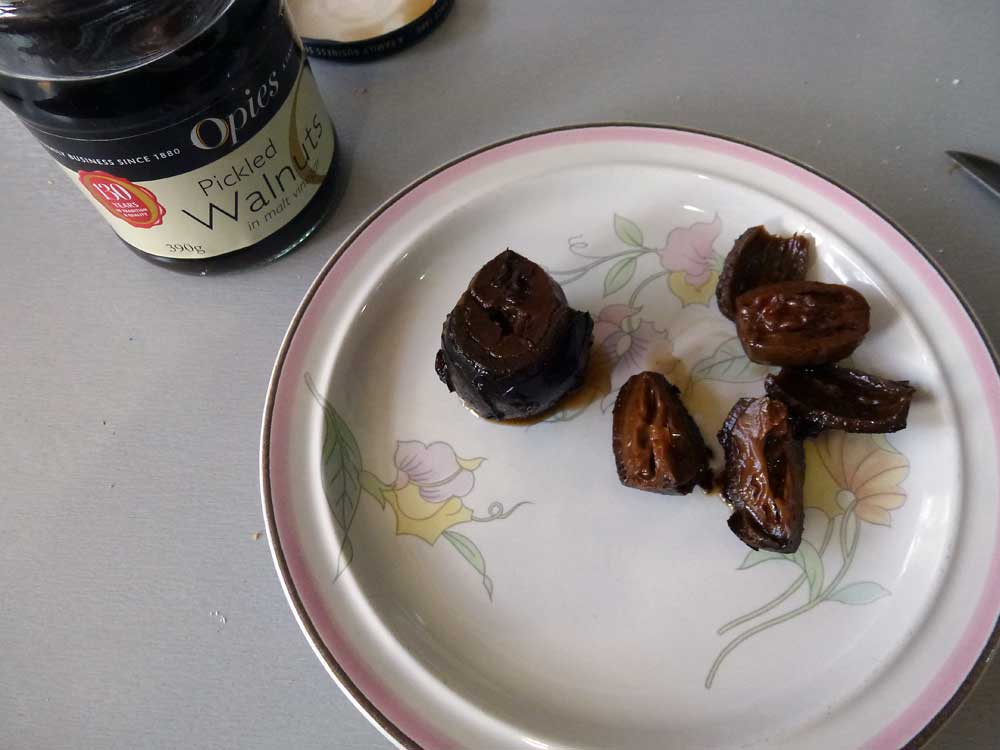
I had forgotten about these. I must have tried them and hated them when I was about ten. Some repeated BBC food programmes mentioned them and said they’re a British speciality. I think it’s only Opies who still make them. What is pickled is the immature walnut with all the surrounding flesh, outside the shell. I now find them very good with a pork pie. You have to like malt vinegar, though.

An internet search reveals many recipes to make your own, which should be OK if you have walnut trees. The commenters here are seeking a recipe for squirrel casserole with walnuts.

One possibility of ordering food from the UK is britishcornershop.co.uk. I seem to remember that during the ordering process, they tell you ‘you can still order 30 kilos more without increasing the postage’, so it’s OK for a group buy. They do have Matthew Walker individual (100 gram) Christmas puddings – similar to ones I bought at Waitrose as little presents. Mine have instructions ‘steam 30 minutes’ plus microwave time. They have Duchy ones too, but we don’t want to support people who charge twice as much and spend their time exercising unfair influence in politics.

Meanwhile, Fuchsia Dunlop can’t get used to the Japanese word tofu, as opposed to dou fu. I think beancurd is outdated, though. I didn’t realize tofu was Japanese, I thought it was Wade-Giles or something. But I think she is right.

I am being targeted by comment spammers at the moment so comments may cease to be possible for a while.

LATER NOTE: I completely forgot I once tasted Romanian green walnuts in honey. I found similar recipes for Greece and Armenia, and an Italian liqueur.

U.S. Supreme Court case pronunciation/Aussprache der Namen beim Supreme Court

The Volokh Conspiracy has a post on A Pronouncing Dictionary of the Supreme Court of the United States:

Gene Fidell (Yale Law School) and some of his students are putting together an article tentatively titled A Pronouncing Dictionary of the Supreme Court of the United States, which will basically help people know the standard ways of pronouncing Supreme Court case names (such as City of Boerne v. Flores and Gentile v. State Bar of Nevada). They have a list of cases to include, but if you have some suggestions, please post them in the comments. The requirements, of course, are that (1) it’s not obvious what the standard pronunciation is, and (2) the case comes up often enough to make it worth knowing the standard pronunciation.

Some amusing comments.

ERISA lawyers have always wondered how to pronounce Pilot Life Ins. Co. v. Dedeaux, 481 U.S. 41 (1987). Cajun style (like “Geaux Tigers”) perhaps?

I’ve been told that Free Enterprise Fund v. PCAOB has been pronounced “Peek-A-Boo” in the field. Of course, the case is much easier as “Public Company Accounting Oversight Board.”

More discussion at languagehat, from whom I got the link.