Harry Potter leak / Strafbarkeit der Verbreitung des neuen Harry Potter

The Times online (via Boing Boing) reports that it may be possible to trace the person who leaked the Harry Potter book in photos on the Web yesterday (the publisher, Bloomsbury, won’t confirm that this was genuine, presumably as a damage limitation exercise). The serial number of the camera is part of the EXIF data, and if the camera, an early Digital Rebel, has been repaired or registered, the number will be linked to a name.

However, there would probably be no criminal charges, as there was no commercial gain. Civil damages would be based on the loss in book sales.

If traced, the person who photographed the Harry Potter novel could be found guilty of copyright infringement, but would be unlikely to face criminal charges as the photos appear not to have been published for commercial gain, lawyers said.
“There are criminal provisions in copyright legislation, but they tend to be used in cases of obvious counterfeiting – such as selling fake computer games or DVDs in a car boot sale,” Mark Owen, an intellectual property partner at the London firm Harbottle & Lewis, said. “If Bloomsbury were to pursue an action, it would more likely be a civil case, in which case any damages would be assessed according to the loss in book sales.”

The Times calls the EXIF numbers ‘digital DNA’!

Some EXIF data (bottom left) from a Sony DSC-H5 (click to enlarge).

screenshw.jpg

US bowdlerization of children’s book/Rotraut Susanne Berner und die USA

Pimmel_3_DW_Kultur__312406g.jpg

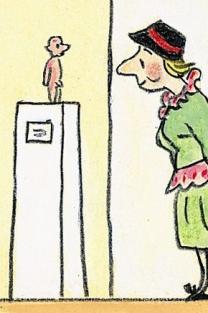
Something in this picture was too much for Boyds Mills Press in the USA. They wanted to publish a translation of Rotraut Susanne Berner’s children’s book, but without this picture and another picture of a nude, both exhibits in an art gallery. The author insisted on the censorship being made obvious, for example by the pictures being blacked out, so it seems the book is unlikely to appear. Die Welt writes:

Erst im Februar hatten US-Bibliotheken ein preisgekröntes Kinderbuch aus ihren Regalen verbannt, weil auf der ersten Seite das Wort „scrotum“ (Hodensack) vorkam. Zuvor geriet selbst „Harry Potter“ wegen angeblicher Bezüge zum Satanismus unter Beschuss der selbst ernannten Sittenwächter.

Author’s nude drawings too hot for US publisher, from the Independent.
Kein deutscher Mini-Penis für die USA, from Die Welt (with 4 illustrations).

LATER NOTE: for visitors from the Absolute Write Water Cooler, here’s the other offending picture:

Pimmel_1_DW_Kultur__312404g.jpg

This subject is generating as much traffic as my old entry on how IKEA names its furniture.

Comparative Legal Linguistics / Buch

Professor Heikki E.S. Mattila of the University of Lapland has published a book on comparative legal linguistics that looks interesting and expensive. The amazon.com page lets you look inside and see the full table of contents and an extract. The publisher’s page is fairly long too, so I’ll quote from that here:

Contents
Foreword; Foreword to the Finnish original; Part 1 General Introduction: Legal language and legal linguistics; The concept of legal language; Genres of legal language; Legal linguistics as a discipline; The importance of legal-linguistic knowledge; Structure and content of this book. Part 2 Legal Language as a Language for Special Purposes: Functions of Legal Language: Importance of the theory of communication; Achieving justice; Transmission of legal messages; Strengthening the authority of the law; Strengthening lawyers’ team spirit; Linguistic policy; The cultural task of legal language. Part 3 Characteristics of Legal Language: Precision; Information (over)load; Universality and aloofness; Systemic character; Structure and formalism in legal texts; Frequency of initializations and acronyms; Sentence complexity and diversity of language elements; Archaism and solemnity; Proper use of legal language. Legal Terminology: Legal concepts; Characteristics of legal terminology; Formation of legal terminology. The Major Legal Languages: The Heritage of Legal Latin; The importance of Roman law; History of legal Latin; Latin in modern legal languages; The communication value of legal Latin; Dictionaries of legal Latin. Legal German: History of legal German; Characteristics of legal German; International importance of legal German. Legal French: History of legal French; Characteristics of legal French; International position today. Legal English: The common law system; Development of legal English; Characteristics of legal English; Legal English as a global language. Part 4 Conclusion:Lexical comprehension and research needs;changes in legal-linguistic dominance in the international arena; Terminological interaction between legal languages; Problems of lexical comprehension; The need for jurilinguistic research on legal institutions and concepts; Foreign terms and other expressions; Index.

(Via DORES, which has a new set of references out on publications on language and law)

The Special Translation Tool/Die Besondere Übersetzungshilfe

I’ve mentioned Jerry (Gerold) Harfst’s book Die Besondere Übersetzungshilfe before , but now I can present some pages from it to show what it’s like.

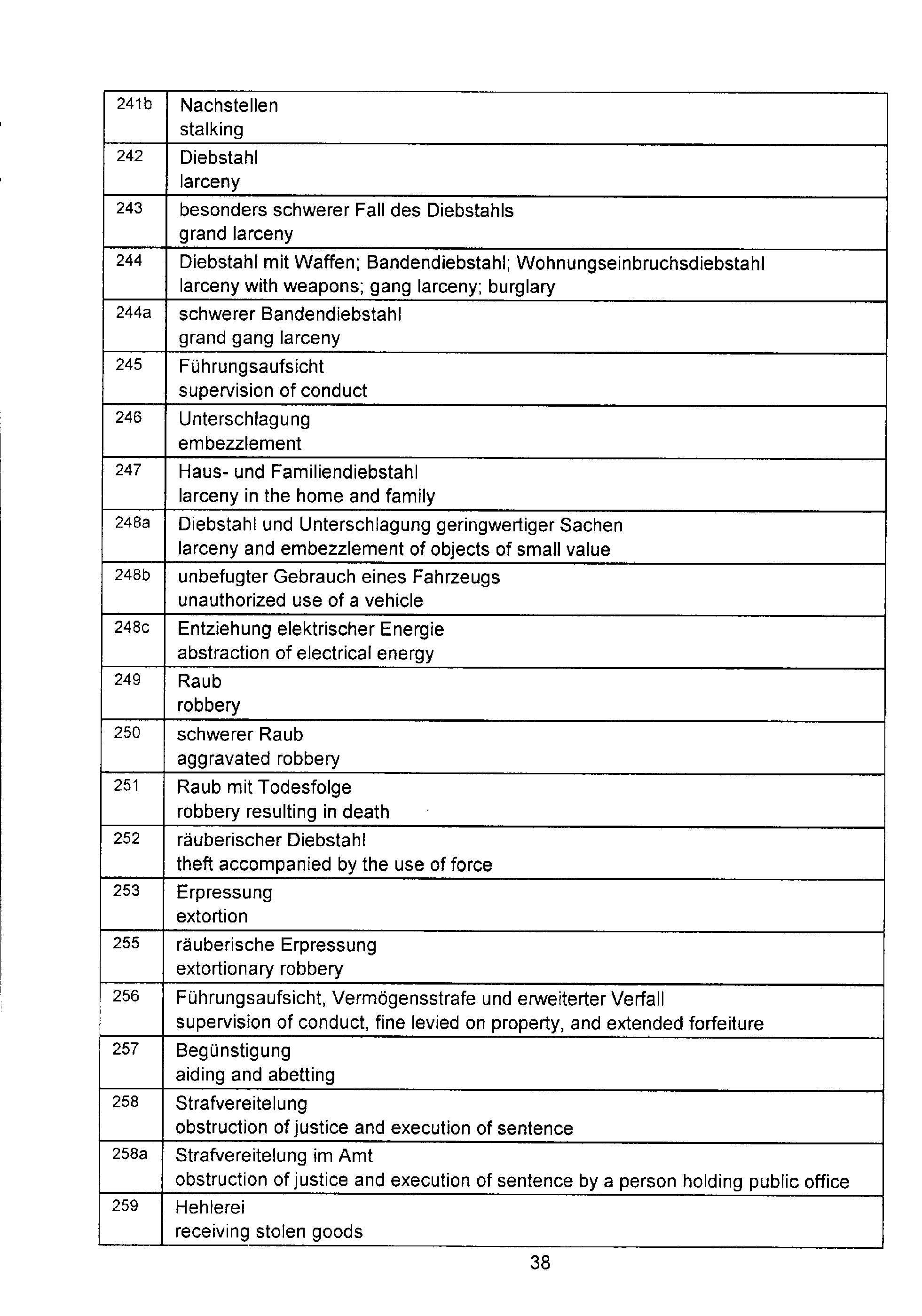
The book is a criminal law glossary divided into three sections: in the first, the German terms are arranged by order of paragraph number: that is, first comes the Betäubungsmittelgesetz with entries from 1 to 39, then the Jugendgerichtsgesetz, Ordnungswidrigkeitengesetz, Strafgesetzbuch, Strafprozessordnung, Strafvollzugsgesetz, Straßenverkehrsgesetz, Straßenverkehrsordnung, and Waffengesetz.

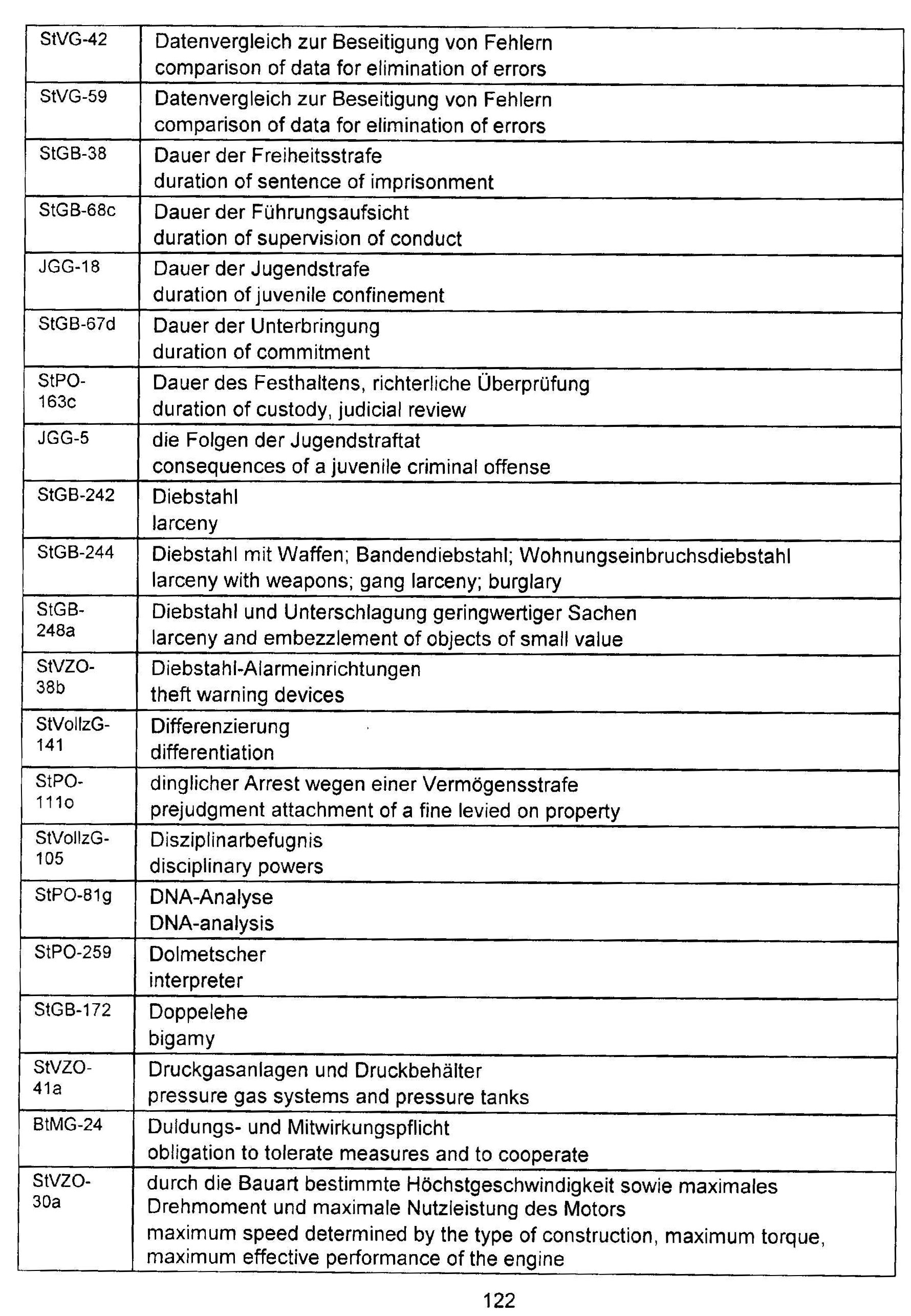
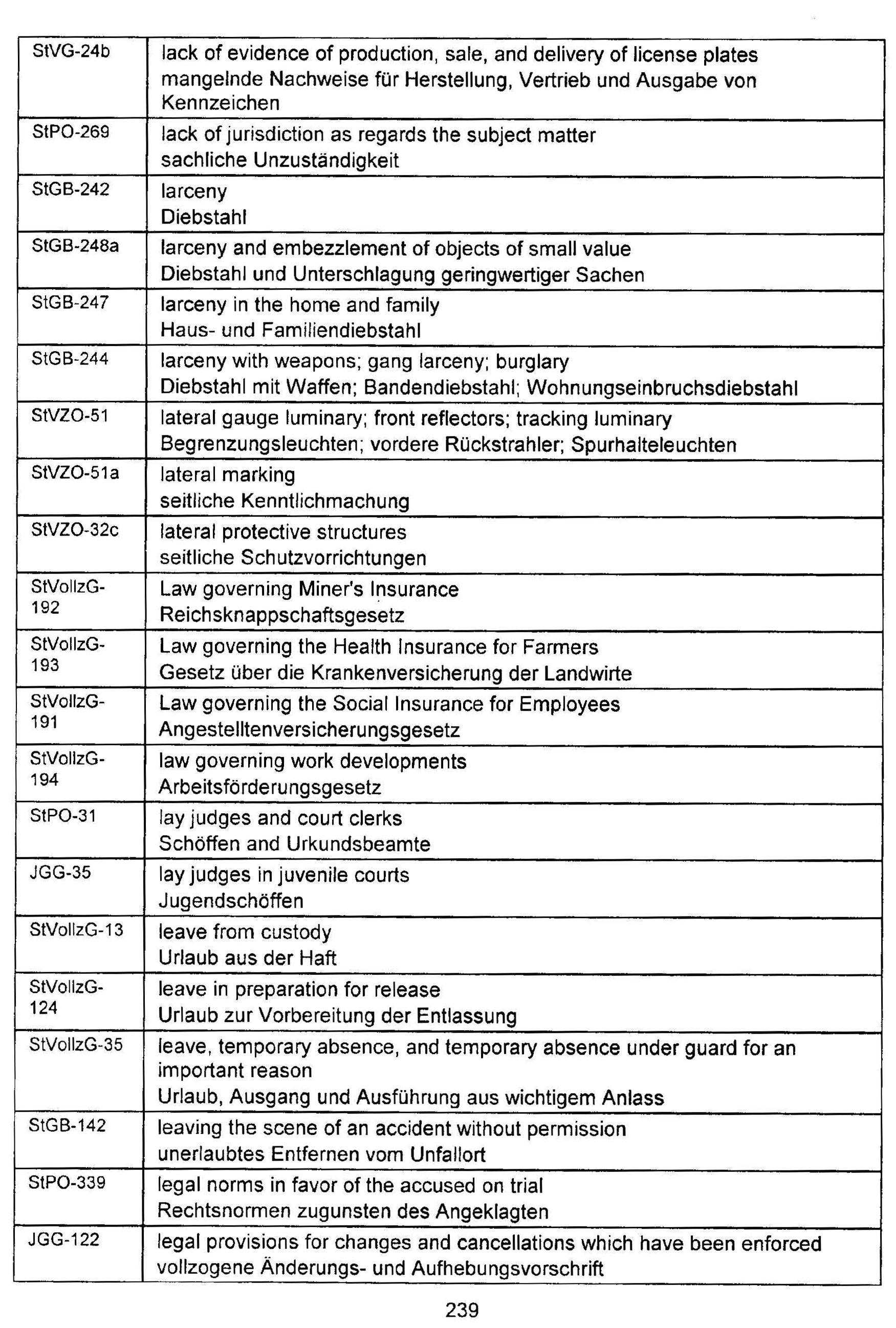
Second comes a German-English glossary, and third an English-German glossary. In each of these, the section numbers are given in the margin.

Thus an interpreter in court might want to use the section arranged by paragraph numbers, for instance in a case about drugs.

Example:

P. 38: StGB 242 Diebstahl: larceny (the US term for theft)
p. 122: Diebstahl: larceny (StGB-242)
p. 239: larceny: Diebstahl (StGB-242)

Click on pictures to enlarge:

harfst38w.jpg

harfst122w.jpg

harfst-239w.jpg

The quality of the printing is good, unlike my scans, which are reduced to make smaller files. More information and ordering here.

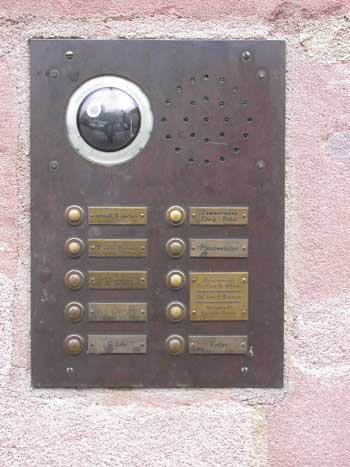
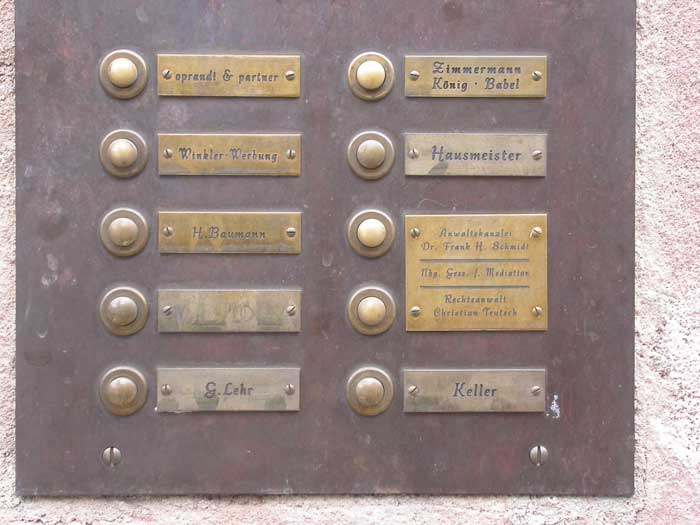
Doorbells and weblogs

Stuart Mudie asks in a comment to the last entry whether I’m trying to compete with Andrew Losowsky. Well, I had not seen his doorbell pictures although I had heard of Barçablog.

Anyway, I can’t say at the moment when I took my first doorbell photo, but it was before the first posted here on September 16th 2003. And I see that was about the time Andrew started noticing the Florence doorbells. On September 21 2004 he writes:

Nearly a year ago, I was wondering around Florence and found myself unnecessarily fascinated by a single aspect of that Renaissance city of incredible art and breathtaking architecture: the doorbells.

He adds a short fiction to each picture now (here’s an example – being a literal sort of person, I was disappointed by a fiction).

I am not trying to say Look I was first! I just don’t want people thinking I got the idea from a famous and trendy blogger.

door4w.jpg

door5w.jpg

(Nürnberg)

Wörterbuch der deutschen Gegenwartssprache

Die Zeit provides Wörterbuch der deutschen Gegenwartssprache online – reported by Handakte WebLAWg

An der Berlin-Brandenburgischen Akademie der Wissenschaften wurde Anfang März 2003 durch das Projekt “Digitales Wörterbuch der deutschen Sprache (DWDS)” das größte frei zugängliche, online abfragbare Wörterbuch für die deutsche Sprache zur Testbenutzung frei geschaltet.