From London Shop Fronts: QED. I see they now have an online shop for postcards etc.


From London Shop Fronts: QED. I see they now have an online shop for postcards etc.
No, not ruminations on this interesting topic, but a Translators Association workshop on the topic, on 29th July, in London I presume.
In many languages, our private parts can be described in neutral language, for example the French ‘le sexe’, which is applicable to either gender. In English however we often find ourselves vacillating between medical, pornographic and downright crude vocabulary.
Translators from any language are invited to join Polly McLean in a facilitated discussion of the impact on register and tone of these less than perfect choices. If you would like to contribute some problems or examples in advance, please email her on pollymclean@googlemail.com
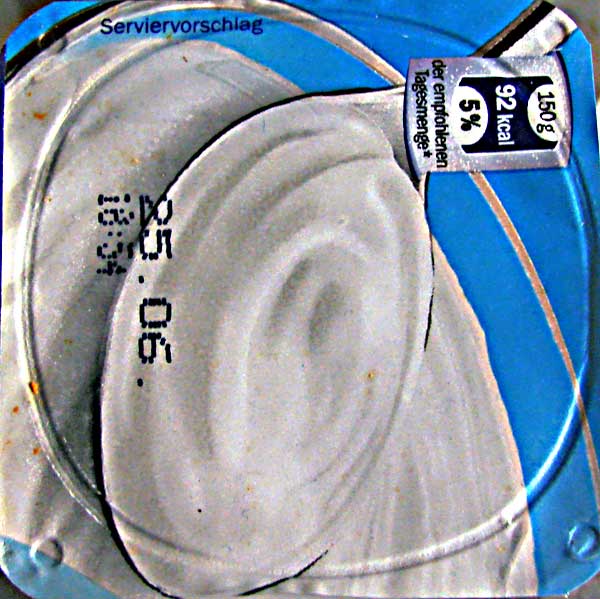
I’ve tried the serving suggestion on the lid of this yogurt – use a spoon – and it definitely works. Mind you, I haven’t tried any other method for comparison, such as knife and fork.
Some (non-native) customers’ reactions to English expressions (some stolen anonymously from a list):
Don’t like façade – ‘doesn’t sound very English’ – prefer facade.
Don’t like well (for drawing water from) – well is the adverb from good.
A German reviser forbids an English translator to use the word erection (of an installation) in English, because the word has other meanings in German.
(That one reminds me of being told not to translate Glaubhaftmachung using prima facie evidence because prima facie has a different meaning in legal German). Glaubhaftmachung is the relatively generous minimum evidence you need to get an interim injunction rather than a final decision.
Don’t translate Klausenburg as Cluj this time – the American official said it doesn’t exist.
A few more from an old entry (August 2004).
Client says, ‘The translation was first-class. But just one thing – why did you write express agreement and not expressive agreement?’
Author’s English expert (a native German, Leipzig): ‘I have the impression the translator has researched the terminology very well, but her grammar is certainly not that of a native speaker, as I can tell from my university study of English.’ Translator spends several hours refuting grammar ‘errors’ that never were errors except to a non-native speaker (can anyone suggest a better tactic?). A couple of the errors were content errors though, but only 1%. The author, a clergyman: ‘This has been a helpful exercise, as the translation is now improved’.
Author’s quote: ‘The translator’s English is unreliable. In English, there are never commas before relative sentences (sic), nor before but or that.’The painting is said to date from’ should be ‘The painting allegedly dates from’. ‘It was known as the chapter-house’ should be ‘the so-called chapter-house’.
LATER NOTE: Forgot this one:
German client objects at great length to translating Lebensziel as ‘goal in life’, because ‘as we know,
goal is used in English in the context of football and football only’.
And two entries on Peter Harvey’s blog on the same topic: here and here.
Jeremy Day teaches English for Specific Purposes, mainly legal English, in Poland, and has an interesting weblog on the subject.
In a post of 20 June, he had a (deliberately) polarizing description of legal English teachers:
Samantha Smug has got a law degree and thinks she knows everything about Legal English. She didn’t get a very good law degree, which is why she ended up as an English teacher. Her lessons are pretty dull – lots of explanations and translations, but at least she knows her stuff. She charges a lot for her lessons, and clients are happy to pay for her expertise.
Ken Cool, is currently working his way around the world, using income from ELT to support his life as a surfer. One of his classes is with a group of lawyers, but they rarely touch on the subject of law. His lessons are very touchy-feely – lots of jazz chants, self-expression and kinaesthetic group dynamics. He’s discovered a new technique is called dogme, which he used to call ‘winging it when you’ve forgotten to plan’.
Yes, ‘touchy-feely’ was exactly the term that occurred to me for many teachers of English as a Foreign Language. That was beginning to open up as a field when I graduated in 1969 and has really taken on a life of its own. I have done a short RSA course and teacher training myself, but because I am not very outgoing, I suspect my teaching was rather like Samantha Smug’s, but with more jokes. (I thought dogme was in the cinema, but I seem to be behind the times there).
Of course, we were teaching translation. There are many teachers of legal English and English or American law in German university law faculties who know more law than language and wonder how to improve their students’ language.
Anyway, the Cambridge International Legal English course has become very successful, so I imagine many lawyers-to-be will be learning their legal English through the Ken Cool-ish approach. One feature of this is using a lot of genuine legal English texts to skim and answer questions on, where the teacher probably can’t explain every word. But some effort has to be left to the students whatever the approach.
There’s an association of legal English teachers called EULETA. Here’s a blurb on Euleta recently posted on the Euleta Yahoo Group by Matt Firth (overleaf!):