BILD on law/BILD-BGB

BILDblog corrects some legal advice given in BILD Zeitung, quoted as follows:

Laut Artikel 195 des Bundesgesetzbuches (BGB) können Sie Fehler von Handwerkern bis zu drei Jahre nach der Dienstleistung geltend machen.

Apart from the fact that the usual period for a Werkvertrag (loosely translated as contract for work and services) is two years, the misquotation of a Paragraf (section) of the Bürgerliches Gesetzbuch reminds me of a howler contained in a book of standard English translations of German legal texts that is sold by a translator in Germany, where at least at one time EGBGB (Einführungsgesetz zum BGB – Introductory Act to the Civil Code) was rendered as European Civil Code (we’re still waiting for that).

(Via der winkelschreiber)

British blood refused/Britische Blutspende abgelehnt

John Flood, temporarily at Miami Law School, tries to give blood:

I hand in the forms and a moment later the medic looks glum. Was it because I’d admitted to taking an aspirin that morning? No.

“I have to reject you,” he said. “You’ve been in the UK.”

“So? I come from there.”

“It’s because of ‘mad cow disease’. We can’t risk you.”

LATER NOTE: the Wikipedia entry on Creutzfeldt-Jacob disease has more details of the dangers, and information on bans on blood donors in other countries – Australia, Singapore, Canada, Denmark, Switzerland. In the UK, blood donors may not include those who have had a blood transfusion since 1980:

In 2004 a new report published in the Lancet medical journal showed that vCJD can be transmitted by blood transfusions.[19] The finding alarmed healthcare officials because a large epidemic of the disease might arise in the near future. There is no test to determine if a blood donor is infected and in the latent phase of vCJD. In reaction to this report, the British government banned anyone who had received a blood transfusion since January 1980 from donating blood.

Details of McCartney-Mills divorce/Details der McCartney-Mills-Scheidung

Yesterday’s judgment in the Paul McCartney – Heather Mills McCartney divorce has been released in full. Both the Guardian and the Independent have the full text online, and no doubt they are not alone.

There hasn’t yet been a divorce. Both parties have agreed to wait until after May 1, when they will have been separated for two years and can therefore base their divorce on the fact of separation rather than ‘unreasonable’ behaviour.

This judgment relates to the ancillary proceedings for maintenance pending divorce and for property arrangements. The English courts can decide themselves what is a fair division of property, guided by statute and precedent.

The husband’s case on financial provision for the wife is summarised at paragraph 9 of the opening note of Mr Mostyn QC as follows:
“We submit that fundamentally this is a straightforward case. Because of H’s enormous pre-marital wealth and because of the brief duration of this marriage W’s claim should be determined by reference to the principle of need alone. This is not a case where the principle of sharing of the “marital acquest” is engaged at all. Nor is it a case where the principle of compensation will arise. W’s needs fall to be fairly assessed, not predominantly by reference to the standard of living during the marriage. W’s award should be reduced to reflect her postseparation misconduct. That misconduct is based on three distinct episodes as explained in our Conduct Note.”

Heather Mills McCartney’s case was harder to summarize. She argued inter alia that she was wealthy when she met her future husband and gave up a lucrative career for his sake; he advised her against taking on job offers:

Countless lucrative business opportunities were made to me once Paul and I married. Sadly, Paul advised against 99% of all of them. He stated that they were only interested in me because of his name and that I should just stick to charity work and he would take car of me. When I was asked to design clothes, create a food line, write books, make a video, write music or do photography, Paul would almost always state something like “Oh no you can’t do that, Stella does that or Mary does that or Heather (his adopted daughter) used to do that or Linda did that.” even though I had been involved with fashion and modelling for years.

There is much more.

The Guardian reports that Mills confirmed to the press that she had poured a jug of water over Fiona Shackleton:

Mills also confirmed reports that she had poured water on Sir Paul’s lawyer, Fiona Shackleton. Mills said she approached the lawyer and said: “I’m not a loser” before tipping the water jug over her.

“I poured the whole jug of water on her head. I was very calm”, she said.

Borders/Grenzen

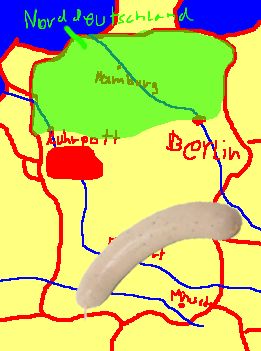
Weißwurstäquator, from the mysterious Kamelopedia (albeit misplacing Franconia vis-à-vis the WW):
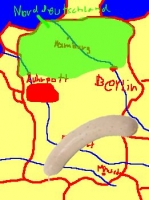
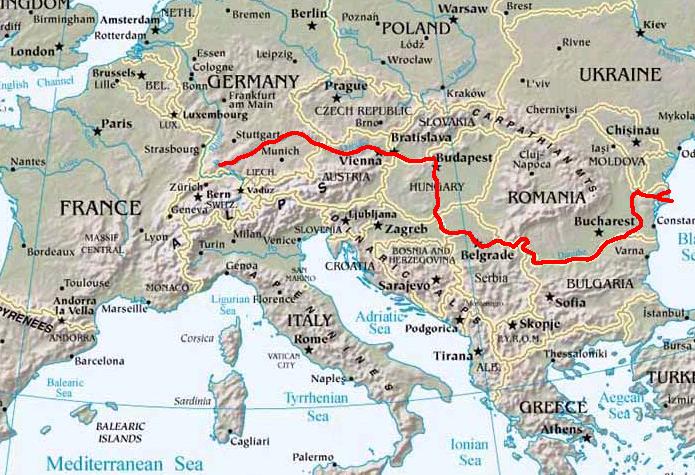
Within Germany, the dividing line is the River Danube, which puts me north of the equator. Wikipedia has a map showing the Danube, but the Weißwurst is not eaten everywhere south of the Danube, of course, only, at most, in the German bit (and there, ideally only before the cuckoo clock strikes midday).
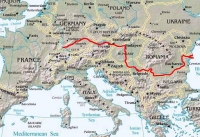
Meanwhile, Strange Maps has a graphic image of the Swiss Röstigraben, and much information. Here is a more detailed map.

The language border dividing these two areas is known jestingly as the Röstigraben (in German) or the rideau de rösti (in French). A Graben is a ditch and a rideau is a curtain, so you get the idea of separation – but what a Rösti is and why it is significant, requires a bit more explanation.

This dish is made mainly by frying grated potatoes in a pan. It was formerly eaten as breakfast by farmers in the (German-speaking) Bern canton. The original conceit of the Röstigraben was that it constituted the western limit of the German Swiss culture, beyond which people spoke (and ate) differently.

The Rösti has gained popularity as a side dish all over Switzerland, but the language and cultural differences persist.

Another culinary division mentioned in comments to the above is the Gefilte Fish Line:

The “gefilte fish line” ran though eastern Poland.
Jews living to the west — most of Poland, as well as Germany and the rest of Western Europe — ate the sweet gefilte fish. Those to the east — Lithuania, Latvia and Russia — ate the peppery version.
But Steinlauf’s tale is not just a fish story. It’s also about language.
He said the “gefilte fish line” roughly overlaps another important line: a linguistic divide between two major variants of Yiddish.

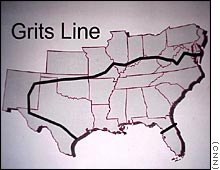
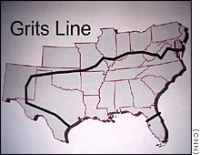
LATER NOTE: Here is a map showing the Grits Line (see comments). The map was originally from CNN but I found it in this forum.
Thanks to the Great Wall of Catalonia.